

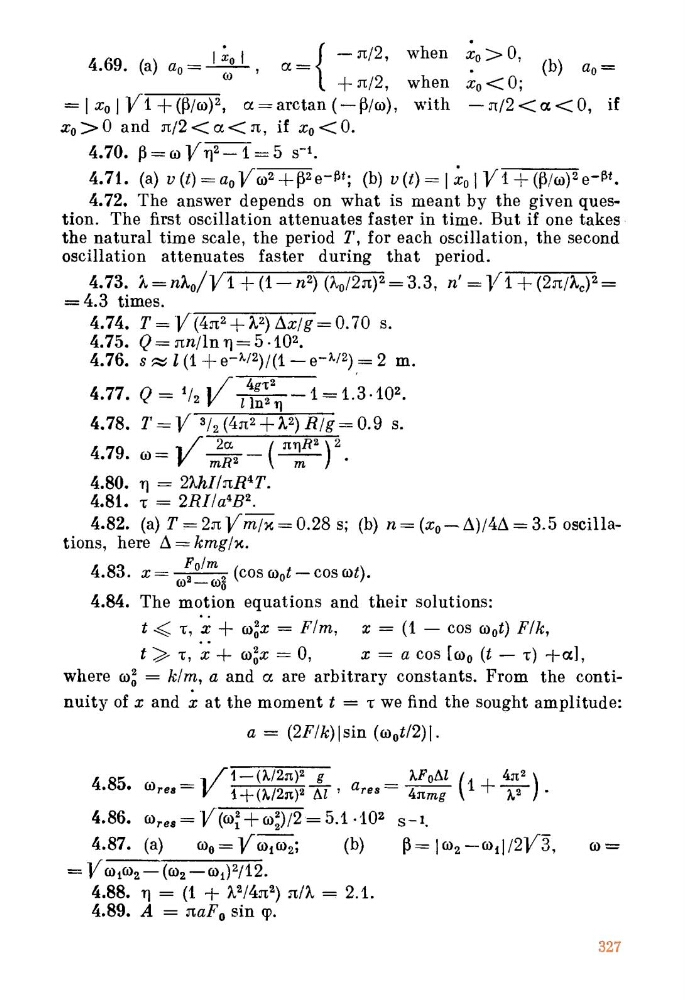
x°
4.69. (a) ao —
,
a = — n/2, when xo >
(b) ao =
TE/2, when xo <0;
= I x o
±(13/co)2, a = arctan (-13/4 with —3- [/2 xo > 0 and n/2 < a< a, if xo
4.71. (a) v (t) = a o /cat P 2 e-Ot; (b) v (t) = I xo IV" 1 ± ((3/co)2 e-Pt.
4.72. The answer depends on what is meant by the given question. The first oscillation attenuates faster in time. But if one takes
the natural time scale, the period T, for each oscillation, the second
oscillation attenuates faster during that period.
4.73. 'A = nX0/]I1 + (1— nz) (X0/2n)2 = 3.3, n' ---1/1 (2n/ke)2 =
= 4.3 times.
4.74. T = 1/-(4a2 + X2) AxIg = 0.70 s.
4.75. Q= an/ln = 5 .102.
4.76. s 1(1 +e-242)/(1 —e-k/2) = 2 m.
4g 2
4.77.
1/2 V
T 1 — L 3 102.
4.78. T = V 3/2 (4n2 H-X2) filg = 0.9 s.
4.79. co—A/ 7
T, 2c 1;2
( 1111 : 2 ) 2
4.80. 11 = AhllaR4T.
4.81. T = 2R11a4B2.
4.82. (a) T = 2n - 11m/x = 0.28 s; (b) n = (xo — 6)/4,a, --- - 3.5 oscillations, here = kmg/x.
F
4.83. x
(cos coot — cos cot).
,,,2 ol coo
4.84. The motion equations and their solutions:
t <
x
o4x
Flm, x = (1 — cos coot) Flk,
. .
t
v, X ± CO:x = 0,
x = a cos [coo (t — T)
where co( 2, = klm, a and a are arbitrary constants. From the continuity of x and x at the moment t = x we find the sought amplitude:
a = (2F1k) I sin (coot/2)1 .
a
4amg
/1 —(k/23- ) 2 g
4.85. cores= V 14-01,/2n)2 A/ ' res
A,F0A/
4.86. (Ores= (0 4 ± COD 12 = 5.1 .10z s-1.
(1 +
4n2
262
4.87. (a)
coo = licolo.)2;
(b)
=- 0)2 -(011 /2V-5,
Co =
="iwz — (0)2 — (0i)2/12.
4.88. ri = (1 + 2,.,2/4312) n/A. = 2.1.
4.89. A = naFo sin cp.
327
4.69. (a) ao —
,
a = — n/2, when xo >
(b) ao =
TE/2, when xo <0;
= I x o
±(13/co)2, a = arctan (-13/4 with —3- [/2 xo > 0 and n/2 < a< a, if xo
4.71. (a) v (t) = a o /cat P 2 e-Ot; (b) v (t) = I xo IV" 1 ± ((3/co)2 e-Pt.
4.72. The answer depends on what is meant by the given question. The first oscillation attenuates faster in time. But if one takes
the natural time scale, the period T, for each oscillation, the second
oscillation attenuates faster during that period.
4.73. 'A = nX0/]I1 + (1— nz) (X0/2n)2 = 3.3, n' ---1/1 (2n/ke)2 =
= 4.3 times.
4.74. T = 1/-(4a2 + X2) AxIg = 0.70 s.
4.75. Q= an/ln = 5 .102.
4.76. s 1(1 +e-242)/(1 —e-k/2) = 2 m.
4g 2
4.77.
1/2 V
T 1 — L 3 102.
4.78. T = V 3/2 (4n2 H-X2) filg = 0.9 s.
4.79. co—A/ 7
T, 2c 1;2
( 1111 : 2 ) 2
4.80. 11 = AhllaR4T.
4.81. T = 2R11a4B2.
4.82. (a) T = 2n - 11m/x = 0.28 s; (b) n = (xo — 6)/4,a, --- - 3.5 oscillations, here = kmg/x.
F
4.83. x
(cos coot — cos cot).
,,,2 ol coo
4.84. The motion equations and their solutions:
t <
x
o4x
Flm, x = (1 — cos coot) Flk,
. .
t
v, X ± CO:x = 0,
x = a cos [coo (t — T)
where co( 2, = klm, a and a are arbitrary constants. From the continuity of x and x at the moment t = x we find the sought amplitude:
a = (2F1k) I sin (coot/2)1 .
a
4amg
/1 —(k/23- ) 2 g
4.85. cores= V 14-01,/2n)2 A/ ' res
A,F0A/
4.86. (Ores= (0 4 ± COD 12 = 5.1 .10z s-1.
(1 +
4n2
262
4.87. (a)
coo = licolo.)2;
(b)
=- 0)2 -(011 /2V-5,
Co =
="iwz — (0)2 — (0i)2/12.
4.88. ri = (1 + 2,.,2/4312) n/A. = 2.1.
4.89. A = naFo sin cp.
327