

2.4 Identifying Particle Decays with Jet Substructure
35
D
(α,β,γ )
3
=
e
(γ )
4
e
(α)
2
3γ /α
e
(β)
3
3γ /β + x
e
(γ )
4
e
(α)
2
2γ /β−1
e
(β)
3
2γ /β
+ y
e
(γ )
4
e
(α)
2
2β/α−γ /α
e
(β)
3
2
, (2.35)
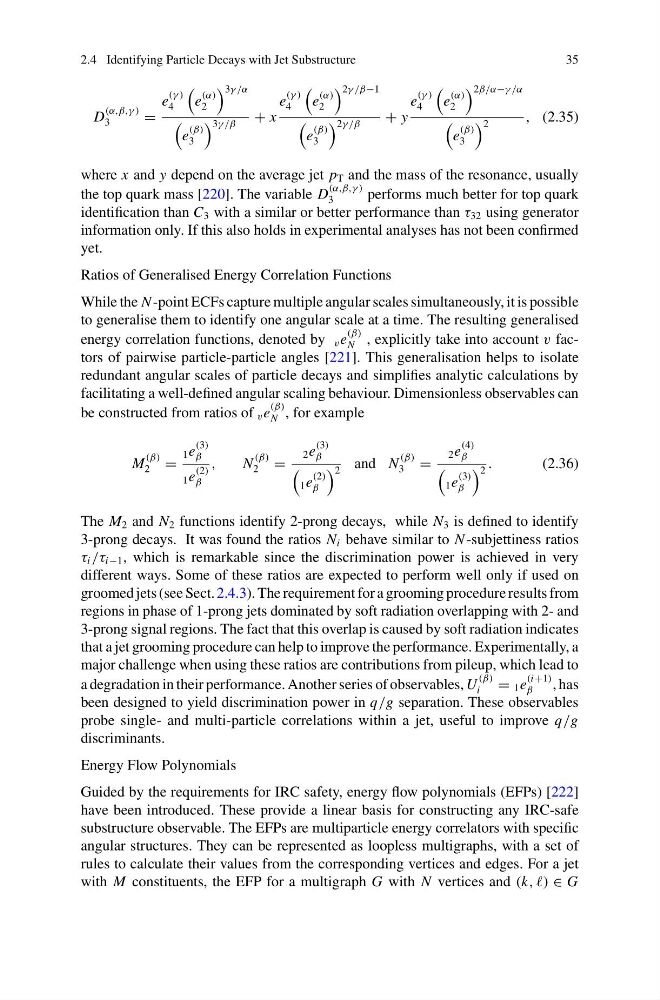
where x and y depend on the average jet p T and the mass of the resonance, usually
the top quark mass [220]. The variable D
(α,β,γ )
3
performs much better for top quark
identification than C 3 with a similar or better performance than τ 32 using generator
information only. If this also holds in experimental analyses has not been confirmed
yet.
Ratios of Generalised Energy Correlation Functions
While the N -point ECFs capture multiple angular scales simultaneously, it is possible
to generalise them to identify one angular scale at a time. The resulting generalised
energy correlation functions, denoted by v e
(β)
N , explicitly take into account v factors of pairwise particle-particle angles [221]. This generalisation helps to isolate
redundant angular scales of particle decays and simplifies analytic calculations by
facilitating a well-defined angular scaling behaviour. Dimensionless observables can
be constructed from ratios of v e
(β)
N , for example
M
(β)
2 =
1 e
(3)
β
1 e
(2)
β
,
N
(β)
2 =
2 e
(3)
β
1 e
(2)
β
2 and N
(β)
3 =
2 e
(4)
β
1 e
(3)
β
2 .
(2.36)
The M 2 and N 2 functions identify 2-prong decays, while N 3 is defined to identify
3-prong decays. It was found the ratios N i behave similar to N -subjettiness ratios
τ i /τ i−1 , which is remarkable since the discrimination power is achieved in very
different ways. Some of these ratios are expected to perform well only if used on
groomed jets (see Sect. 2.4.3). The requirement for a grooming procedure results from
regions in phase of 1-prong jets dominated by soft radiation overlapping with 2- and
3-prong signal regions. The fact that this overlap is caused by soft radiation indicates
that a jet grooming procedure can help to improve the performance. Experimentally, a
major challenge when using these ratios are contributions from pileup, which lead to
a degradation in their performance. Another series of observables, U
(β)
i
= 1 e
(i+1)
β
, has
been designed to yield discrimination power in q/g separation. These observables
probe single- and multi-particle correlations within a jet, useful to improve q/g
discriminants.
Energy Flow Polynomials
Guided by the requirements for IRC safety, energy flow polynomials (EFPs) [222]
have been introduced. These provide a linear basis for constructing any IRC-safe
substructure observable. The EFPs are multiparticle energy correlators with specific
angular structures. They can be represented as loopless multigraphs, with a set of
rules to calculate their values from the corresponding vertices and edges. For a jet
with M constituents, the EFP for a multigraph G with N vertices and (k, ,) ∈ G
35
D
(α,β,γ )
3
=
e
(γ )
4
e
(α)
2
3γ /α
e
(β)
3
3γ /β + x
e
(γ )
4
e
(α)
2
2γ /β−1
e
(β)
3
2γ /β
+ y
e
(γ )
4
e
(α)
2
2β/α−γ /α
e
(β)
3
2
, (2.35)
where x and y depend on the average jet p T and the mass of the resonance, usually
the top quark mass [220]. The variable D
(α,β,γ )
3
performs much better for top quark
identification than C 3 with a similar or better performance than τ 32 using generator
information only. If this also holds in experimental analyses has not been confirmed
yet.
Ratios of Generalised Energy Correlation Functions
While the N -point ECFs capture multiple angular scales simultaneously, it is possible
to generalise them to identify one angular scale at a time. The resulting generalised
energy correlation functions, denoted by v e
(β)
N , explicitly take into account v factors of pairwise particle-particle angles [221]. This generalisation helps to isolate
redundant angular scales of particle decays and simplifies analytic calculations by
facilitating a well-defined angular scaling behaviour. Dimensionless observables can
be constructed from ratios of v e
(β)
N , for example
M
(β)
2 =
1 e
(3)
β
1 e
(2)
β
,
N
(β)
2 =
2 e
(3)
β
1 e
(2)
β
2 and N
(β)
3 =
2 e
(4)
β
1 e
(3)
β
2 .
(2.36)
The M 2 and N 2 functions identify 2-prong decays, while N 3 is defined to identify
3-prong decays. It was found the ratios N i behave similar to N -subjettiness ratios
τ i /τ i−1 , which is remarkable since the discrimination power is achieved in very
different ways. Some of these ratios are expected to perform well only if used on
groomed jets (see Sect. 2.4.3). The requirement for a grooming procedure results from
regions in phase of 1-prong jets dominated by soft radiation overlapping with 2- and
3-prong signal regions. The fact that this overlap is caused by soft radiation indicates
that a jet grooming procedure can help to improve the performance. Experimentally, a
major challenge when using these ratios are contributions from pileup, which lead to
a degradation in their performance. Another series of observables, U
(β)
i
= 1 e
(i+1)
β
, has
been designed to yield discrimination power in q/g separation. These observables
probe single- and multi-particle correlations within a jet, useful to improve q/g
discriminants.
Energy Flow Polynomials
Guided by the requirements for IRC safety, energy flow polynomials (EFPs) [222]
have been introduced. These provide a linear basis for constructing any IRC-safe
substructure observable. The EFPs are multiparticle energy correlators with specific
angular structures. They can be represented as loopless multigraphs, with a set of
rules to calculate their values from the corresponding vertices and edges. For a jet
with M constituents, the EFP for a multigraph G with N vertices and (k, ,) ∈ G