

34
2 Phenomenology of Jet Substructure
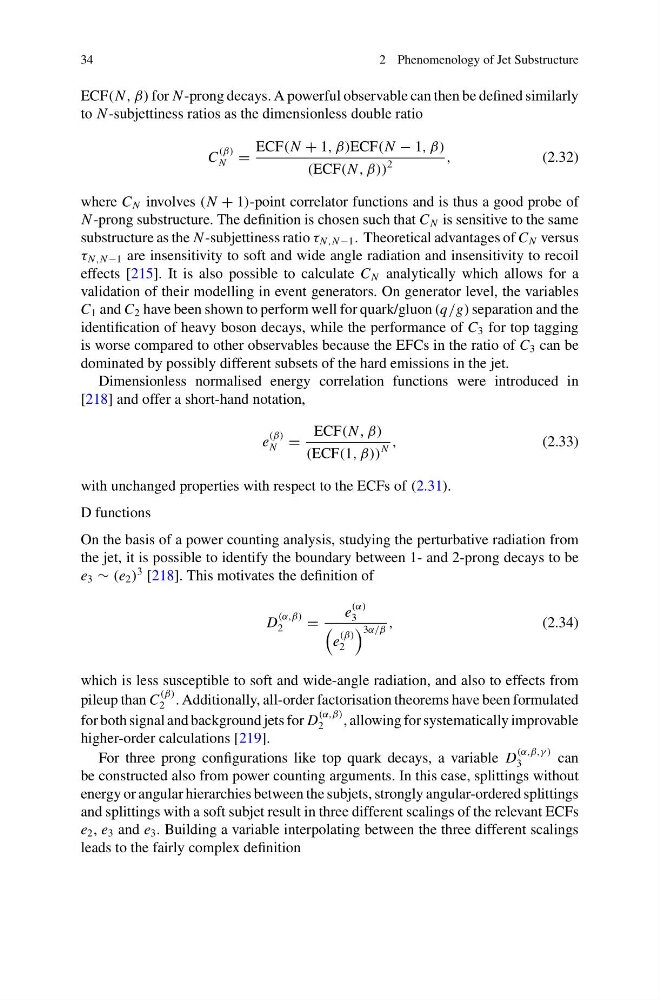
ECF(N , β) for N -prong decays. A powerful observable can then be defined similarly
to N -subjettiness ratios as the dimensionless double ratio
C
(β)
N =
ECF(N + 1, β)ECF(N − 1, β)
(ECF(N , β))
2
,
(2.32)
where C N involves (N + 1)-point correlator functions and is thus a good probe of
N -prong substructure. The definition is chosen such that C N is sensitive to the same
substructure as the N -subjettiness ratio τ N ,N −1 . Theoretical advantages of C N versus
τ N ,N −1 are insensitivity to soft and wide angle radiation and insensitivity to recoil
effects [215]. It is also possible to calculate C N analytically which allows for a
validation of their modelling in event generators. On generator level, the variables
C 1 and C 2 have been shown to perform well for quark/gluon (q/g) separation and the
identification of heavy boson decays, while the performance of C 3 for top tagging
is worse compared to other observables because the EFCs in the ratio of C 3 can be
dominated by possibly different subsets of the hard emissions in the jet.
Dimensionless normalised energy correlation functions were introduced in
[218] and offer a short-hand notation,
e
(β)
N =
ECF(N , β)
(ECF(1, β))
N
,
(2.33)
with unchanged properties with respect to the ECFs of (2.31).
D functions
On the basis of a power counting analysis, studying the perturbative radiation from
the jet, it is possible to identify the boundary between 1- and 2-prong decays to be
e 3 ∼ (e 2 )
3 [218]. This motivates the definition of
D
(α,β)
2
=
e
(α)
3
e
(β)
2
3α/β ,
(2.34)
which is less susceptible to soft and wide-angle radiation, and also to effects from
pileup than C
(β)
2 . Additionally, all-order factorisation theorems have been formulated
for both signal and background jets for D
(α,β)
2
, allowing for systematically improvable
higher-order calculations [219].
For three prong configurations like top quark decays, a variable D
(α,β,γ )
3
can
be constructed also from power counting arguments. In this case, splittings without
energy or angular hierarchies between the subjets, strongly angular-ordered splittings
and splittings with a soft subjet result in three different scalings of the relevant ECFs
e 2 , e 3 and e 3 . Building a variable interpolating between the three different scalings
leads to the fairly complex definition
2 Phenomenology of Jet Substructure
ECF(N , β) for N -prong decays. A powerful observable can then be defined similarly
to N -subjettiness ratios as the dimensionless double ratio
C
(β)
N =
ECF(N + 1, β)ECF(N − 1, β)
(ECF(N , β))
2
,
(2.32)
where C N involves (N + 1)-point correlator functions and is thus a good probe of
N -prong substructure. The definition is chosen such that C N is sensitive to the same
substructure as the N -subjettiness ratio τ N ,N −1 . Theoretical advantages of C N versus
τ N ,N −1 are insensitivity to soft and wide angle radiation and insensitivity to recoil
effects [215]. It is also possible to calculate C N analytically which allows for a
validation of their modelling in event generators. On generator level, the variables
C 1 and C 2 have been shown to perform well for quark/gluon (q/g) separation and the
identification of heavy boson decays, while the performance of C 3 for top tagging
is worse compared to other observables because the EFCs in the ratio of C 3 can be
dominated by possibly different subsets of the hard emissions in the jet.
Dimensionless normalised energy correlation functions were introduced in
[218] and offer a short-hand notation,
e
(β)
N =
ECF(N , β)
(ECF(1, β))
N
,
(2.33)
with unchanged properties with respect to the ECFs of (2.31).
D functions
On the basis of a power counting analysis, studying the perturbative radiation from
the jet, it is possible to identify the boundary between 1- and 2-prong decays to be
e 3 ∼ (e 2 )
3 [218]. This motivates the definition of
D
(α,β)
2
=
e
(α)
3
e
(β)
2
3α/β ,
(2.34)
which is less susceptible to soft and wide-angle radiation, and also to effects from
pileup than C
(β)
2 . Additionally, all-order factorisation theorems have been formulated
for both signal and background jets for D
(α,β)
2
, allowing for systematically improvable
higher-order calculations [219].
For three prong configurations like top quark decays, a variable D
(α,β,γ )
3
can
be constructed also from power counting arguments. In this case, splittings without
energy or angular hierarchies between the subjets, strongly angular-ordered splittings
and splittings with a soft subjet result in three different scalings of the relevant ECFs
e 2 , e 3 and e 3 . Building a variable interpolating between the three different scalings
leads to the fairly complex definition