

2.2 General Considerations
19
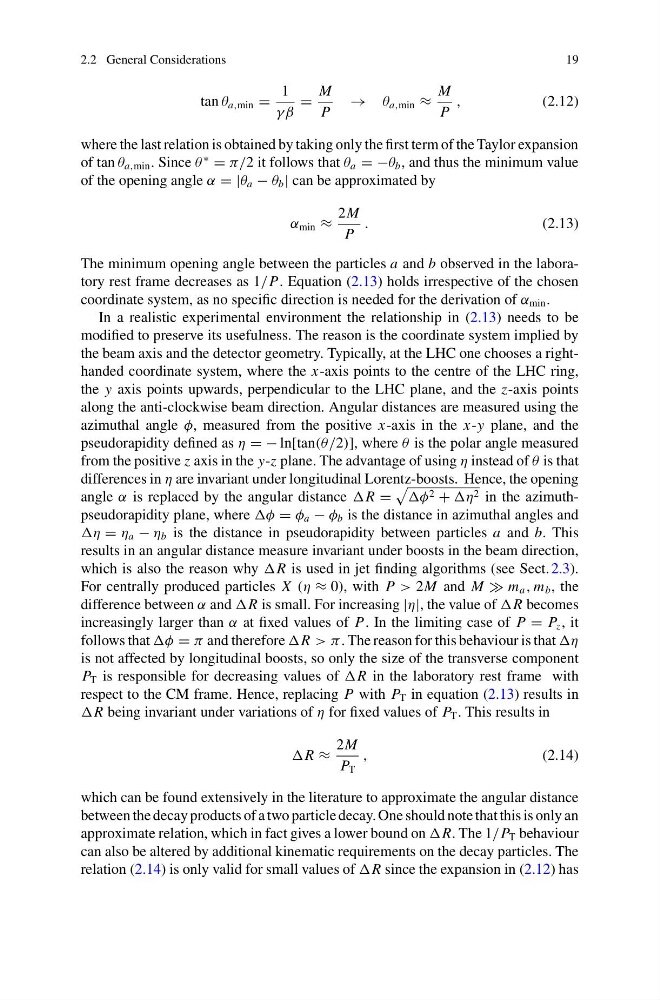
tan θ a,min =
1
γβ
=
M
P
→ θ a,min ≈
M
P
,
(2.12)
where the last relation is obtained by taking only the first term of the Taylor expansion
of tan θ a,min . Since θ
∗
= π/2 it follows that θ a = −θ b , and thus the minimum value
of the opening angle α = |θ a − θ b | can be approximated by
α min ≈
2M
P
.
(2.13)
The minimum opening angle between the particles a and b observed in the laboratory rest frame decreases as 1/P. Equation (2.13) holds irrespective of the chosen
coordinate system, as no specific direction is needed for the derivation of α min .
In a realistic experimental environment the relationship in (2.13) needs to be
modified to preserve its usefulness. The reason is the coordinate system implied by
the beam axis and the detector geometry. Typically, at the LHC one chooses a righthanded coordinate system, where the x-axis points to the centre of the LHC ring,
the y axis points upwards, perpendicular to the LHC plane, and the z-axis points
along the anti-clockwise beam direction. Angular distances are measured using the
azimuthal angle φ, measured from the positive x-axis in the x-y plane, and the
pseudorapidity defined as η = − ln[tan(θ/2)], where θ is the polar angle measured
from the positive z axis in the y-z plane. The advantage of using η instead of θ is that
differences in η are invariant under longitudinal Lorentz-boosts. Hence, the opening
angle α is replaced by the angular distance R =
φ 2 + η 2 in the azimuthpseudorapidity plane, where φ = φ a − φ b is the distance in azimuthal angles and
η = η a − η b is the distance in pseudorapidity between particles a and b. This
results in an angular distance measure invariant under boosts in the beam direction,
which is also the reason why R is used in jet finding algorithms (see Sect. 2.3).
For centrally produced particles X (η ≈ 0), with P > 2M and M m a , m b , the
difference between α and R is small. For increasing |η|, the value of R becomes
increasingly larger than α at fixed values of P. In the limiting case of P = P z , it
follows that φ = π and therefore R > π. The reason for this behaviour is that η
is not affected by longitudinal boosts, so only the size of the transverse component
P T is responsible for decreasing values of R in the laboratory rest frame with
respect to the CM frame. Hence, replacing P with P T in equation (2.13) results in
R being invariant under variations of η for fixed values of P T . This results in
R ≈
2M
P T
,
(2.14)
which can be found extensively in the literature to approximate the angular distance
between the decay products of a two particle decay. One should note that this is only an
approximate relation, which in fact gives a lower bound on R. The 1/P T behaviour
can also be altered by additional kinematic requirements on the decay particles. The
relation (2.14) is only valid for small values of R since the expansion in (2.12) has
19
tan θ a,min =
1
γβ
=
M
P
→ θ a,min ≈
M
P
,
(2.12)
where the last relation is obtained by taking only the first term of the Taylor expansion
of tan θ a,min . Since θ
∗
= π/2 it follows that θ a = −θ b , and thus the minimum value
of the opening angle α = |θ a − θ b | can be approximated by
α min ≈
2M
P
.
(2.13)
The minimum opening angle between the particles a and b observed in the laboratory rest frame decreases as 1/P. Equation (2.13) holds irrespective of the chosen
coordinate system, as no specific direction is needed for the derivation of α min .
In a realistic experimental environment the relationship in (2.13) needs to be
modified to preserve its usefulness. The reason is the coordinate system implied by
the beam axis and the detector geometry. Typically, at the LHC one chooses a righthanded coordinate system, where the x-axis points to the centre of the LHC ring,
the y axis points upwards, perpendicular to the LHC plane, and the z-axis points
along the anti-clockwise beam direction. Angular distances are measured using the
azimuthal angle φ, measured from the positive x-axis in the x-y plane, and the
pseudorapidity defined as η = − ln[tan(θ/2)], where θ is the polar angle measured
from the positive z axis in the y-z plane. The advantage of using η instead of θ is that
differences in η are invariant under longitudinal Lorentz-boosts. Hence, the opening
angle α is replaced by the angular distance R =
φ 2 + η 2 in the azimuthpseudorapidity plane, where φ = φ a − φ b is the distance in azimuthal angles and
η = η a − η b is the distance in pseudorapidity between particles a and b. This
results in an angular distance measure invariant under boosts in the beam direction,
which is also the reason why R is used in jet finding algorithms (see Sect. 2.3).
For centrally produced particles X (η ≈ 0), with P > 2M and M m a , m b , the
difference between α and R is small. For increasing |η|, the value of R becomes
increasingly larger than α at fixed values of P. In the limiting case of P = P z , it
follows that φ = π and therefore R > π. The reason for this behaviour is that η
is not affected by longitudinal boosts, so only the size of the transverse component
P T is responsible for decreasing values of R in the laboratory rest frame with
respect to the CM frame. Hence, replacing P with P T in equation (2.13) results in
R being invariant under variations of η for fixed values of P T . This results in
R ≈
2M
P T
,
(2.14)
which can be found extensively in the literature to approximate the angular distance
between the decay products of a two particle decay. One should note that this is only an
approximate relation, which in fact gives a lower bound on R. The 1/P T behaviour
can also be altered by additional kinematic requirements on the decay particles. The
relation (2.14) is only valid for small values of R since the expansion in (2.12) has