

18
2 Phenomenology of Jet Substructure
f R
f L
f 0
√
s=7 TeV
-
.
Polarisation fractions
0
0.2
0.4
0.6
0.8
-
.
P
W
T [GeV]
dσ/dP W
T [fb GeV −1
]
500
400
300
200
100
0
0.001
0.1
10
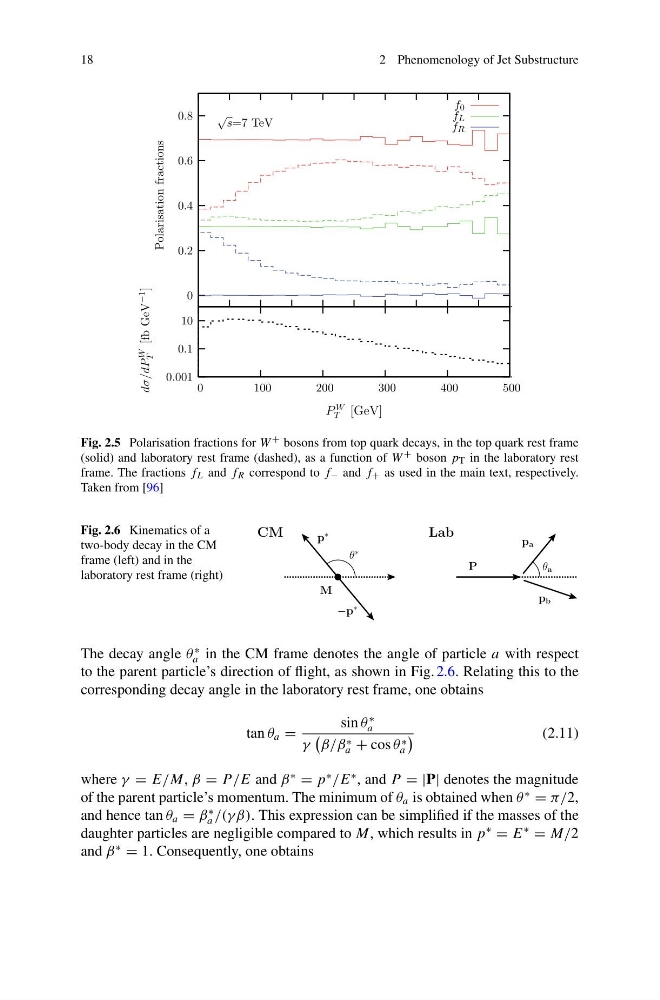
Fig. 2.5 Polarisation fractions for W + bosons from top quark decays, in the top quark rest frame
(solid) and laboratory rest frame (dashed), as a function of W + boson p T in the laboratory rest
frame. The fractions f L and f R correspond to f − and f + as used in the main text, respectively.
Taken from [96]
Fig. 2.6 Kinematics of a
two-body decay in the CM
frame (left) and in the
laboratory rest frame (right)
θ
∗
M
p
∗
−p
∗
CM
Lab
P
p a
p b
θ a
The decay angle θ
∗
a in the CM frame denotes the angle of particle a with respect
to the parent particle’s direction of flight, as shown in Fig. 2.6. Relating this to the
corresponding decay angle in the laboratory rest frame, one obtains
tan θ a =
sin θ
∗
a
γ
β/β ∗
a + cos θ ∗
a
(2.11)
where γ = E/M, β = P/E and β
∗
= p
∗
/E
∗ , and P = |P| denotes the magnitude
of the parent particle’s momentum. The minimum of θ a is obtained when θ
∗
= π/2,
and hence tan θ a = β
∗
a /(γβ). This expression can be simplified if the masses of the
daughter particles are negligible compared to M, which results in p
∗
= E
∗
= M/2
and β
∗
= 1. Consequently, one obtains
2 Phenomenology of Jet Substructure
f R
f L
f 0
√
s=7 TeV
-
.
Polarisation fractions
0
0.2
0.4
0.6
0.8
-
.
P
W
T [GeV]
dσ/dP W
T [fb GeV −1
]
500
400
300
200
100
0
0.001
0.1
10
Fig. 2.5 Polarisation fractions for W + bosons from top quark decays, in the top quark rest frame
(solid) and laboratory rest frame (dashed), as a function of W + boson p T in the laboratory rest
frame. The fractions f L and f R correspond to f − and f + as used in the main text, respectively.
Taken from [96]
Fig. 2.6 Kinematics of a
two-body decay in the CM
frame (left) and in the
laboratory rest frame (right)
θ
∗
M
p
∗
−p
∗
CM
Lab
P
p a
p b
θ a
The decay angle θ
∗
a in the CM frame denotes the angle of particle a with respect
to the parent particle’s direction of flight, as shown in Fig. 2.6. Relating this to the
corresponding decay angle in the laboratory rest frame, one obtains
tan θ a =
sin θ
∗
a
γ
β/β ∗
a + cos θ ∗
a
(2.11)
where γ = E/M, β = P/E and β
∗
= p
∗
/E
∗ , and P = |P| denotes the magnitude
of the parent particle’s momentum. The minimum of θ a is obtained when θ
∗
= π/2,
and hence tan θ a = β
∗
a /(γβ). This expression can be simplified if the masses of the
daughter particles are negligible compared to M, which results in p
∗
= E
∗
= M/2
and β
∗
= 1. Consequently, one obtains