

2.2 General Considerations
17
mation time of hadronic bound states. In other words, the top quark can be treated
as a free quark in production and decay processes [147].
The top quark decay is a weak process and hence results in polarised decay
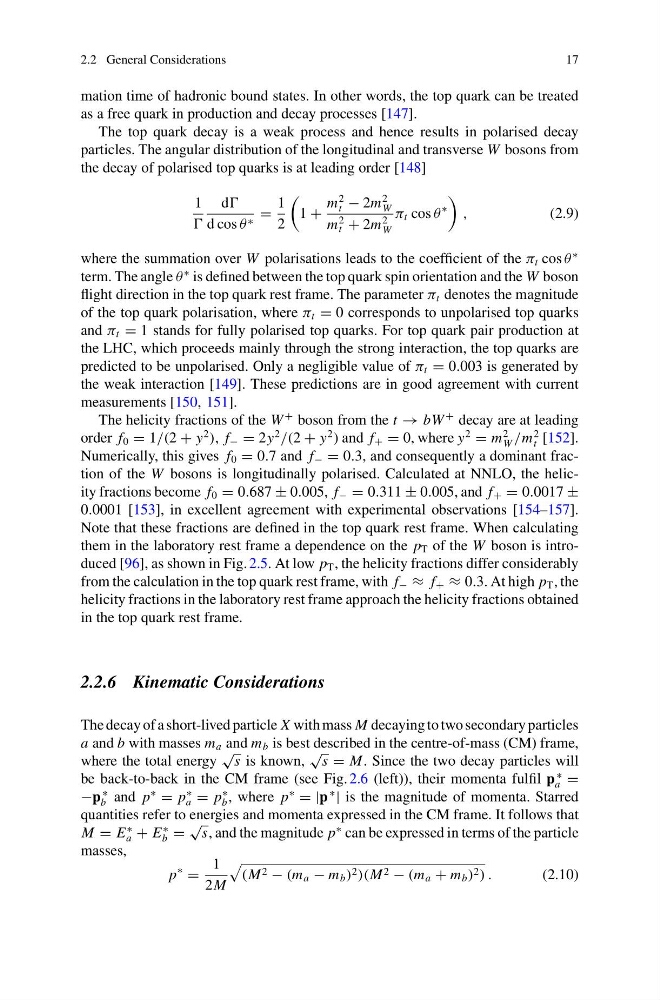
particles. The angular distribution of the longitudinal and transverse W bosons from
the decay of polarised top quarks is at leading order [148]
1
d
d cos θ ∗ =
1
2
1 +
m
2
t − 2m
2
W
m
2
t + 2m
2
W
π t cos θ
∗
,
(2.9)
where the summation over W polarisations leads to the coefficient of the π t cos θ
∗
term. The angle θ
∗ is defined between the top quark spin orientation and the W boson
flight direction in the top quark rest frame. The parameter π t denotes the magnitude
of the top quark polarisation, where π t = 0 corresponds to unpolarised top quarks
and π t = 1 stands for fully polarised top quarks. For top quark pair production at
the LHC, which proceeds mainly through the strong interaction, the top quarks are
predicted to be unpolarised. Only a negligible value of π t = 0.003 is generated by
the weak interaction [149]. These predictions are in good agreement with current
measurements [150, 151].
The helicity fractions of the W
+ boson from the t → bW
+ decay are at leading
order f 0 = 1/(2 + y
2
), f − = 2y
2
/(2 + y
2
) and f + = 0, where y
2
= m
2
W /m
2
t [152].
Numerically, this gives f 0 = 0.7 and f − = 0.3, and consequently a dominant fraction of the W bosons is longitudinally polarised. Calculated at NNLO, the helicity fractions become f 0 = 0.687 ± 0.005, f − = 0.311 ± 0.005, and f + = 0.0017 ±
0.0001 [153], in excellent agreement with experimental observations [154–157].
Note that these fractions are defined in the top quark rest frame. When calculating
them in the laboratory rest frame a dependence on the p T of the W boson is introduced [96], as shown in Fig. 2.5. At low p T , the helicity fractions differ considerably
from the calculation in the top quark rest frame, with f − ≈ f + ≈ 0.3. At high p T , the
helicity fractions in the laboratory rest frame approach the helicity fractions obtained
in the top quark rest frame.
2.2.6 Kinematic Considerations
The decay of a short-lived particle X with mass M decaying to two secondary particles
a and b with masses m a and m b is best described in the centre-of-mass (CM) frame,
where the total energy
√
s is known,
√
s = M. Since the two decay particles will
be back-to-back in the CM frame (see Fig. 2.6 (left)), their momenta fulfil p
∗
a =
−p
∗
b and p
∗
= p
∗
a = p
∗
b , where p
∗
= |p
∗
| is the magnitude of momenta. Starred
quantities refer to energies and momenta expressed in the CM frame. It follows that
M = E
∗
a + E
∗
b =
√
s, and the magnitude p
∗ can be expressed in terms of the particle
masses,
p
∗
=
1
2M
(M 2 − (m a − m b ) 2 )(M 2 − (m a + m b ) 2 ) .
(2.10)
17
mation time of hadronic bound states. In other words, the top quark can be treated
as a free quark in production and decay processes [147].
The top quark decay is a weak process and hence results in polarised decay
particles. The angular distribution of the longitudinal and transverse W bosons from
the decay of polarised top quarks is at leading order [148]
1
d
d cos θ ∗ =
1
2
1 +
m
2
t − 2m
2
W
m
2
t + 2m
2
W
π t cos θ
∗
,
(2.9)
where the summation over W polarisations leads to the coefficient of the π t cos θ
∗
term. The angle θ
∗ is defined between the top quark spin orientation and the W boson
flight direction in the top quark rest frame. The parameter π t denotes the magnitude
of the top quark polarisation, where π t = 0 corresponds to unpolarised top quarks
and π t = 1 stands for fully polarised top quarks. For top quark pair production at
the LHC, which proceeds mainly through the strong interaction, the top quarks are
predicted to be unpolarised. Only a negligible value of π t = 0.003 is generated by
the weak interaction [149]. These predictions are in good agreement with current
measurements [150, 151].
The helicity fractions of the W
+ boson from the t → bW
+ decay are at leading
order f 0 = 1/(2 + y
2
), f − = 2y
2
/(2 + y
2
) and f + = 0, where y
2
= m
2
W /m
2
t [152].
Numerically, this gives f 0 = 0.7 and f − = 0.3, and consequently a dominant fraction of the W bosons is longitudinally polarised. Calculated at NNLO, the helicity fractions become f 0 = 0.687 ± 0.005, f − = 0.311 ± 0.005, and f + = 0.0017 ±
0.0001 [153], in excellent agreement with experimental observations [154–157].
Note that these fractions are defined in the top quark rest frame. When calculating
them in the laboratory rest frame a dependence on the p T of the W boson is introduced [96], as shown in Fig. 2.5. At low p T , the helicity fractions differ considerably
from the calculation in the top quark rest frame, with f − ≈ f + ≈ 0.3. At high p T , the
helicity fractions in the laboratory rest frame approach the helicity fractions obtained
in the top quark rest frame.
2.2.6 Kinematic Considerations
The decay of a short-lived particle X with mass M decaying to two secondary particles
a and b with masses m a and m b is best described in the centre-of-mass (CM) frame,
where the total energy
√
s is known,
√
s = M. Since the two decay particles will
be back-to-back in the CM frame (see Fig. 2.6 (left)), their momenta fulfil p
∗
a =
−p
∗
b and p
∗
= p
∗
a = p
∗
b , where p
∗
= |p
∗
| is the magnitude of momenta. Starred
quantities refer to energies and momenta expressed in the CM frame. It follows that
M = E
∗
a + E
∗
b =
√
s, and the magnitude p
∗ can be expressed in terms of the particle
masses,
p
∗
=
1
2M
(M 2 − (m a − m b ) 2 )(M 2 − (m a + m b ) 2 ) .
(2.10)