

20
2 Phenomenology of Jet Substructure
to hold. Consequently, P T M needs to be fulfilled to ensure its validity. Practically,
P T > 2M is sufficient to ensure that (2.14) gives a reliable lower bound on
2.2.7 Kinematics of Vector and Higgs Boson Decays
The hadronic two-body decays W/Z /H → qq
( are the most important applications
of the above considerations in jet substructure analyses. In the following, results
are presented from numerical calculations using realistic decay angle distributions.
Quark mass effects are included, albeit small. The considerations are based on the
kinematics of the plain 1 → 2 process with coloured quarks in the final state, not
including radiation or hadronisation effects.
In realistic applications there exist a minimum detection threshold for the quarks
from the boson decay. This threshold is introduced due to the inability to distinguish soft and wide-angle radiation from uncorrelated radiation in hadron-hadron
collisions, such as contributions from the underlying event or pileup. Typically, p T
thresholds on the reconstructed quarks are applied, either directly or indirectly, when
using jet substructure observables. The effect such a p T threshold has on the detection efficiency depends on the decay angle distribution, and thus on the nature and
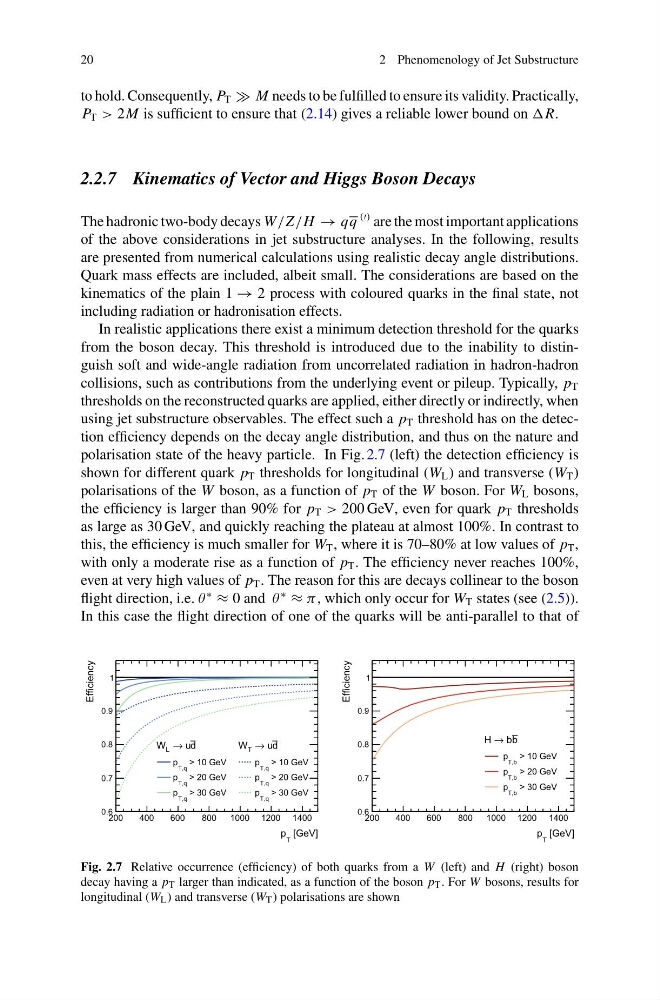
polarisation state of the heavy particle. In Fig. 2.7 (left) the detection efficiency is
shown for different quark p T thresholds for longitudinal (W L ) and transverse (W T )
polarisations of the W boson, as a function of p T of the W boson. For W L bosons,
the efficiency is larger than 90% for p T > 200 GeV, even for quark p T thresholds
as large as 30 GeV, and quickly reaching the plateau at almost 100%. In contrast to
this, the efficiency is much smaller for W T , where it is 70–80% at low values of p T ,
with only a moderate rise as a function of p T . The efficiency never reaches 100%,
even at very high values of p T . The reason for this are decays collinear to the boson
flight direction, i.e. θ
∗
≈ 0 and θ
∗
≈ π , which only occur for W T states (see (2.5)).
In this case the flight direction of one of the quarks will be anti-parallel to that of
[GeV]
T
p
200
400
600
800
1000 1200 1400
Efficiency
0.6
0.7
0.8
0.9
1
d
u
→
L
W
> 10 GeV
T,q
p
> 20 GeV
T,q
p
> 30 GeV
T,q
p
d
u
→
T
W
> 10 GeV
T,q
p
> 20 GeV
T,q
p
> 30 GeV
T,q
p
[GeV]
T
p
200
400
600
800
1000 1200 1400
Efficiency
0.6
0.7
0.8
0.9
1
b
b
→
H
> 10 GeV
T,b
p
> 20 GeV
T,b
p
> 30 GeV
T,b
p
Fig. 2.7 Relative occurrence (efficiency) of both quarks from a W (left) and H (right) boson
decay having a p T larger than indicated, as a function of the boson p T . For W bosons, results for
longitudinal (W L ) and transverse (W T ) polarisations are shown
2 Phenomenology of Jet Substructure
to hold. Consequently, P T M needs to be fulfilled to ensure its validity. Practically,
P T > 2M is sufficient to ensure that (2.14) gives a reliable lower bound on
2.2.7 Kinematics of Vector and Higgs Boson Decays
The hadronic two-body decays W/Z /H → qq
( are the most important applications
of the above considerations in jet substructure analyses. In the following, results
are presented from numerical calculations using realistic decay angle distributions.
Quark mass effects are included, albeit small. The considerations are based on the
kinematics of the plain 1 → 2 process with coloured quarks in the final state, not
including radiation or hadronisation effects.
In realistic applications there exist a minimum detection threshold for the quarks
from the boson decay. This threshold is introduced due to the inability to distinguish soft and wide-angle radiation from uncorrelated radiation in hadron-hadron
collisions, such as contributions from the underlying event or pileup. Typically, p T
thresholds on the reconstructed quarks are applied, either directly or indirectly, when
using jet substructure observables. The effect such a p T threshold has on the detection efficiency depends on the decay angle distribution, and thus on the nature and
polarisation state of the heavy particle. In Fig. 2.7 (left) the detection efficiency is
shown for different quark p T thresholds for longitudinal (W L ) and transverse (W T )
polarisations of the W boson, as a function of p T of the W boson. For W L bosons,
the efficiency is larger than 90% for p T > 200 GeV, even for quark p T thresholds
as large as 30 GeV, and quickly reaching the plateau at almost 100%. In contrast to
this, the efficiency is much smaller for W T , where it is 70–80% at low values of p T ,
with only a moderate rise as a function of p T . The efficiency never reaches 100%,
even at very high values of p T . The reason for this are decays collinear to the boson
flight direction, i.e. θ
∗
≈ 0 and θ
∗
≈ π , which only occur for W T states (see (2.5)).
In this case the flight direction of one of the quarks will be anti-parallel to that of
[GeV]
T
p
200
400
600
800
1000 1200 1400
Efficiency
0.6
0.7
0.8
0.9
1
d
u
→
L
W
> 10 GeV
T,q
p
> 20 GeV
T,q
p
> 30 GeV
T,q
p
d
u
→
T
W
> 10 GeV
T,q
p
> 20 GeV
T,q
p
> 30 GeV
T,q
p
[GeV]
T
p
200
400
600
800
1000 1200 1400
Efficiency
0.6
0.7
0.8
0.9
1
b
b
→
H
> 10 GeV
T,b
p
> 20 GeV
T,b
p
> 30 GeV
T,b
p
Fig. 2.7 Relative occurrence (efficiency) of both quarks from a W (left) and H (right) boson
decay having a p T larger than indicated, as a function of the boson p T . For W bosons, results for
longitudinal (W L ) and transverse (W T ) polarisations are shown