

12
2 Phenomenology of Jet Substructure
W → f ¯
f = C
G F M
3
W
6
√
2π
,
(2.2)
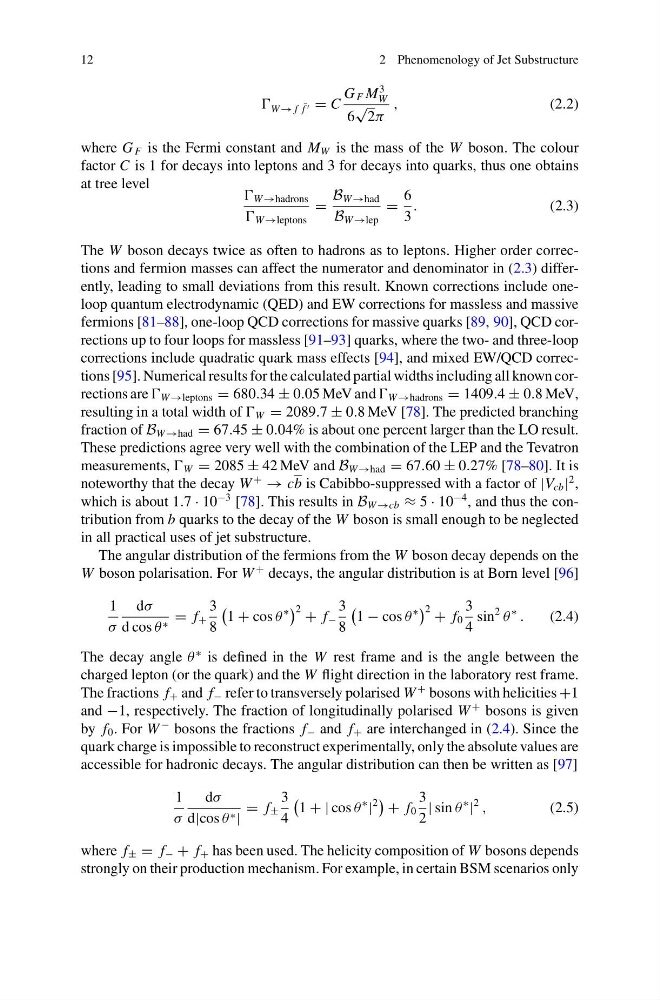
where G F is the Fermi constant and M W is the mass of the W boson. The colour
factor C is 1 for decays into leptons and 3 for decays into quarks, thus one obtains
at tree level
W →hadrons
W →leptons
=
B W →had
B W →lep
=
6
3
.
(2.3)
The W boson decays twice as often to hadrons as to leptons. Higher order corrections and fermion masses can affect the numerator and denominator in (2.3) differently, leading to small deviations from this result. Known corrections include oneloop quantum electrodynamic (QED) and EW corrections for massless and massive
fermions [81–88], one-loop QCD corrections for massive quarks [89, 90], QCD corrections up to four loops for massless [91–93] quarks, where the two- and three-loop
corrections include quadratic quark mass effects [94], and mixed EW/QCD corrections [95]. Numerical results for the calculated partial widths including all known corrections are W →leptons = 680.34 ± 0.05 MeV and W →hadrons = 1409.4 ± 0.8 MeV,
resulting in a total width of W = 2089.7 ± 0.8 MeV [78]. The predicted branching
fraction of B W →had = 67.45 ± 0.04% is about one percent larger than the LO result.
These predictions agree very well with the combination of the LEP and the Tevatron
measurements, W = 2085 ± 42 MeV and B W →had = 67.60 ± 0.27% [78–80]. It is
noteworthy that the decay W
+
→ cb is Cabibbo-suppressed with a factor of |V cb |
2 ,
which is about 1.7 · 10
−3 [78]. This results in B W →cb ≈ 5 · 10
−4 , and thus the contribution from b quarks to the decay of the W boson is small enough to be neglected
in all practical uses of jet substructure.
The angular distribution of the fermions from the W boson decay depends on the
W boson polarisation. For W
+ decays, the angular distribution is at Born level [96]
1
σ
dσ
d cos θ ∗ = f +
3
8
1 + cos θ
∗
2 + f −
3
8
1 − cos θ
∗
2 + f 0
3
4
sin
2
θ
∗
.
(2.4)
The decay angle θ
∗ is defined in the W rest frame and is the angle between the
charged lepton (or the quark) and the W flight direction in the laboratory rest frame.
The fractions f + and f − refer to transversely polarised W
+ bosons with helicities +1
and −1, respectively. The fraction of longitudinally polarised W
+ bosons is given
by f 0 . For W
− bosons the fractions f − and f + are interchanged in (2.4). Since the
quark charge is impossible to reconstruct experimentally, only the absolute values are
accessible for hadronic decays. The angular distribution can then be written as [97]
1
σ
dσ
d|cos θ ∗ |
= f ±
3
4
1 + | cos θ
∗
|
2
+ f 0
3
2
| sin θ
∗
|
2
,
(2.5)
where f ± = f − + f + has been used. The helicity composition of W bosons depends
strongly on their production mechanism. For example, in certain BSM scenarios only
2 Phenomenology of Jet Substructure
W → f ¯
f = C
G F M
3
W
6
√
2π
,
(2.2)
where G F is the Fermi constant and M W is the mass of the W boson. The colour
factor C is 1 for decays into leptons and 3 for decays into quarks, thus one obtains
at tree level
W →hadrons
W →leptons
=
B W →had
B W →lep
=
6
3
.
(2.3)
The W boson decays twice as often to hadrons as to leptons. Higher order corrections and fermion masses can affect the numerator and denominator in (2.3) differently, leading to small deviations from this result. Known corrections include oneloop quantum electrodynamic (QED) and EW corrections for massless and massive
fermions [81–88], one-loop QCD corrections for massive quarks [89, 90], QCD corrections up to four loops for massless [91–93] quarks, where the two- and three-loop
corrections include quadratic quark mass effects [94], and mixed EW/QCD corrections [95]. Numerical results for the calculated partial widths including all known corrections are W →leptons = 680.34 ± 0.05 MeV and W →hadrons = 1409.4 ± 0.8 MeV,
resulting in a total width of W = 2089.7 ± 0.8 MeV [78]. The predicted branching
fraction of B W →had = 67.45 ± 0.04% is about one percent larger than the LO result.
These predictions agree very well with the combination of the LEP and the Tevatron
measurements, W = 2085 ± 42 MeV and B W →had = 67.60 ± 0.27% [78–80]. It is
noteworthy that the decay W
+
→ cb is Cabibbo-suppressed with a factor of |V cb |
2 ,
which is about 1.7 · 10
−3 [78]. This results in B W →cb ≈ 5 · 10
−4 , and thus the contribution from b quarks to the decay of the W boson is small enough to be neglected
in all practical uses of jet substructure.
The angular distribution of the fermions from the W boson decay depends on the
W boson polarisation. For W
+ decays, the angular distribution is at Born level [96]
1
σ
dσ
d cos θ ∗ = f +
3
8
1 + cos θ
∗
2 + f −
3
8
1 − cos θ
∗
2 + f 0
3
4
sin
2
θ
∗
.
(2.4)
The decay angle θ
∗ is defined in the W rest frame and is the angle between the
charged lepton (or the quark) and the W flight direction in the laboratory rest frame.
The fractions f + and f − refer to transversely polarised W
+ bosons with helicities +1
and −1, respectively. The fraction of longitudinally polarised W
+ bosons is given
by f 0 . For W
− bosons the fractions f − and f + are interchanged in (2.4). Since the
quark charge is impossible to reconstruct experimentally, only the absolute values are
accessible for hadronic decays. The angular distribution can then be written as [97]
1
σ
dσ
d|cos θ ∗ |
= f ±
3
4
1 + | cos θ
∗
|
2
+ f 0
3
2
| sin θ
∗
|
2
,
(2.5)
where f ± = f − + f + has been used. The helicity composition of W bosons depends
strongly on their production mechanism. For example, in certain BSM scenarios only