

2.2 General Considerations
13
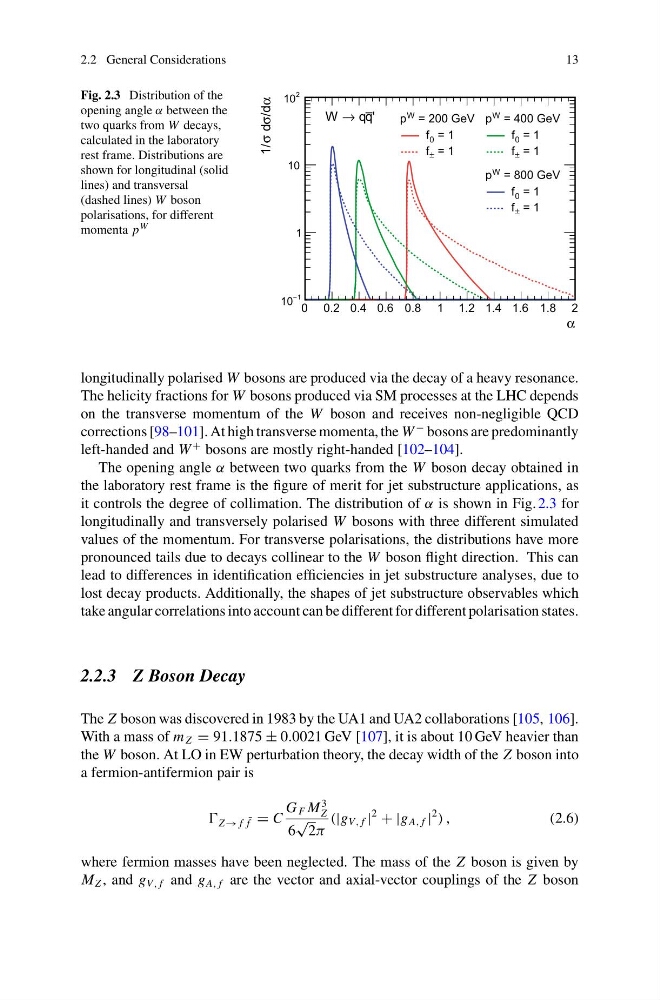
Fig. 2.3 Distribution of the
opening angle α between the
two quarks from W decays,
calculated in the laboratory
rest frame. Distributions are
shown for longitudinal (solid
lines) and transversal
(dashed lines) W boson
polarisations, for different
momenta p W
α
0 0.2 0.4 0.6 0.8 1 1.2 1.4 1.6 1.8 2
α
/d
σ
d
σ
1/
1
−
10
1
10
2
10
= 200 GeV
W
p
= 1
0
f
= 1
±
f
= 400 GeV
W
p
= 1
0
f
= 1
±
f
= 800 GeV
W
p
= 1
0
f
= 1
±
f
'
q
q
→
W
longitudinally polarised W bosons are produced via the decay of a heavy resonance.
The helicity fractions for W bosons produced via SM processes at the LHC depends
on the transverse momentum of the W boson and receives non-negligible QCD
corrections [98–101]. At high transverse momenta, the W
− bosons are predominantly
left-handed and W
+ bosons are mostly right-handed [102–104].
The opening angle α between two quarks from the W boson decay obtained in
the laboratory rest frame is the figure of merit for jet substructure applications, as
it controls the degree of collimation. The distribution of α is shown in Fig. 2.3 for
longitudinally and transversely polarised W bosons with three different simulated
values of the momentum. For transverse polarisations, the distributions have more
pronounced tails due to decays collinear to the W boson flight direction. This can
lead to differences in identification efficiencies in jet substructure analyses, due to
lost decay products. Additionally, the shapes of jet substructure observables which
take angular correlations into account can be different for different polarisation states.
2.2.3 Z Boson Decay
The Z boson was discovered in 1983 by the UA1 and UA2 collaborations [105, 106].
With a mass of m Z = 91.1875 ± 0.0021 GeV [107], it is about 10 GeV heavier than
the W boson. At LO in EW perturbation theory, the decay width of the Z boson into
a fermion-antifermion pair is
Z → f ¯
f = C
G F M
3
Z
6
√
2π
(|g V, f |
2
+ |g A, f |
2
) ,
(2.6)
where fermion masses have been neglected. The mass of the Z boson is given by
M Z , and g V, f and g A, f are the vector and axial-vector couplings of the Z boson
13
Fig. 2.3 Distribution of the
opening angle α between the
two quarks from W decays,
calculated in the laboratory
rest frame. Distributions are
shown for longitudinal (solid
lines) and transversal
(dashed lines) W boson
polarisations, for different
momenta p W
α
0 0.2 0.4 0.6 0.8 1 1.2 1.4 1.6 1.8 2
α
/d
σ
d
σ
1/
1
−
10
1
10
2
10
= 200 GeV
W
p
= 1
0
f
= 1
±
f
= 400 GeV
W
p
= 1
0
f
= 1
±
f
= 800 GeV
W
p
= 1
0
f
= 1
±
f
'
q
q
→
W
longitudinally polarised W bosons are produced via the decay of a heavy resonance.
The helicity fractions for W bosons produced via SM processes at the LHC depends
on the transverse momentum of the W boson and receives non-negligible QCD
corrections [98–101]. At high transverse momenta, the W
− bosons are predominantly
left-handed and W
+ bosons are mostly right-handed [102–104].
The opening angle α between two quarks from the W boson decay obtained in
the laboratory rest frame is the figure of merit for jet substructure applications, as
it controls the degree of collimation. The distribution of α is shown in Fig. 2.3 for
longitudinally and transversely polarised W bosons with three different simulated
values of the momentum. For transverse polarisations, the distributions have more
pronounced tails due to decays collinear to the W boson flight direction. This can
lead to differences in identification efficiencies in jet substructure analyses, due to
lost decay products. Additionally, the shapes of jet substructure observables which
take angular correlations into account can be different for different polarisation states.
2.2.3 Z Boson Decay
The Z boson was discovered in 1983 by the UA1 and UA2 collaborations [105, 106].
With a mass of m Z = 91.1875 ± 0.0021 GeV [107], it is about 10 GeV heavier than
the W boson. At LO in EW perturbation theory, the decay width of the Z boson into
a fermion-antifermion pair is
Z → f ¯
f = C
G F M
3
Z
6
√
2π
(|g V, f |
2
+ |g A, f |
2
) ,
(2.6)
where fermion masses have been neglected. The mass of the Z boson is given by
M Z , and g V, f and g A, f are the vector and axial-vector couplings of the Z boson