

2.2 General Considerations
11
2.2 General Considerations
2.2.1 Heavy Particle Decays
Detailed knowledge of the decay properties of heavy particles in the SM is crucial
for devising and understanding jet substructure applications. Here and elsewhere,
heavy refers to masses at the order of the W boson mass or higher. Thus, heavy SM
particles refer to the electroweak gauge bosons W and Z , the Higgs boson H , and
the top quark t.
All of these particles have hadronic and leptonic decay modes. The top quark is
the only fermion in this list and takes a special role, since its decay is governed by the
W boson decay, t → W b. The boson decays in the SM are described by two-body
kinematics,
3 while the top quark features a three-body decay. However, since in this
case the narrow width approximation for the W boson is accurate with sufficient
precision, the top quark decay can be treated as two subsequent two-body decays.
The total width of a particle can be expressed as a sum over all partial widths,
=
i i . This relation can be used to express the branching fraction B X →Y of a
particle X to final state Y , i.e. the probability that the particle decays into a given
final state, which is given by
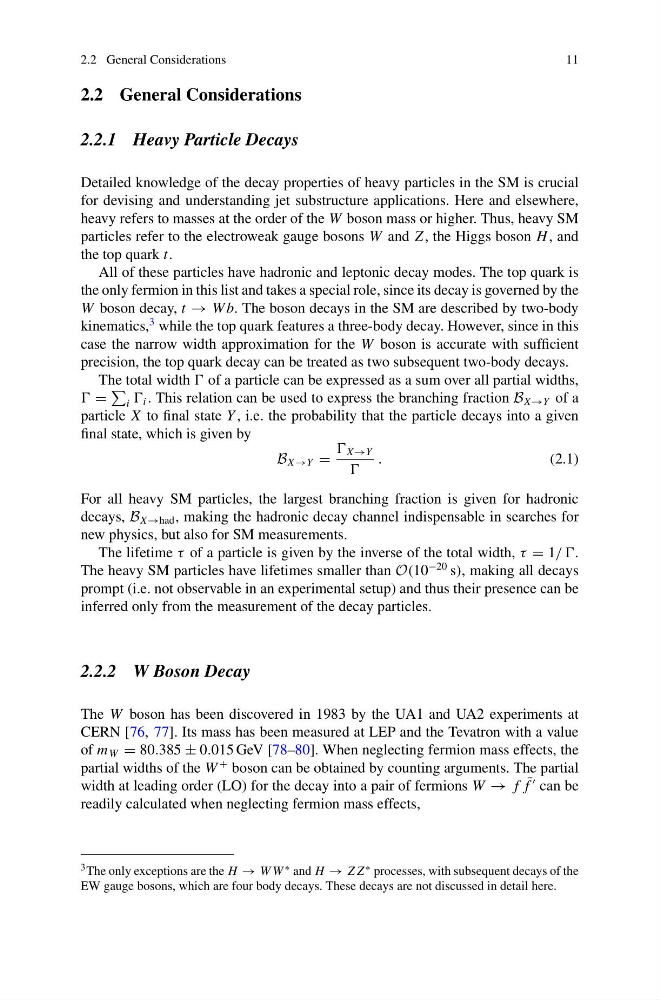
B X →Y =
X →Y
.
(2.1)
For all heavy SM particles, the largest branching fraction is given for hadronic
decays, B X →had , making the hadronic decay channel indispensable in searches for
new physics, but also for SM measurements.
The lifetime τ of a particle is given by the inverse of the total width, τ = 1/ /.
The heavy SM particles have lifetimes smaller than O(10
−20 s), making all decays
prompt (i.e. not observable in an experimental setup) and thus their presence can be
inferred only from the measurement of the decay particles.
2.2.2 W Boson Decay
The W boson has been discovered in 1983 by the UA1 and UA2 experiments at
CERN [76, 77]. Its mass has been measured at LEP and the Tevatron with a value
of m W = 80.385 ± 0.015 GeV [78–80]. When neglecting fermion mass effects, the
partial widths of the W
+ boson can be obtained by counting arguments. The partial
width at leading order (LO) for the decay into a pair of fermions W → f ¯
f
can be
readily calculated when neglecting fermion mass effects,
3 The only exceptions are the H → W W ∗ and H → Z Z ∗ processes, with subsequent decays of the
EW gauge bosons, which are four body decays. These decays are not discussed in detail here.
11
2.2 General Considerations
2.2.1 Heavy Particle Decays
Detailed knowledge of the decay properties of heavy particles in the SM is crucial
for devising and understanding jet substructure applications. Here and elsewhere,
heavy refers to masses at the order of the W boson mass or higher. Thus, heavy SM
particles refer to the electroweak gauge bosons W and Z , the Higgs boson H , and
the top quark t.
All of these particles have hadronic and leptonic decay modes. The top quark is
the only fermion in this list and takes a special role, since its decay is governed by the
W boson decay, t → W b. The boson decays in the SM are described by two-body
kinematics,
3 while the top quark features a three-body decay. However, since in this
case the narrow width approximation for the W boson is accurate with sufficient
precision, the top quark decay can be treated as two subsequent two-body decays.
The total width of a particle can be expressed as a sum over all partial widths,
=
i i . This relation can be used to express the branching fraction B X →Y of a
particle X to final state Y , i.e. the probability that the particle decays into a given
final state, which is given by
B X →Y =
X →Y
.
(2.1)
For all heavy SM particles, the largest branching fraction is given for hadronic
decays, B X →had , making the hadronic decay channel indispensable in searches for
new physics, but also for SM measurements.
The lifetime τ of a particle is given by the inverse of the total width, τ = 1/ /.
The heavy SM particles have lifetimes smaller than O(10
−20 s), making all decays
prompt (i.e. not observable in an experimental setup) and thus their presence can be
inferred only from the measurement of the decay particles.
2.2.2 W Boson Decay
The W boson has been discovered in 1983 by the UA1 and UA2 experiments at
CERN [76, 77]. Its mass has been measured at LEP and the Tevatron with a value
of m W = 80.385 ± 0.015 GeV [78–80]. When neglecting fermion mass effects, the
partial widths of the W
+ boson can be obtained by counting arguments. The partial
width at leading order (LO) for the decay into a pair of fermions W → f ¯
f
can be
readily calculated when neglecting fermion mass effects,
3 The only exceptions are the H → W W ∗ and H → Z Z ∗ processes, with subsequent decays of the
EW gauge bosons, which are four body decays. These decays are not discussed in detail here.