

196
5 Direct Searches for New Physics
A prime example where jet substructure methods help to improve the sensitivity
are searches for top squark production, where squarks denote superpartners of the SM
quarks. The two supersymmetric partners of the t L and t R SM chiral states are denoted
by ˜
t 1 and ˜
t 2 , where the lighter state will be denoted simply by ˜
t in the following.
The lightest neutralino ˜
χ
0
1 is in many models the stable, lightest supersymmetric
particle (LSP). In simplified models [1153–1155], the ˜
t can decay directly through
a two-body decay, ˜
t → t ˜
χ
0
1 , or it can decay via the three-body decay ˜
t → bW ˜
χ
0
1 . The
direct production of ˜
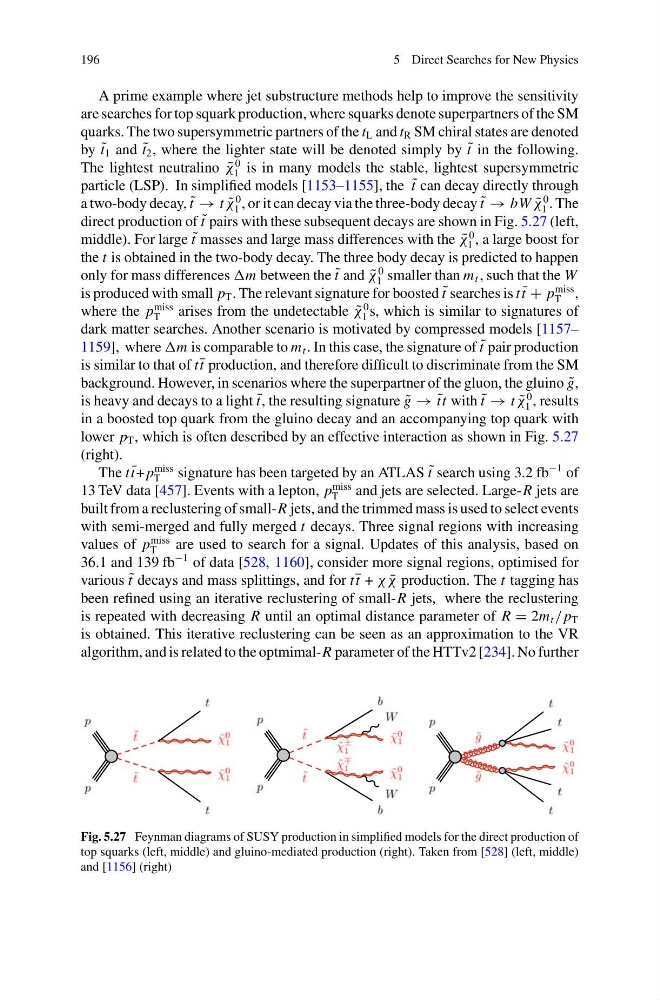
t pairs with these subsequent decays are shown in Fig. 5.27 (left,
middle). For large ˜
t masses and large mass differences with the ˜
χ
0
1 , a large boost for
the t is obtained in the two-body decay. The three body decay is predicted to happen
only for mass differences between the ˜
t and ˜
χ
0
1 smaller than m t , such that the W
is produced with small p T . The relevant signature for boosted ˜
t searches is t ¯
t + p
miss
T ,
where the p
miss
T
arises from the undetectable ˜
χ
0
1 s, which is similar to signatures of
dark matter searches. Another scenario is motivated by compressed models [1157–
1159], where is comparable to m t . In this case, the signature of ˜
t pair production
is similar to that of tt production, and therefore difficult to discriminate from the SM
background. However, in scenarios where the superpartner of the gluon, the gluino ˜
g,
is heavy and decays to a light ˜
t, the resulting signature ˜
g → ˜
tt with ˜
t → t ˜
χ
0
1 , results
in a boosted top quark from the gluino decay and an accompanying top quark with
lower p T , which is often described by an effective interaction as shown in Fig. 5.27
(right).
The t ¯
t+ p
miss
T
signature has been targeted by an ATLAS ˜
t search using 3.2 fb
−1 of
13 TeV data [457]. Events with a lepton, p
miss
T
and jets are selected. Large-R jets are
built from a reclustering of small-R jets, and the trimmed mass is used to select events
with semi-merged and fully merged t decays. Three signal regions with increasing
values of p
miss
T
are used to search for a signal. Updates of this analysis, based on
36.1 and 139 fb
−1 of data [528, 1160], consider more signal regions, optimised for
various ˜
t decays and mass splittings, and for tt + χ ¯
χ production. The t tagging has
been refined using an iterative reclustering of small-R jets, where the reclustering
is repeated with decreasing R until an optimal distance parameter of R = 2m t / p T
is obtained. This iterative reclustering can be seen as an approximation to the VR
algorithm, and is related to the optmimal-R parameter of the HTTv2 [234]. No further
Fig. 5.27 Feynman diagrams of SUSY production in simplified models for the direct production of
top squarks (left, middle) and gluino-mediated production (right). Taken from [528] (left, middle)
and [1156] (right)
5 Direct Searches for New Physics
A prime example where jet substructure methods help to improve the sensitivity
are searches for top squark production, where squarks denote superpartners of the SM
quarks. The two supersymmetric partners of the t L and t R SM chiral states are denoted
by ˜
t 1 and ˜
t 2 , where the lighter state will be denoted simply by ˜
t in the following.
The lightest neutralino ˜
χ
0
1 is in many models the stable, lightest supersymmetric
particle (LSP). In simplified models [1153–1155], the ˜
t can decay directly through
a two-body decay, ˜
t → t ˜
χ
0
1 , or it can decay via the three-body decay ˜
t → bW ˜
χ
0
1 . The
direct production of ˜
t pairs with these subsequent decays are shown in Fig. 5.27 (left,
middle). For large ˜
t masses and large mass differences with the ˜
χ
0
1 , a large boost for
the t is obtained in the two-body decay. The three body decay is predicted to happen
only for mass differences between the ˜
t and ˜
χ
0
1 smaller than m t , such that the W
is produced with small p T . The relevant signature for boosted ˜
t searches is t ¯
t + p
miss
T ,
where the p
miss
T
arises from the undetectable ˜
χ
0
1 s, which is similar to signatures of
dark matter searches. Another scenario is motivated by compressed models [1157–
1159], where is comparable to m t . In this case, the signature of ˜
t pair production
is similar to that of tt production, and therefore difficult to discriminate from the SM
background. However, in scenarios where the superpartner of the gluon, the gluino ˜
g,
is heavy and decays to a light ˜
t, the resulting signature ˜
g → ˜
tt with ˜
t → t ˜
χ
0
1 , results
in a boosted top quark from the gluino decay and an accompanying top quark with
lower p T , which is often described by an effective interaction as shown in Fig. 5.27
(right).
The t ¯
t+ p
miss
T
signature has been targeted by an ATLAS ˜
t search using 3.2 fb
−1 of
13 TeV data [457]. Events with a lepton, p
miss
T
and jets are selected. Large-R jets are
built from a reclustering of small-R jets, and the trimmed mass is used to select events
with semi-merged and fully merged t decays. Three signal regions with increasing
values of p
miss
T
are used to search for a signal. Updates of this analysis, based on
36.1 and 139 fb
−1 of data [528, 1160], consider more signal regions, optimised for
various ˜
t decays and mass splittings, and for tt + χ ¯
χ production. The t tagging has
been refined using an iterative reclustering of small-R jets, where the reclustering
is repeated with decreasing R until an optimal distance parameter of R = 2m t / p T
is obtained. This iterative reclustering can be seen as an approximation to the VR
algorithm, and is related to the optmimal-R parameter of the HTTv2 [234]. No further
Fig. 5.27 Feynman diagrams of SUSY production in simplified models for the direct production of
top squarks (left, middle) and gluino-mediated production (right). Taken from [528] (left, middle)
and [1156] (right)