

5.7 Supersymmetry
197
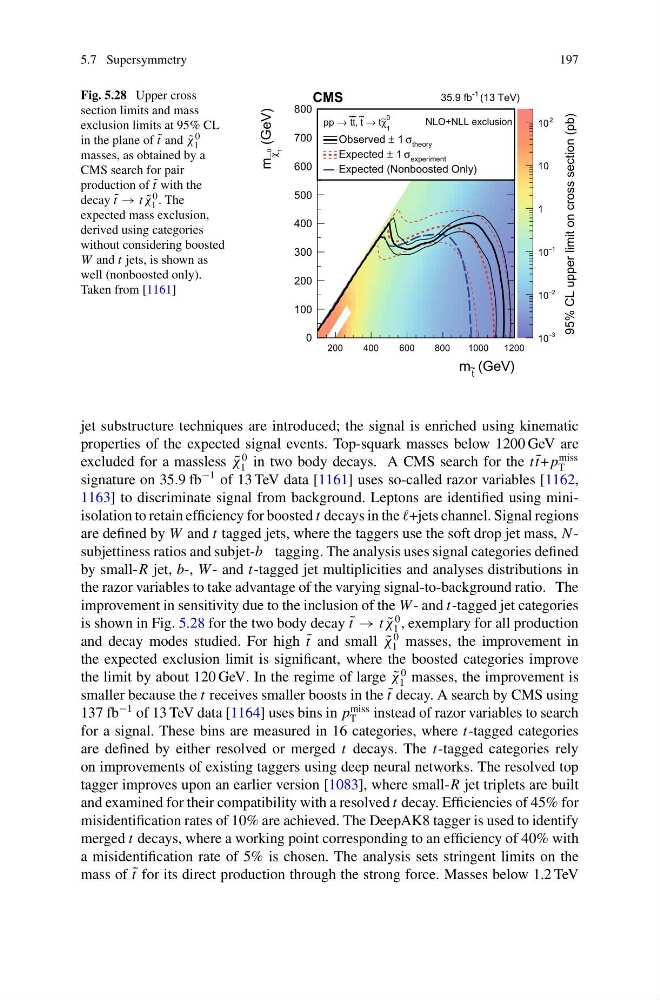
Fig. 5.28 Upper cross
section limits and mass
exclusion limits at 95% CL
in the plane of ˜
t and ˜
χ 0
1
masses, as obtained by a
CMS search for pair
production of ˜
t with the
decay ˜
t → t ˜
χ 0
1 . The
expected mass exclusion,
derived using categories
without considering boosted
W and t jets, is shown as
well (nonboosted only).
Taken from [1161]
(GeV)
t
~
m
200
400
600
800
1000
1200
(GeV)
1
0
χ ∼
m
0
100
200
300
400
500
600
700
800
3
−
10
2
−
10
1
−
10
1
10
2
10
CMS
(13 TeV)
-1
35.9 fb
1
0
χ
∼
t
→
t
~
,
t
~
t
~
→
pp
NLO+NLL exclusion
theory
σ
1
±
Observed
experiment
σ
1
±
Expected
Expected (Nonboosted Only)
95% CL upper limit on cross section (pb)
jet substructure techniques are introduced; the signal is enriched using kinematic
properties of the expected signal events. Top-squark masses below 1200 GeV are
excluded for a massless ˜
χ
0
1 in two body decays. A CMS search for the t ¯
t+ p
miss
T
signature on 35.9 fb
−1 of 13 TeV data [1161] uses so-called razor variables [1162,
1163] to discriminate signal from background. Leptons are identified using miniisolation to retain efficiency for boosted t decays in the +jets channel. Signal regions
are defined by W and t tagged jets, where the taggers use the soft drop jet mass, N -
subjettiness ratios and subjet-b tagging. The analysis uses signal categories defined
by small-R jet, b-, W - and t-tagged jet multiplicities and analyses distributions in
the razor variables to take advantage of the varying signal-to-background ratio. The
improvement in sensitivity due to the inclusion of the W - and t-tagged jet categories
is shown in Fig. 5.28 for the two body decay ˜
t → t ˜
χ
0
1 , exemplary for all production
and decay modes studied. For high ˜
t and small ˜
χ
0
1 masses, the improvement in
the expected exclusion limit is significant, where the boosted categories improve
the limit by about 120 GeV. In the regime of large ˜
χ
0
1 masses, the improvement is
smaller because the t receives smaller boosts in the ˜
t decay. A search by CMS using
137 fb
−1 of 13 TeV data [1164] uses bins in p
miss
T
instead of razor variables to search
for a signal. These bins are measured in 16 categories, where t-tagged categories
are defined by either resolved or merged t decays. The t-tagged categories rely
on improvements of existing taggers using deep neural networks. The resolved top
tagger improves upon an earlier version [1083], where small-R jet triplets are built
and examined for their compatibility with a resolved t decay. Efficiencies of 45% for
misidentification rates of 10% are achieved. The DeepAK8 tagger is used to identify
merged t decays, where a working point corresponding to an efficiency of 40% with
a misidentification rate of 5% is chosen. The analysis sets stringent limits on the
mass of ˜
t for its direct production through the strong force. Masses below 1.2 TeV
197
Fig. 5.28 Upper cross
section limits and mass
exclusion limits at 95% CL
in the plane of ˜
t and ˜
χ 0
1
masses, as obtained by a
CMS search for pair
production of ˜
t with the
decay ˜
t → t ˜
χ 0
1 . The
expected mass exclusion,
derived using categories
without considering boosted
W and t jets, is shown as
well (nonboosted only).
Taken from [1161]
(GeV)
t
~
m
200
400
600
800
1000
1200
(GeV)
1
0
χ ∼
m
0
100
200
300
400
500
600
700
800
3
−
10
2
−
10
1
−
10
1
10
2
10
CMS
(13 TeV)
-1
35.9 fb
1
0
χ
∼
t
→
t
~
,
t
~
t
~
→
pp
NLO+NLL exclusion
theory
σ
1
±
Observed
experiment
σ
1
±
Expected
Expected (Nonboosted Only)
95% CL upper limit on cross section (pb)
jet substructure techniques are introduced; the signal is enriched using kinematic
properties of the expected signal events. Top-squark masses below 1200 GeV are
excluded for a massless ˜
χ
0
1 in two body decays. A CMS search for the t ¯
t+ p
miss
T
signature on 35.9 fb
−1 of 13 TeV data [1161] uses so-called razor variables [1162,
1163] to discriminate signal from background. Leptons are identified using miniisolation to retain efficiency for boosted t decays in the +jets channel. Signal regions
are defined by W and t tagged jets, where the taggers use the soft drop jet mass, N -
subjettiness ratios and subjet-b tagging. The analysis uses signal categories defined
by small-R jet, b-, W - and t-tagged jet multiplicities and analyses distributions in
the razor variables to take advantage of the varying signal-to-background ratio. The
improvement in sensitivity due to the inclusion of the W - and t-tagged jet categories
is shown in Fig. 5.28 for the two body decay ˜
t → t ˜
χ
0
1 , exemplary for all production
and decay modes studied. For high ˜
t and small ˜
χ
0
1 masses, the improvement in
the expected exclusion limit is significant, where the boosted categories improve
the limit by about 120 GeV. In the regime of large ˜
χ
0
1 masses, the improvement is
smaller because the t receives smaller boosts in the ˜
t decay. A search by CMS using
137 fb
−1 of 13 TeV data [1164] uses bins in p
miss
T
instead of razor variables to search
for a signal. These bins are measured in 16 categories, where t-tagged categories
are defined by either resolved or merged t decays. The t-tagged categories rely
on improvements of existing taggers using deep neural networks. The resolved top
tagger improves upon an earlier version [1083], where small-R jet triplets are built
and examined for their compatibility with a resolved t decay. Efficiencies of 45% for
misidentification rates of 10% are achieved. The DeepAK8 tagger is used to identify
merged t decays, where a working point corresponding to an efficiency of 40% with
a misidentification rate of 5% is chosen. The analysis sets stringent limits on the
mass of ˜
t for its direct production through the strong force. Masses below 1.2 TeV