

5.7 Supersymmetry
195
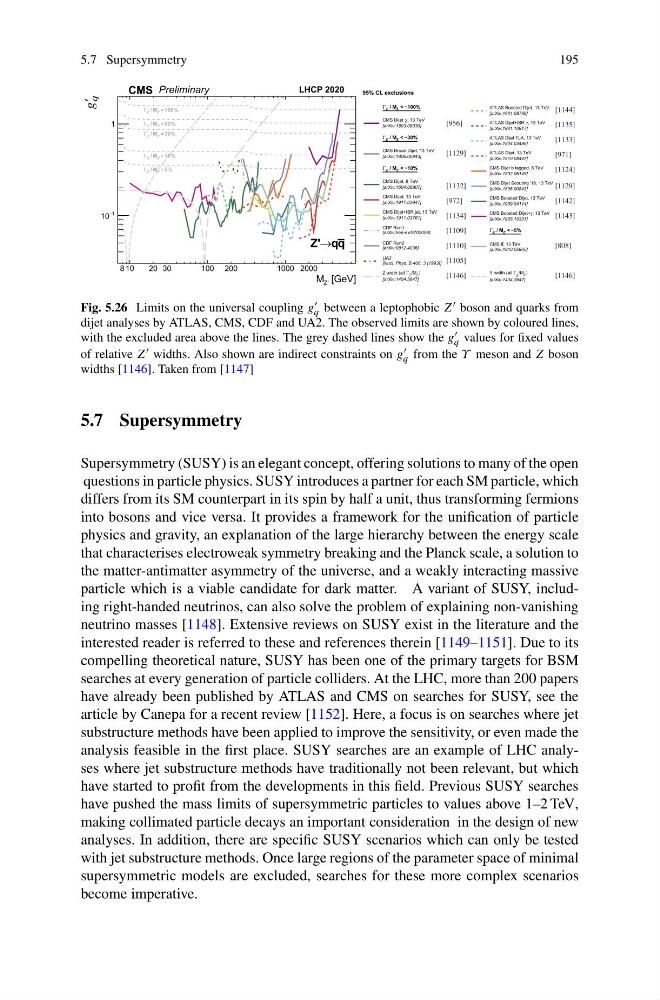
Fig. 5.26 Limits on the universal coupling g
q between a leptophobic Z boson and quarks from
dijet analyses by ATLAS, CMS, CDF and UA2. The observed limits are shown by coloured lines,
with the excluded area above the lines. The grey dashed lines show the g
q values for fixed values
of relative Z widths. Also shown are indirect constraints on g
q from the Υ meson and Z boson
widths [1146]. Taken from [1147]
5.7 Supersymmetry
Supersymmetry (SUSY) is an elegant concept, offering solutions to many of the open
questions in particle physics. SUSY introduces a partner for each SM particle, which
differs from its SM counterpart in its spin by half a unit, thus transforming fermions
into bosons and vice versa. It provides a framework for the unification of particle
physics and gravity, an explanation of the large hierarchy between the energy scale
that characterises electroweak symmetry breaking and the Planck scale, a solution to
the matter-antimatter asymmetry of the universe, and a weakly interacting massive
particle which is a viable candidate for dark matter. A variant of SUSY, including right-handed neutrinos, can also solve the problem of explaining non-vanishing
neutrino masses [1148]. Extensive reviews on SUSY exist in the literature and the
interested reader is referred to these and references therein [1149–1151]. Due to its
compelling theoretical nature, SUSY has been one of the primary targets for BSM
searches at every generation of particle colliders. At the LHC, more than 200 papers
have already been published by ATLAS and CMS on searches for SUSY, see the
article by Canepa for a recent review [1152]. Here, a focus is on searches where jet
substructure methods have been applied to improve the sensitivity, or even made the
analysis feasible in the first place. SUSY searches are an example of LHC analyses where jet substructure methods have traditionally not been relevant, but which
have started to profit from the developments in this field. Previous SUSY searches
have pushed the mass limits of supersymmetric particles to values above 1–2 TeV,
making collimated particle decays an important consideration in the design of new
analyses. In addition, there are specific SUSY scenarios which can only be tested
with jet substructure methods. Once large regions of the parameter space of minimal
supersymmetric models are excluded, searches for these more complex scenarios
become imperative.
195
Fig. 5.26 Limits on the universal coupling g
q between a leptophobic Z boson and quarks from
dijet analyses by ATLAS, CMS, CDF and UA2. The observed limits are shown by coloured lines,
with the excluded area above the lines. The grey dashed lines show the g
q values for fixed values
of relative Z widths. Also shown are indirect constraints on g
q from the Υ meson and Z boson
widths [1146]. Taken from [1147]
5.7 Supersymmetry
Supersymmetry (SUSY) is an elegant concept, offering solutions to many of the open
questions in particle physics. SUSY introduces a partner for each SM particle, which
differs from its SM counterpart in its spin by half a unit, thus transforming fermions
into bosons and vice versa. It provides a framework for the unification of particle
physics and gravity, an explanation of the large hierarchy between the energy scale
that characterises electroweak symmetry breaking and the Planck scale, a solution to
the matter-antimatter asymmetry of the universe, and a weakly interacting massive
particle which is a viable candidate for dark matter. A variant of SUSY, including right-handed neutrinos, can also solve the problem of explaining non-vanishing
neutrino masses [1148]. Extensive reviews on SUSY exist in the literature and the
interested reader is referred to these and references therein [1149–1151]. Due to its
compelling theoretical nature, SUSY has been one of the primary targets for BSM
searches at every generation of particle colliders. At the LHC, more than 200 papers
have already been published by ATLAS and CMS on searches for SUSY, see the
article by Canepa for a recent review [1152]. Here, a focus is on searches where jet
substructure methods have been applied to improve the sensitivity, or even made the
analysis feasible in the first place. SUSY searches are an example of LHC analyses where jet substructure methods have traditionally not been relevant, but which
have started to profit from the developments in this field. Previous SUSY searches
have pushed the mass limits of supersymmetric particles to values above 1–2 TeV,
making collimated particle decays an important consideration in the design of new
analyses. In addition, there are specific SUSY scenarios which can only be tested
with jet substructure methods. Once large regions of the parameter space of minimal
supersymmetric models are excluded, searches for these more complex scenarios
become imperative.