

194
5 Direct Searches for New Physics
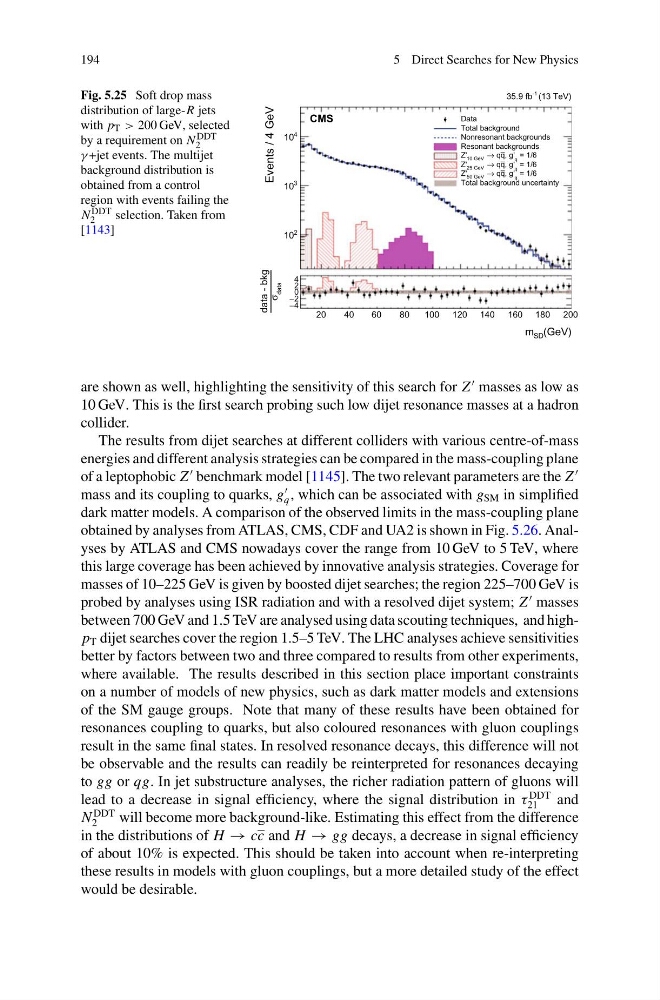
Fig. 5.25 Soft drop mass
distribution of large-R jets
with p T > 200 GeV, selected
by a requirement on N DDT
2
γ +jet events. The multijet
background distribution is
obtained from a control
region with events failing the
N DDT
2
selection. Taken from
[1143]
2
10
3
10
4
10
Events / 4 GeV
Data
Total background
Nonresonant backgrounds
Resonant backgrounds
= 1/6
q
, g'
q
q
→
10 GeV
Z'
= 1/6
q
, g'
q
q
→
25 GeV
Z'
= 1/6
q
, g'
q
q
→
50 GeV
Z'
Total background uncertainty
(13 TeV)
-1
35.9 fb
CMS
20
40
60
80
100 120 140 160 180 200
(GeV)
SD
m
4
−
2
−
0
2
4
data
σ
data - bkg
are shown as well, highlighting the sensitivity of this search for Z
masses as low as
10 GeV. This is the first search probing such low dijet resonance masses at a hadron
collider.
The results from dijet searches at different colliders with various centre-of-mass
energies and different analysis strategies can be compared in the mass-coupling plane
of a leptophobic Z
benchmark model [1145]. The two relevant parameters are the Z
mass and its coupling to quarks, g
q , which can be associated with g SM in simplified
dark matter models. A comparison of the observed limits in the mass-coupling plane
obtained by analyses from ATLAS, CMS, CDF and UA2 is shown in Fig. 5.26. Analyses by ATLAS and CMS nowadays cover the range from 10 GeV to 5 TeV, where
this large coverage has been achieved by innovative analysis strategies. Coverage for
masses of 10–225 GeV is given by boosted dijet searches; the region 225–700 GeV is
probed by analyses using ISR radiation and with a resolved dijet system; Z
masses
between 700 GeV and 1.5 TeV are analysed using data scouting techniques, and highp T dijet searches cover the region 1.5–5 TeV. The LHC analyses achieve sensitivities
better by factors between two and three compared to results from other experiments,
where available. The results described in this section place important constraints
on a number of models of new physics, such as dark matter models and extensions
of the SM gauge groups. Note that many of these results have been obtained for
resonances coupling to quarks, but also coloured resonances with gluon couplings
result in the same final states. In resolved resonance decays, this difference will not
be observable and the results can readily be reinterpreted for resonances decaying
to gg or qg. In jet substructure analyses, the richer radiation pattern of gluons will
lead to a decrease in signal efficiency, where the signal distribution in τ
DDT
21
and
N
DDT
2
will become more background-like. Estimating this effect from the difference
in the distributions of H → cc and H → gg decays, a decrease in signal efficiency
of about 10% is expected. This should be taken into account when re-interpreting
these results in models with gluon couplings, but a more detailed study of the effect
would be desirable.
5 Direct Searches for New Physics
Fig. 5.25 Soft drop mass
distribution of large-R jets
with p T > 200 GeV, selected
by a requirement on N DDT
2
γ +jet events. The multijet
background distribution is
obtained from a control
region with events failing the
N DDT
2
selection. Taken from
[1143]
2
10
3
10
4
10
Events / 4 GeV
Data
Total background
Nonresonant backgrounds
Resonant backgrounds
= 1/6
q
, g'
q
q
→
10 GeV
Z'
= 1/6
q
, g'
q
q
→
25 GeV
Z'
= 1/6
q
, g'
q
q
→
50 GeV
Z'
Total background uncertainty
(13 TeV)
-1
35.9 fb
CMS
20
40
60
80
100 120 140 160 180 200
(GeV)
SD
m
4
−
2
−
0
2
4
data
σ
data - bkg
are shown as well, highlighting the sensitivity of this search for Z
masses as low as
10 GeV. This is the first search probing such low dijet resonance masses at a hadron
collider.
The results from dijet searches at different colliders with various centre-of-mass
energies and different analysis strategies can be compared in the mass-coupling plane
of a leptophobic Z
benchmark model [1145]. The two relevant parameters are the Z
mass and its coupling to quarks, g
q , which can be associated with g SM in simplified
dark matter models. A comparison of the observed limits in the mass-coupling plane
obtained by analyses from ATLAS, CMS, CDF and UA2 is shown in Fig. 5.26. Analyses by ATLAS and CMS nowadays cover the range from 10 GeV to 5 TeV, where
this large coverage has been achieved by innovative analysis strategies. Coverage for
masses of 10–225 GeV is given by boosted dijet searches; the region 225–700 GeV is
probed by analyses using ISR radiation and with a resolved dijet system; Z
masses
between 700 GeV and 1.5 TeV are analysed using data scouting techniques, and highp T dijet searches cover the region 1.5–5 TeV. The LHC analyses achieve sensitivities
better by factors between two and three compared to results from other experiments,
where available. The results described in this section place important constraints
on a number of models of new physics, such as dark matter models and extensions
of the SM gauge groups. Note that many of these results have been obtained for
resonances coupling to quarks, but also coloured resonances with gluon couplings
result in the same final states. In resolved resonance decays, this difference will not
be observable and the results can readily be reinterpreted for resonances decaying
to gg or qg. In jet substructure analyses, the richer radiation pattern of gluons will
lead to a decrease in signal efficiency, where the signal distribution in τ
DDT
21
and
N
DDT
2
will become more background-like. Estimating this effect from the difference
in the distributions of H → cc and H → gg decays, a decrease in signal efficiency
of about 10% is expected. This should be taken into account when re-interpreting
these results in models with gluon couplings, but a more detailed study of the effect
would be desirable.