

5.6 Light Resonances Coupling to Quarks or Gluons
193
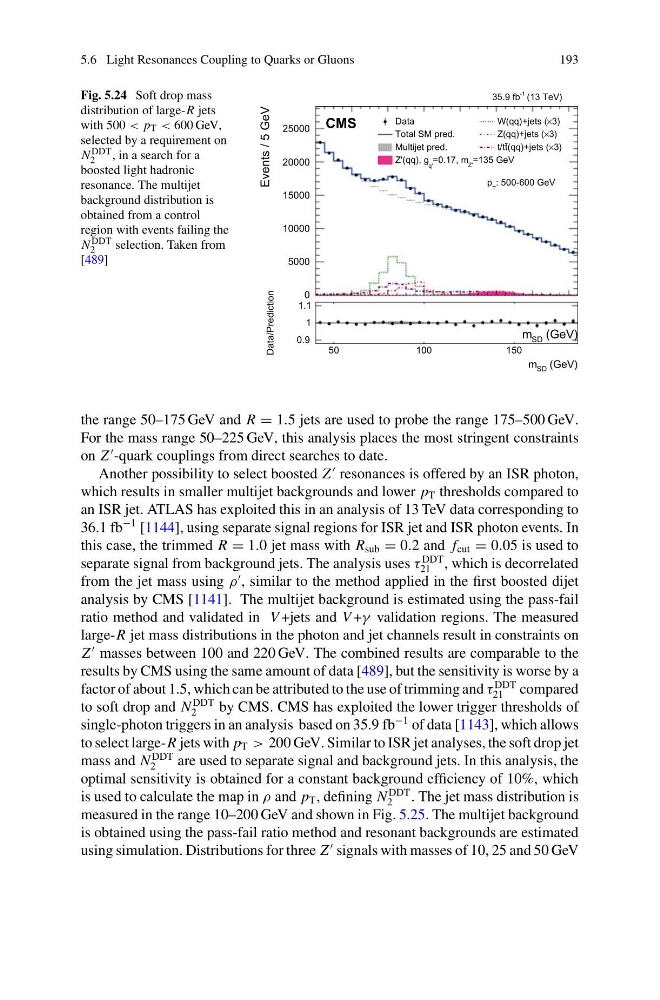
Fig. 5.24 Soft drop mass
distribution of large-R jets
with 500 < p T < 600 GeV,
selected by a requirement on
N DDT
2
, in a search for a
boosted light hadronic
resonance. The multijet
background distribution is
obtained from a control
region with events failing the
N DDT
2
selection. Taken from
[489]
(GeV)
SD
m
Events / 5 GeV
0
5000
10000
15000
20000
25000
Data
3)
×
W(qq)+jets (
Total SM pred.
3)
×
Z(qq)+jets (
Multijet pred.
3)
×
(qq)+jets (
t
t/t
=135 GeV
Z'
=0.17, m
q'
Z'(qq), g
(13 TeV)
-1
35.9 fb
CMS
: 500-600 GeV
T
p
(GeV)
SD
m
50
100
150
Data/Prediction
0.9
1
1.1
the range 50–175 GeV and R = 1.5 jets are used to probe the range 175–500 GeV.
For the mass range 50–225 GeV, this analysis places the most stringent constraints
on Z
-quark couplings from direct searches to date.
Another possibility to select boosted Z
resonances is offered by an ISR photon,
which results in smaller multijet backgrounds and lower p T thresholds compared to
an ISR jet. ATLAS has exploited this in an analysis of 13 TeV data corresponding to
36.1 fb
−1 [1144], using separate signal regions for ISR jet and ISR photon events. In
this case, the trimmed R = 1.0 jet mass with R sub = 0.2 and f cut = 0.05 is used to
separate signal from background jets. The analysis uses τ
DDT
21 , which is decorrelated
from the jet mass using ρ
, similar to the method applied in the first boosted dijet
analysis by CMS [1141]. The multijet background is estimated using the pass-fail
ratio method and validated in V +jets and V +γ validation regions. The measured
large-R jet mass distributions in the photon and jet channels result in constraints on
Z
masses between 100 and 220 GeV. The combined results are comparable to the
results by CMS using the same amount of data [489], but the sensitivity is worse by a
factor of about 1.5, which can be attributed to the use of trimming and τ
DDT
21
compared
to soft drop and N
DDT
2
by CMS. CMS has exploited the lower trigger thresholds of
single-photon triggers in an analysis based on 35.9 fb
−1 of data [1143], which allows
to select large-R jets with p T > 200 GeV. Similar to ISR jet analyses, the soft drop jet
mass and N
DDT
2
are used to separate signal and background jets. In this analysis, the
optimal sensitivity is obtained for a constant background efficiency of 10%, which
is used to calculate the map in ρ and p T , defining N
DDT
2
. The jet mass distribution is
measured in the range 10–200 GeV and shown in Fig. 5.25. The multijet background
is obtained using the pass-fail ratio method and resonant backgrounds are estimated
using simulation. Distributions for three Z
signals with masses of 10, 25 and 50 GeV
193
Fig. 5.24 Soft drop mass
distribution of large-R jets
with 500 < p T < 600 GeV,
selected by a requirement on
N DDT
2
, in a search for a
boosted light hadronic
resonance. The multijet
background distribution is
obtained from a control
region with events failing the
N DDT
2
selection. Taken from
[489]
(GeV)
SD
m
Events / 5 GeV
0
5000
10000
15000
20000
25000
Data
3)
×
W(qq)+jets (
Total SM pred.
3)
×
Z(qq)+jets (
Multijet pred.
3)
×
(qq)+jets (
t
t/t
=135 GeV
Z'
=0.17, m
q'
Z'(qq), g
(13 TeV)
-1
35.9 fb
CMS
: 500-600 GeV
T
p
(GeV)
SD
m
50
100
150
Data/Prediction
0.9
1
1.1
the range 50–175 GeV and R = 1.5 jets are used to probe the range 175–500 GeV.
For the mass range 50–225 GeV, this analysis places the most stringent constraints
on Z
-quark couplings from direct searches to date.
Another possibility to select boosted Z
resonances is offered by an ISR photon,
which results in smaller multijet backgrounds and lower p T thresholds compared to
an ISR jet. ATLAS has exploited this in an analysis of 13 TeV data corresponding to
36.1 fb
−1 [1144], using separate signal regions for ISR jet and ISR photon events. In
this case, the trimmed R = 1.0 jet mass with R sub = 0.2 and f cut = 0.05 is used to
separate signal from background jets. The analysis uses τ
DDT
21 , which is decorrelated
from the jet mass using ρ
, similar to the method applied in the first boosted dijet
analysis by CMS [1141]. The multijet background is estimated using the pass-fail
ratio method and validated in V +jets and V +γ validation regions. The measured
large-R jet mass distributions in the photon and jet channels result in constraints on
Z
masses between 100 and 220 GeV. The combined results are comparable to the
results by CMS using the same amount of data [489], but the sensitivity is worse by a
factor of about 1.5, which can be attributed to the use of trimming and τ
DDT
21
compared
to soft drop and N
DDT
2
by CMS. CMS has exploited the lower trigger thresholds of
single-photon triggers in an analysis based on 35.9 fb
−1 of data [1143], which allows
to select large-R jets with p T > 200 GeV. Similar to ISR jet analyses, the soft drop jet
mass and N
DDT
2
are used to separate signal and background jets. In this analysis, the
optimal sensitivity is obtained for a constant background efficiency of 10%, which
is used to calculate the map in ρ and p T , defining N
DDT
2
. The jet mass distribution is
measured in the range 10–200 GeV and shown in Fig. 5.25. The multijet background
is obtained using the pass-fail ratio method and resonant backgrounds are estimated
using simulation. Distributions for three Z
signals with masses of 10, 25 and 50 GeV