

166
5 Direct Searches for New Physics
type VLQs [916]. The search uses 19.7 fb
−1 of 8 TeV data and considers the single
production decays channels Dq → W qq and Dq → Zqq, and the pair production
channels W qW q, W q Zq, W q Hq, Zq Zq and Zq Hq. The analysis is performed
in the +jets and multi-lepton final states, where a kinematic fit is performed in the
single-lepton final state to reconstruct the VLQ mass. In this fit, the subjets of W -,
Z - or H -tagged large-R jets are used if the decay can not be resolved by smallR jets, similar to the strategy adopted in [880]. Observables sensitive to m VLQ are
used in the multi-lepton final states to discriminate between background and signal
events. This analysis sets the most stringent mass limits on VLQs coupling to light
quarks, ranging from 400 to 1800 TeV, depending on the electroweak coupling and
the branching fractions into W , Z and H . The weakest constrains are obtained for
large branching fractions into H , where this analysis has not been optimised for.
Even when considering only pair production, the obtained limits are better by more
than 150 GeV than results from searches by ATLAS at 7 [917] and 8 TeV [918],
which did not include jet substructure methods.
The results commonly given in experimental searches are upper cross section limits. These are directly derived from the data and can be obtained in a fairly modelindependent fashion. The only assumptions are the acceptance and experimental
efficiency to observe a given final state, which are derived using explicit signal models. As long as the acceptance and efficiency are approximately unchanged, the cross
section limits can be used to place constrains on any model predicting the same
final state. However, an intermediate step is needed in order to derive the allowed
parameter space of a given model. Cross sections have to be computed for a set of
parameters and compared to the experimental results. For a phenomenological analysis, it is more convenient to have bounds on model parameters explicitly appearing
in the Lagrange density, like couplings and masses. This eliminates the need for a
computation of cross sections for various model parameters. A more general representation of the experimental results is more important for single production of
VLQs than for pair production. In pair production, the QCD-induced cross section
is independent of the electroweak representation and the corresponding coupling
parameters. This allows for a reinterpretation of the results by treating the branching
fractions as free parameters instead of the coupling parameters. In single production,
the situation is more involved, because the couplings enter the production and decay
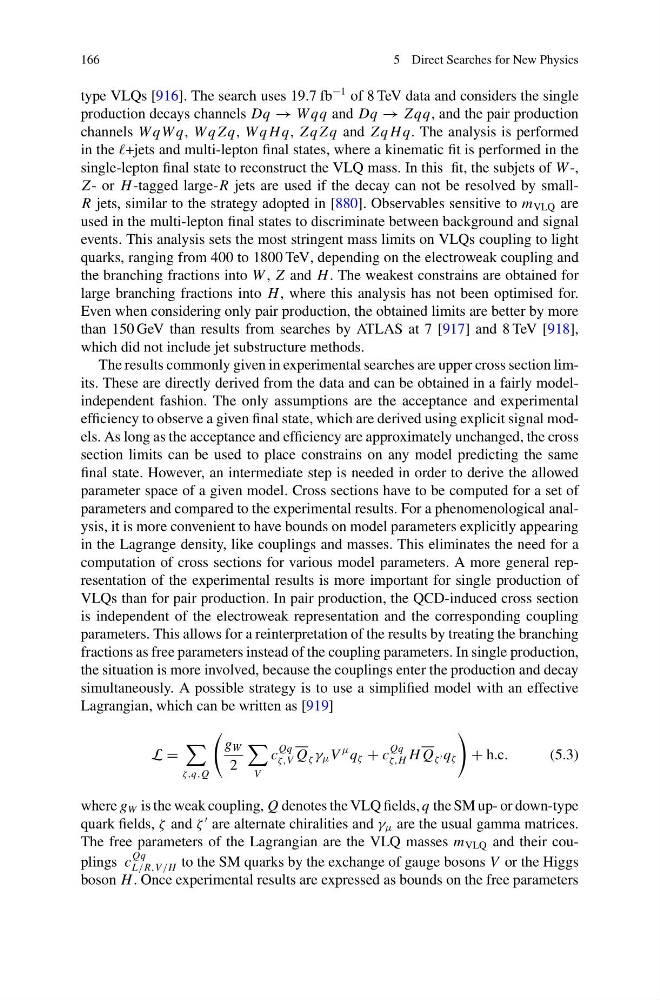
simultaneously. A possible strategy is to use a simplified model with an effective
Lagrangian, which can be written as [919]
L =
ζ,q,Q
g W
2
V
c
Qq
ζ,V Q ζ γ μ V
μ q ζ + c
Qq
ζ,H H Q ζ q ζ
+ h.c.
(5.3)
where g W is the weak coupling, Q denotes the VLQ fields, q the SM up- or down-type
quark fields, ζ and ζ
are alternate chiralities and γ μ are the usual gamma matrices.
The free parameters of the Lagrangian are the VLQ masses m VLQ and their couplings c
Qq
L/R,V /H to the SM quarks by the exchange of gauge bosons V or the Higgs
boson H . Once experimental results are expressed as bounds on the free parameters
5 Direct Searches for New Physics
type VLQs [916]. The search uses 19.7 fb
−1 of 8 TeV data and considers the single
production decays channels Dq → W qq and Dq → Zqq, and the pair production
channels W qW q, W q Zq, W q Hq, Zq Zq and Zq Hq. The analysis is performed
in the +jets and multi-lepton final states, where a kinematic fit is performed in the
single-lepton final state to reconstruct the VLQ mass. In this fit, the subjets of W -,
Z - or H -tagged large-R jets are used if the decay can not be resolved by smallR jets, similar to the strategy adopted in [880]. Observables sensitive to m VLQ are
used in the multi-lepton final states to discriminate between background and signal
events. This analysis sets the most stringent mass limits on VLQs coupling to light
quarks, ranging from 400 to 1800 TeV, depending on the electroweak coupling and
the branching fractions into W , Z and H . The weakest constrains are obtained for
large branching fractions into H , where this analysis has not been optimised for.
Even when considering only pair production, the obtained limits are better by more
than 150 GeV than results from searches by ATLAS at 7 [917] and 8 TeV [918],
which did not include jet substructure methods.
The results commonly given in experimental searches are upper cross section limits. These are directly derived from the data and can be obtained in a fairly modelindependent fashion. The only assumptions are the acceptance and experimental
efficiency to observe a given final state, which are derived using explicit signal models. As long as the acceptance and efficiency are approximately unchanged, the cross
section limits can be used to place constrains on any model predicting the same
final state. However, an intermediate step is needed in order to derive the allowed
parameter space of a given model. Cross sections have to be computed for a set of
parameters and compared to the experimental results. For a phenomenological analysis, it is more convenient to have bounds on model parameters explicitly appearing
in the Lagrange density, like couplings and masses. This eliminates the need for a
computation of cross sections for various model parameters. A more general representation of the experimental results is more important for single production of
VLQs than for pair production. In pair production, the QCD-induced cross section
is independent of the electroweak representation and the corresponding coupling
parameters. This allows for a reinterpretation of the results by treating the branching
fractions as free parameters instead of the coupling parameters. In single production,
the situation is more involved, because the couplings enter the production and decay
simultaneously. A possible strategy is to use a simplified model with an effective
Lagrangian, which can be written as [919]
L =
ζ,q,Q
g W
2
V
c
ζ,V Q ζ γ μ V
μ q ζ + c
ζ,H H Q ζ q ζ
+ h.c.
(5.3)
where g W is the weak coupling, Q denotes the VLQ fields, q the SM up- or down-type
quark fields, ζ and ζ
are alternate chiralities and γ μ are the usual gamma matrices.
The free parameters of the Lagrangian are the VLQ masses m VLQ and their couplings c
L/R,V /H to the SM quarks by the exchange of gauge bosons V or the Higgs
boson H . Once experimental results are expressed as bounds on the free parameters