

5.3 Vector-Like Quarks
165
t tag category
Data
Background
= 1100 GeV, RH
B
m
B+b,
= 1700 GeV, RH
B
m
B+b,
channel
μ
CMS
[GeV]
reco
m
0
500 1000 1500 2000 2500 3000 3500
(13 TeV)
-1
35.9 fb
Events / GeV
1
−
10
1
10
2
10
Data / Bkg
0.5
1
1.5
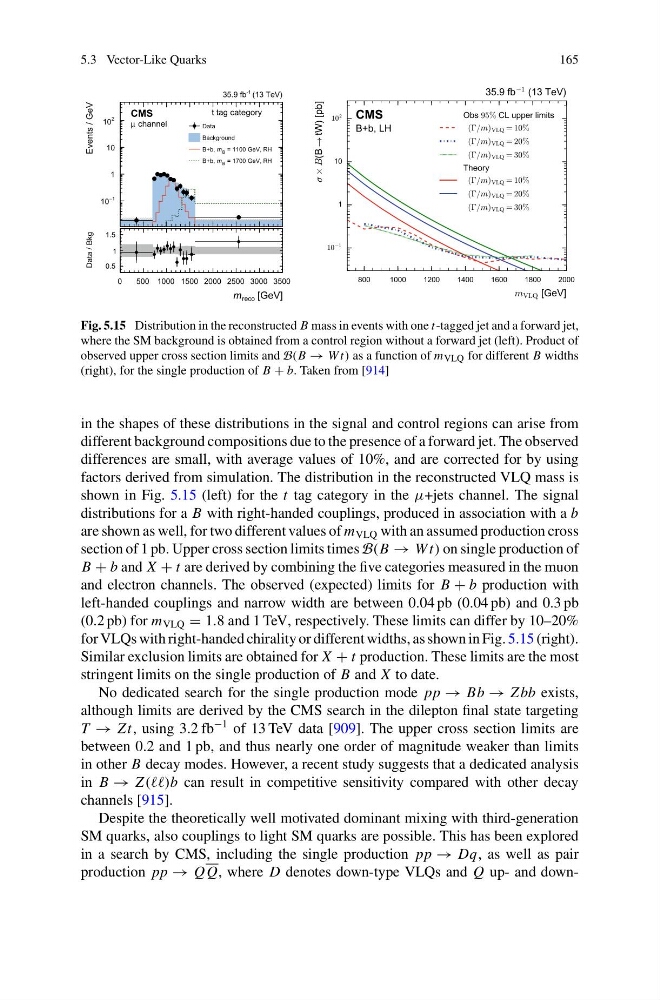
Fig. 5.15 Distribution in the reconstructed B mass in events with one t-tagged jet and a forward jet,
where the SM background is obtained from a control region without a forward jet (left). Product of
observed upper cross section limits and B(B → W t) as a function of m VLQ for different B widths
(right), for the single production of B + b. Taken from [914]
in the shapes of these distributions in the signal and control regions can arise from
different background compositions due to the presence of a forward jet. The observed
differences are small, with average values of 10%, and are corrected for by using
factors derived from simulation. The distribution in the reconstructed VLQ mass is
shown in Fig. 5.15 (left) for the t tag category in the μ+jets channel. The signal
distributions for a B with right-handed couplings, produced in association with a b
are shown as well, for two different values of m VLQ with an assumed production cross
section of 1 pb. Upper cross section limits times B(B → W t) on single production of
B + b and X + t are derived by combining the five categories measured in the muon
and electron channels. The observed (expected) limits for B + b production with
left-handed couplings and narrow width are between 0.04 pb (0.04 pb) and 0.3 pb
(0.2 pb) for m VLQ = 1.8 and 1 TeV, respectively. These limits can differ by 10–20%
for VLQs with right-handed chirality or different widths, as shown in Fig. 5.15 (right).
Similar exclusion limits are obtained for X + t production. These limits are the most
stringent limits on the single production of B and X to date.
No dedicated search for the single production mode pp → Bb → Zbb exists,
although limits are derived by the CMS search in the dilepton final state targeting
T → Zt, using 3.2 fb
−1 of 13 TeV data [909]. The upper cross section limits are
between 0.2 and 1 pb, and thus nearly one order of magnitude weaker than limits
in other B decay modes. However, a recent study suggests that a dedicated analysis
in B → Z ((()b can result in competitive sensitivity compared with other decay
channels [915].
Despite the theoretically well motivated dominant mixing with third-generation
SM quarks, also couplings to light SM quarks are possible. This has been explored
in a search by CMS, including the single production pp → Dq, as well as pair
production pp → Q Q, where D denotes down-type VLQs and Q up- and down-
165
t tag category
Data
Background
= 1100 GeV, RH
B
m
B+b,
= 1700 GeV, RH
B
m
B+b,
channel
μ
CMS
[GeV]
reco
m
0
500 1000 1500 2000 2500 3000 3500
(13 TeV)
-1
35.9 fb
Events / GeV
1
−
10
1
10
2
10
Data / Bkg
0.5
1
1.5
Fig. 5.15 Distribution in the reconstructed B mass in events with one t-tagged jet and a forward jet,
where the SM background is obtained from a control region without a forward jet (left). Product of
observed upper cross section limits and B(B → W t) as a function of m VLQ for different B widths
(right), for the single production of B + b. Taken from [914]
in the shapes of these distributions in the signal and control regions can arise from
different background compositions due to the presence of a forward jet. The observed
differences are small, with average values of 10%, and are corrected for by using
factors derived from simulation. The distribution in the reconstructed VLQ mass is
shown in Fig. 5.15 (left) for the t tag category in the μ+jets channel. The signal
distributions for a B with right-handed couplings, produced in association with a b
are shown as well, for two different values of m VLQ with an assumed production cross
section of 1 pb. Upper cross section limits times B(B → W t) on single production of
B + b and X + t are derived by combining the five categories measured in the muon
and electron channels. The observed (expected) limits for B + b production with
left-handed couplings and narrow width are between 0.04 pb (0.04 pb) and 0.3 pb
(0.2 pb) for m VLQ = 1.8 and 1 TeV, respectively. These limits can differ by 10–20%
for VLQs with right-handed chirality or different widths, as shown in Fig. 5.15 (right).
Similar exclusion limits are obtained for X + t production. These limits are the most
stringent limits on the single production of B and X to date.
No dedicated search for the single production mode pp → Bb → Zbb exists,
although limits are derived by the CMS search in the dilepton final state targeting
T → Zt, using 3.2 fb
−1 of 13 TeV data [909]. The upper cross section limits are
between 0.2 and 1 pb, and thus nearly one order of magnitude weaker than limits
in other B decay modes. However, a recent study suggests that a dedicated analysis
in B → Z ((()b can result in competitive sensitivity compared with other decay
channels [915].
Despite the theoretically well motivated dominant mixing with third-generation
SM quarks, also couplings to light SM quarks are possible. This has been explored
in a search by CMS, including the single production pp → Dq, as well as pair
production pp → Q Q, where D denotes down-type VLQs and Q up- and down-