

90
5 Sampling
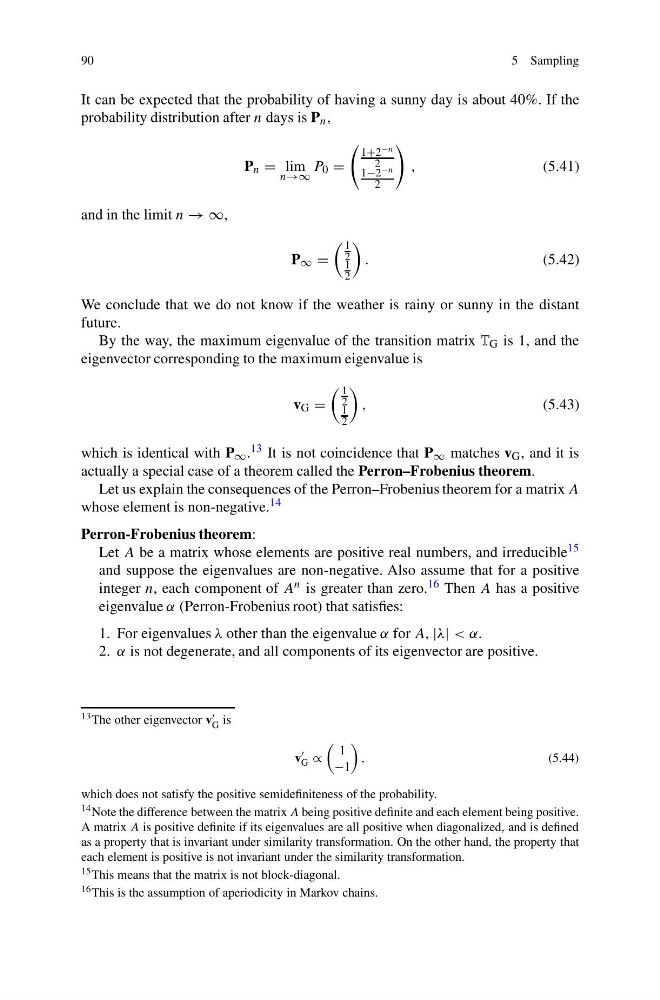
It can be expected that the probability of having a sunny day is about 40%. If the
probability distribution after n days is P n ,
P n = lim
n→∞
P 0 =
1+2 −n
2
1−2 −n
2
,
(5.41)
and in the limit n → ∞,
P ∞ =
1
2
1
2
.
(5.42)
We conclude that we do not know if the weather is rainy or sunny in the distant
future.
By the way, the maximum eigenvalue of the transition matrix T G is 1, and the
eigenvector corresponding to the maximum eigenvalue is
v G =
1
2
1
2
,
(5.43)
which is identical with P ∞ . 13 It is not coincidence that P ∞ matches v G , and it is
actually a special case of a theorem called the Perron–Frobenius theorem.
Let us explain the consequences of the Perron–Frobenius theorem for a matrix A
whose element is non-negative. 14
Perron-Frobenius theorem:
Let A be a matrix whose elements are positive real numbers, and irreducible 15
and suppose the eigenvalues are non-negative. Also assume that for a positive
integer n, each component of A n is greater than zero. 16 Then A has a positive
eigenvalue α (Perron-Frobenius root) that satisfies:
1. For eigenvalues λ other than the eigenvalue α for A, |λ| < α.
2. α is not degenerate, and all components of its eigenvector are positive.
13 The other eigenvector v
G is
v
G ∝
1
−1
,
(5.44)
which does not satisfy the positive semidefiniteness of the probability.
14 Note the difference between the matrix A being positive definite and each element being positive.
A matrix A is positive definite if its eigenvalues are all positive when diagonalized, and is defined
as a property that is invariant under similarity transformation. On the other hand, the property that
each element is positive is not invariant under the similarity transformation.
15 This means that the matrix is not block-diagonal.
16 This is the assumption of aperiodicity in Markov chains.
5 Sampling
It can be expected that the probability of having a sunny day is about 40%. If the
probability distribution after n days is P n ,
P n = lim
n→∞
P 0 =
1+2 −n
2
1−2 −n
2
,
(5.41)
and in the limit n → ∞,
P ∞ =
1
2
1
2
.
(5.42)
We conclude that we do not know if the weather is rainy or sunny in the distant
future.
By the way, the maximum eigenvalue of the transition matrix T G is 1, and the
eigenvector corresponding to the maximum eigenvalue is
v G =
1
2
1
2
,
(5.43)
which is identical with P ∞ . 13 It is not coincidence that P ∞ matches v G , and it is
actually a special case of a theorem called the Perron–Frobenius theorem.
Let us explain the consequences of the Perron–Frobenius theorem for a matrix A
whose element is non-negative. 14
Perron-Frobenius theorem:
Let A be a matrix whose elements are positive real numbers, and irreducible 15
and suppose the eigenvalues are non-negative. Also assume that for a positive
integer n, each component of A n is greater than zero. 16 Then A has a positive
eigenvalue α (Perron-Frobenius root) that satisfies:
1. For eigenvalues λ other than the eigenvalue α for A, |λ| < α.
2. α is not degenerate, and all components of its eigenvector are positive.
13 The other eigenvector v
G is
v
G ∝
1
−1
,
(5.44)
which does not satisfy the positive semidefiniteness of the probability.
14 Note the difference between the matrix A being positive definite and each element being positive.
A matrix A is positive definite if its eigenvalues are all positive when diagonalized, and is defined
as a property that is invariant under similarity transformation. On the other hand, the property that
each element is positive is not invariant under the similarity transformation.
15 This means that the matrix is not block-diagonal.
16 This is the assumption of aperiodicity in Markov chains.