

5.2 Various Sampling Methods
91
In the previous example, the probability distribution of n → ∞ and the
eigenvector of T G matched because of the first property. When multiplying T G
many times, the non-degenerate eigenvector belonging to the largest eigenvalue is
extracted. 17 The components of the eigenvector are positive and can be interpreted
as a probability distribution, all of which are guaranteed by the Perron-Frobenius
theorem.
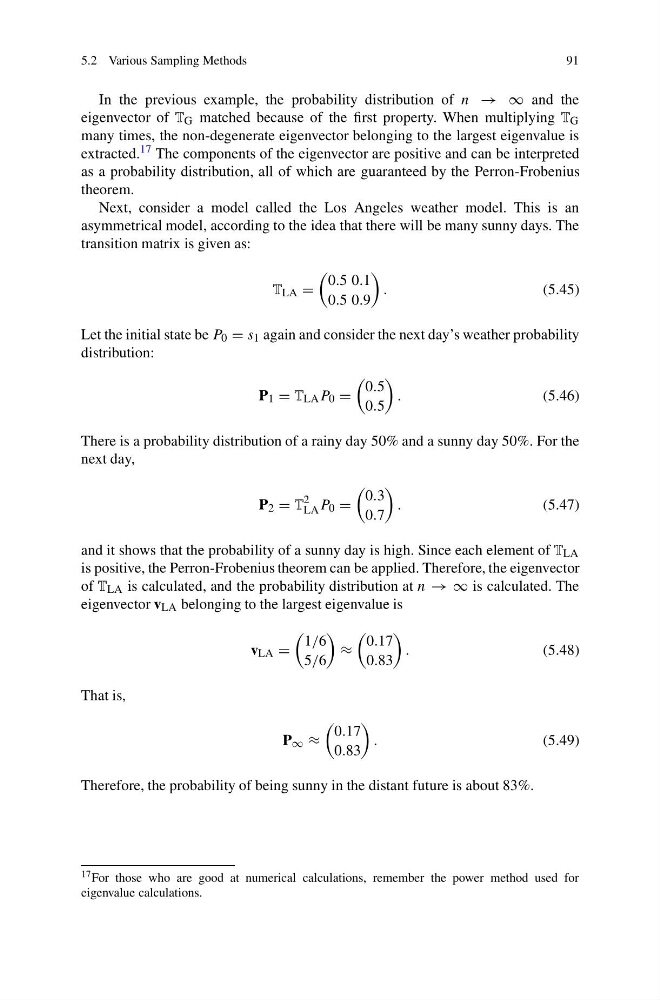
Next, consider a model called the Los Angeles weather model. This is an
asymmetrical model, according to the idea that there will be many sunny days. The
transition matrix is given as:
T LA =
0.5 0.1
0.5 0.9
.
(5.45)
Let the initial state be P 0 = s 1 again and consider the next day’s weather probability
distribution:
P 1 = T LA P 0 =
0.5
0.5
.
(5.46)
There is a probability distribution of a rainy day 50% and a sunny day 50%. For the
next day,
P 2 = T
2
LA P 0 =
0.3
0.7
.
(5.47)
and it shows that the probability of a sunny day is high. Since each element of T LA
is positive, the Perron-Frobenius theorem can be applied. Therefore, the eigenvector
of T LA is calculated, and the probability distribution at n → ∞ is calculated. The
eigenvector v LA belonging to the largest eigenvalue is
v LA =
1/6
5/6
≈
0.17
0.83
.
(5.48)
That is,
P ∞ ≈
0.17
0.83
.
(5.49)
Therefore, the probability of being sunny in the distant future is about 83%.
17 For those who are good at numerical calculations, remember the power method used for
eigenvalue calculations.
91
In the previous example, the probability distribution of n → ∞ and the
eigenvector of T G matched because of the first property. When multiplying T G
many times, the non-degenerate eigenvector belonging to the largest eigenvalue is
extracted. 17 The components of the eigenvector are positive and can be interpreted
as a probability distribution, all of which are guaranteed by the Perron-Frobenius
theorem.
Next, consider a model called the Los Angeles weather model. This is an
asymmetrical model, according to the idea that there will be many sunny days. The
transition matrix is given as:
T LA =
0.5 0.1
0.5 0.9
.
(5.45)
Let the initial state be P 0 = s 1 again and consider the next day’s weather probability
distribution:
P 1 = T LA P 0 =
0.5
0.5
.
(5.46)
There is a probability distribution of a rainy day 50% and a sunny day 50%. For the
next day,
P 2 = T
2
LA P 0 =
0.3
0.7
.
(5.47)
and it shows that the probability of a sunny day is high. Since each element of T LA
is positive, the Perron-Frobenius theorem can be applied. Therefore, the eigenvector
of T LA is calculated, and the probability distribution at n → ∞ is calculated. The
eigenvector v LA belonging to the largest eigenvalue is
v LA =
1/6
5/6
≈
0.17
0.83
.
(5.48)
That is,
P ∞ ≈
0.17
0.83
.
(5.49)
Therefore, the probability of being sunny in the distant future is about 83%.
17 For those who are good at numerical calculations, remember the power method used for
eigenvalue calculations.