

184
12 Application to Superstring Theory
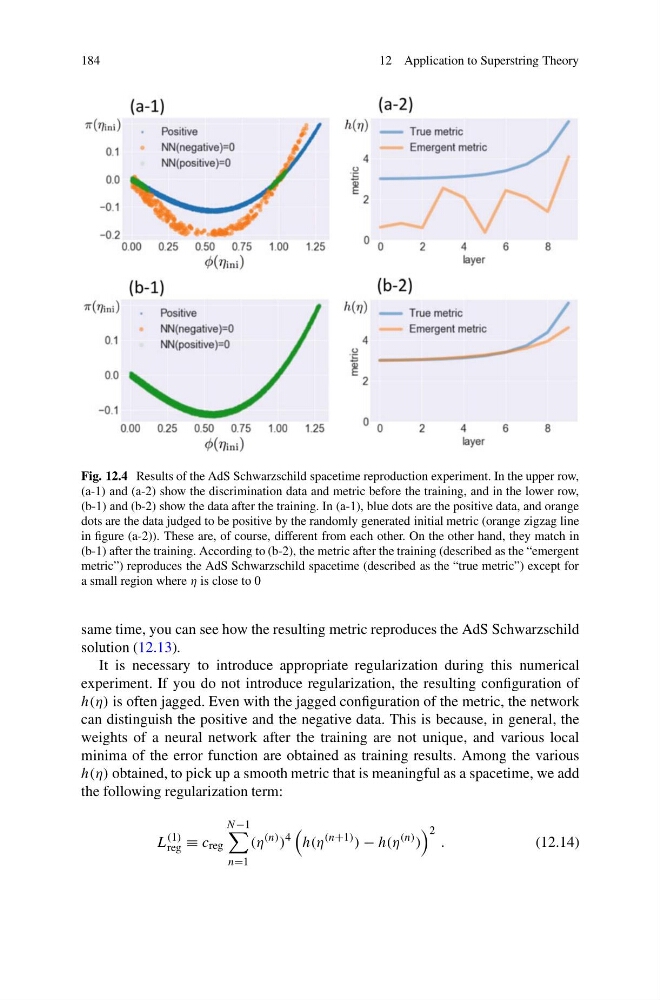
Fig. 12.4 Results of the AdS Schwarzschild spacetime reproduction experiment. In the upper row,
(a-1) and (a-2) show the discrimination data and metric before the training, and in the lower row,
(b-1) and (b-2) show the data after the training. In (a-1), blue dots are the positive data, and orange
dots are the data judged to be positive by the randomly generated initial metric (orange zigzag line
in figure (a-2)). These are, of course, different from each other. On the other hand, they match in
(b-1) after the training. According to (b-2), the metric after the training (described as the “emergent
metric”) reproduces the AdS Schwarzschild spacetime (described as the “true metric”) except for
a small region where η is close to 0
same time, you can see how the resulting metric reproduces the AdS Schwarzschild
solution (12.13).
It is necessary to introduce appropriate regularization during this numerical
experiment. If you do not introduce regularization, the resulting configuration of
h(η) is often jagged. Even with the jagged configuration of the metric, the network
can distinguish the positive and the negative data. This is because, in general, the
weights of a neural network after the training are not unique, and various local
minima of the error function are obtained as training results. Among the various
h(η) obtained, to pick up a smooth metric that is meaningful as a spacetime, we add
the following regularization term:
L
(1)
reg ≡ c reg
N−1
n=1
(η
(n) )
4
h(η
(n+1) ) − h(η
(n) )
2
.
(12.14)
12 Application to Superstring Theory
Fig. 12.4 Results of the AdS Schwarzschild spacetime reproduction experiment. In the upper row,
(a-1) and (a-2) show the discrimination data and metric before the training, and in the lower row,
(b-1) and (b-2) show the data after the training. In (a-1), blue dots are the positive data, and orange
dots are the data judged to be positive by the randomly generated initial metric (orange zigzag line
in figure (a-2)). These are, of course, different from each other. On the other hand, they match in
(b-1) after the training. According to (b-2), the metric after the training (described as the “emergent
metric”) reproduces the AdS Schwarzschild spacetime (described as the “true metric”) except for
a small region where η is close to 0
same time, you can see how the resulting metric reproduces the AdS Schwarzschild
solution (12.13).
It is necessary to introduce appropriate regularization during this numerical
experiment. If you do not introduce regularization, the resulting configuration of
h(η) is often jagged. Even with the jagged configuration of the metric, the network
can distinguish the positive and the negative data. This is because, in general, the
weights of a neural network after the training are not unique, and various local
minima of the error function are obtained as training results. Among the various
h(η) obtained, to pick up a smooth metric that is meaningful as a spacetime, we add
the following regularization term:
L
(1)
reg ≡ c reg
N−1
n=1
(η
(n) )
4
h(η
(n+1) ) − h(η
(n) )
2
.
(12.14)