

12.3 Emergent Spacetime on Neural Networks
185
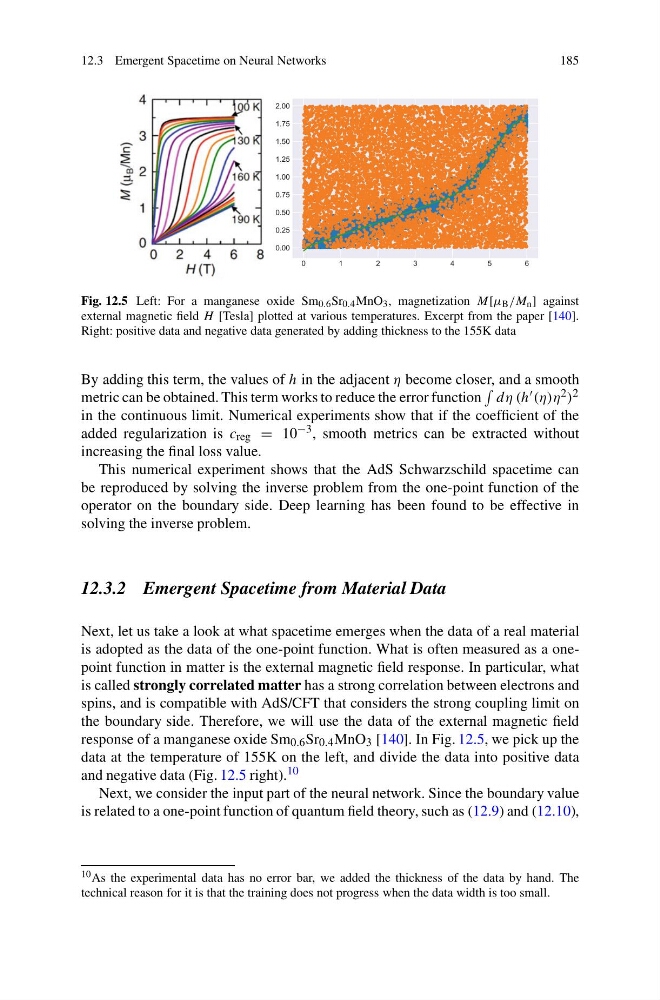
Fig. 12.5 Left: For a manganese oxide Sm 0.6 Sr 0.4 MnO 3 , magnetization M[μ B /M n ] against
external magnetic field H [Tesla] plotted at various temperatures. Excerpt from the paper [140].
Right: positive data and negative data generated by adding thickness to the 155K data
By adding this term, the values of h in the adjacent η become closer, and a smooth
metric can be obtained. This term works to reduce the error function
dη (h (η)η 2 ) 2
in the continuous limit. Numerical experiments show that if the coefficient of the
added regularization is c reg = 10 −3 , smooth metrics can be extracted without
increasing the final loss value.
This numerical experiment shows that the AdS Schwarzschild spacetime can
be reproduced by solving the inverse problem from the one-point function of the
operator on the boundary side. Deep learning has been found to be effective in
solving the inverse problem.
12.3.2 Emergent Spacetime from Material Data
Next, let us take a look at what spacetime emerges when the data of a real material
is adopted as the data of the one-point function. What is often measured as a onepoint function in matter is the external magnetic field response. In particular, what
is called strongly correlated matter has a strong correlation between electrons and
spins, and is compatible with AdS/CFT that considers the strong coupling limit on
the boundary side. Therefore, we will use the data of the external magnetic field
response of a manganese oxide Sm 0.6 Sr 0.4 MnO 3 [140]. In Fig. 12.5, we pick up the
data at the temperature of 155K on the left, and divide the data into positive data
and negative data (Fig. 12.5 right). 10
Next, we consider the input part of the neural network. Since the boundary value
is related to a one-point function of quantum field theory, such as (12.9) and (12.10),
10 As the experimental data has no error bar, we added the thickness of the data by hand. The
technical reason for it is that the training does not progress when the data width is too small.
185
Fig. 12.5 Left: For a manganese oxide Sm 0.6 Sr 0.4 MnO 3 , magnetization M[μ B /M n ] against
external magnetic field H [Tesla] plotted at various temperatures. Excerpt from the paper [140].
Right: positive data and negative data generated by adding thickness to the 155K data
By adding this term, the values of h in the adjacent η become closer, and a smooth
metric can be obtained. This term works to reduce the error function
dη (h (η)η 2 ) 2
in the continuous limit. Numerical experiments show that if the coefficient of the
added regularization is c reg = 10 −3 , smooth metrics can be extracted without
increasing the final loss value.
This numerical experiment shows that the AdS Schwarzschild spacetime can
be reproduced by solving the inverse problem from the one-point function of the
operator on the boundary side. Deep learning has been found to be effective in
solving the inverse problem.
12.3.2 Emergent Spacetime from Material Data
Next, let us take a look at what spacetime emerges when the data of a real material
is adopted as the data of the one-point function. What is often measured as a onepoint function in matter is the external magnetic field response. In particular, what
is called strongly correlated matter has a strong correlation between electrons and
spins, and is compatible with AdS/CFT that considers the strong coupling limit on
the boundary side. Therefore, we will use the data of the external magnetic field
response of a manganese oxide Sm 0.6 Sr 0.4 MnO 3 [140]. In Fig. 12.5, we pick up the
data at the temperature of 155K on the left, and divide the data into positive data
and negative data (Fig. 12.5 right). 10
Next, we consider the input part of the neural network. Since the boundary value
is related to a one-point function of quantum field theory, such as (12.9) and (12.10),
10 As the experimental data has no error bar, we added the thickness of the data by hand. The
technical reason for it is that the training does not progress when the data width is too small.