

66
agricultural machinery, consumables and energy consumption in the ethanol distillery plant, as well as the distance traveled in the intermediary transportation stages
when collecting the sugarcane feedstock in the farmland and distributing ethanol to
filling stations. In the utilization stage, data accounts for the fleet typology and
mobility behavior that reflect the fuel consumption and emission patterns of the
national vehicle fleet in Brazil.
The data was collected based on local and regional specificities of Brazilian reality. Data related to farming and processing stages, as well as fuel utilization in
vehicle, was collected during the field survey conducted in March 2009 and related
literature. Data referring to auxiliary processes, namely, agrochemical and other
consumable production, was obtained in the ecoinvent database (Stutter 2006).
6.3.4 Life Cycle Impact Assessment
In the life cycle impact assessment (LCIA), the GHG emission and nonrenewable
energy (NRE) consumption impact categories have been evaluated. The GHG is
calculated as carbon dioxide equivalents (CO 2e ), being carbon dioxide along with
methane and nitrous oxide the greatest anthropogenic contributors. Global warming
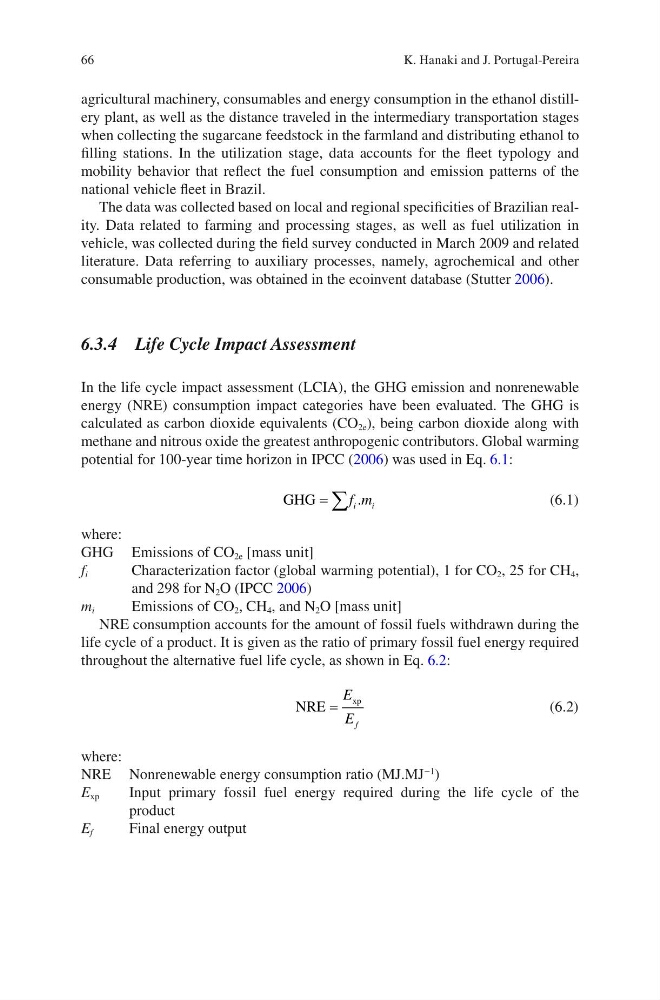
potential for 100-year time horizon in IPCC (2006) was used in Eq. 6.1:
GHG = å f m
i
i
.
(6.1)
where:
GHG Emissions of CO 2e [mass unit]
f i
Characterization factor (global warming potential), 1 for CO 2 , 25 for CH 4 ,
and 298 for N 2 O (IPCC 2006)
m i
Emissions of CO 2 , CH 4 , and N 2 O [mass unit]
NRE consumption accounts for the amount of fossil fuels withdrawn during the
life cycle of a product. It is given as the ratio of primary fossil fuel energy required
throughout the alternative fuel life cycle, as shown in Eq. 6.2:
NRE
xp
=
E
E f
(6.2)
where:
NRE Nonrenewable energy consumption ratio (MJ.MJ
−1
)
E xp
Input primary fossil fuel energy required during the life cycle of the
product
E f
Final energy output
K. Hanaki and J. Portugal-Pereira
agricultural machinery, consumables and energy consumption in the ethanol distillery plant, as well as the distance traveled in the intermediary transportation stages
when collecting the sugarcane feedstock in the farmland and distributing ethanol to
filling stations. In the utilization stage, data accounts for the fleet typology and
mobility behavior that reflect the fuel consumption and emission patterns of the
national vehicle fleet in Brazil.
The data was collected based on local and regional specificities of Brazilian reality. Data related to farming and processing stages, as well as fuel utilization in
vehicle, was collected during the field survey conducted in March 2009 and related
literature. Data referring to auxiliary processes, namely, agrochemical and other
consumable production, was obtained in the ecoinvent database (Stutter 2006).
6.3.4 Life Cycle Impact Assessment
In the life cycle impact assessment (LCIA), the GHG emission and nonrenewable
energy (NRE) consumption impact categories have been evaluated. The GHG is
calculated as carbon dioxide equivalents (CO 2e ), being carbon dioxide along with
methane and nitrous oxide the greatest anthropogenic contributors. Global warming
potential for 100-year time horizon in IPCC (2006) was used in Eq. 6.1:
GHG = å f m
i
i
.
(6.1)
where:
GHG Emissions of CO 2e [mass unit]
f i
Characterization factor (global warming potential), 1 for CO 2 , 25 for CH 4 ,
and 298 for N 2 O (IPCC 2006)
m i
Emissions of CO 2 , CH 4 , and N 2 O [mass unit]
NRE consumption accounts for the amount of fossil fuels withdrawn during the
life cycle of a product. It is given as the ratio of primary fossil fuel energy required
throughout the alternative fuel life cycle, as shown in Eq. 6.2:
NRE
xp
=
E
E f
(6.2)
where:
NRE Nonrenewable energy consumption ratio (MJ.MJ
−1
)
E xp
Input primary fossil fuel energy required during the life cycle of the
product
E f
Final energy output
K. Hanaki and J. Portugal-Pereira