

256
gasoline. Sugarcane ethanol has a smaller CF than that of corn ethanol, which is
equivalent to one-fifth of the gasoline GHG emission. This relative advantage of
sugarcane is because the bagasse—a by-product of the sugarcane plant—can be
used as an energy source in ethanol refinery. METI’s Public Notice No.242 (2010)
specifies that CF from bioethanol should be less than 50 % of that from gasoline
(81.7 g-CO 2 eq/MJ).
CF from soybean biodiesel is reported to be approximately half that of conventional diesel. CF from palm oil biodiesel is even smaller than that of soybean biodiesel if we ignore the methane emissions from the conversion of peatland to oil
palm plantations, a common occurrence in Indonesia and Malaysia.
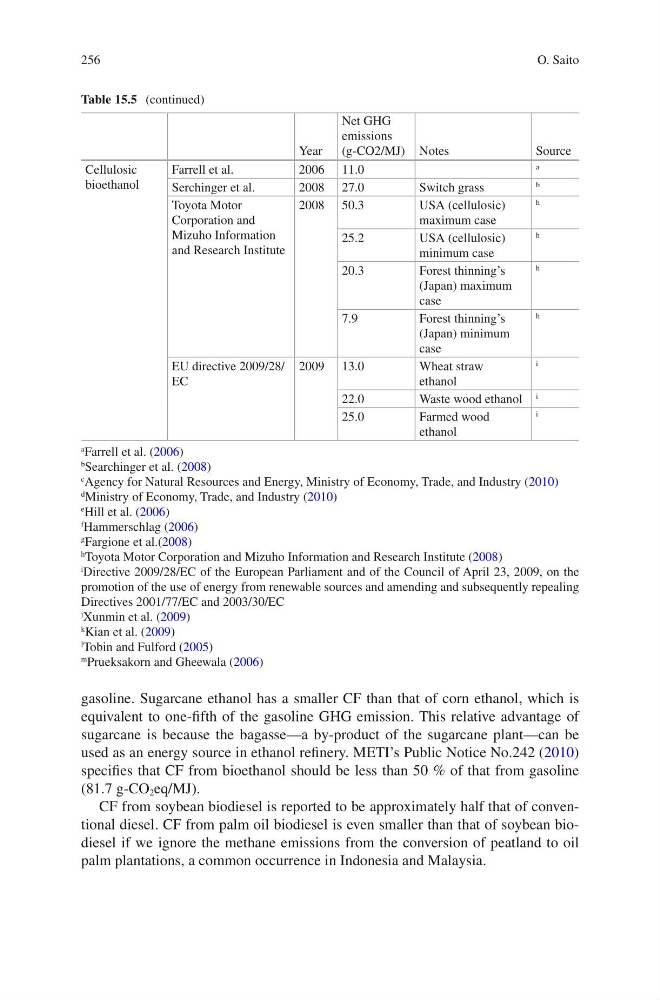
Table 15.5 (continued)
Year
Net GHG
emissions
(g-CO2/MJ) Notes
Source
Cellulosic
bioethanol
Farrell et al.
2006 11.0
a
Serchinger et al.
2008 27.0
Switch grass
b
Toyota Motor
Corporation and
Mizuho Information
and Research Institute
2008 50.3
USA (cellulosic)
maximum case
h
25.2
USA (cellulosic)
minimum case
h
20.3
Forest thinning’s
(Japan) maximum
case
h
7.9
Forest thinning’s
(Japan) minimum
case
h
EU directive 2009/28/
EC
2009 13.0
Wheat straw
ethanol
i
22.0
Waste wood ethanol
i
25.0
Farmed wood
ethanol
i
a
Farrell et al. (2006)
b
Searchinger et al. (2008)
c
Agency for Natural Resources and Energy, Ministry of Economy, Trade, and Industry (2010)
d
Ministry of Economy, Trade, and Industry (2010)
e
Hill et al. (2006)
f
Hammerschlag (2006)
g
Fargione et al.(2008)
h
Toyota Motor Corporation and Mizuho Information and Research Institute (2008)
i Directive 2009/28/EC of the European Parliament and of the Council of April 23, 2009, on the
promotion of the use of energy from renewable sources and amending and subsequently repealing
Directives 2001/77/EC and 2003/30/EC
j Xunmin et al. (2009)
k
Kian et al. (2009)
l Tobin and Fulford (2005)
m Prueksakorn and Gheewala (2006)
O. Saito
gasoline. Sugarcane ethanol has a smaller CF than that of corn ethanol, which is
equivalent to one-fifth of the gasoline GHG emission. This relative advantage of
sugarcane is because the bagasse—a by-product of the sugarcane plant—can be
used as an energy source in ethanol refinery. METI’s Public Notice No.242 (2010)
specifies that CF from bioethanol should be less than 50 % of that from gasoline
(81.7 g-CO 2 eq/MJ).
CF from soybean biodiesel is reported to be approximately half that of conventional diesel. CF from palm oil biodiesel is even smaller than that of soybean biodiesel if we ignore the methane emissions from the conversion of peatland to oil
palm plantations, a common occurrence in Indonesia and Malaysia.
Table 15.5 (continued)
Year
Net GHG
emissions
(g-CO2/MJ) Notes
Source
Cellulosic
bioethanol
Farrell et al.
2006 11.0
a
Serchinger et al.
2008 27.0
Switch grass
b
Toyota Motor
Corporation and
Mizuho Information
and Research Institute
2008 50.3
USA (cellulosic)
maximum case
h
25.2
USA (cellulosic)
minimum case
h
20.3
Forest thinning’s
(Japan) maximum
case
h
7.9
Forest thinning’s
(Japan) minimum
case
h
EU directive 2009/28/
EC
2009 13.0
Wheat straw
ethanol
i
22.0
Waste wood ethanol
i
25.0
Farmed wood
ethanol
i
a
Farrell et al. (2006)
b
Searchinger et al. (2008)
c
Agency for Natural Resources and Energy, Ministry of Economy, Trade, and Industry (2010)
d
Ministry of Economy, Trade, and Industry (2010)
e
Hill et al. (2006)
f
Hammerschlag (2006)
g
Fargione et al.(2008)
h
Toyota Motor Corporation and Mizuho Information and Research Institute (2008)
i Directive 2009/28/EC of the European Parliament and of the Council of April 23, 2009, on the
promotion of the use of energy from renewable sources and amending and subsequently repealing
Directives 2001/77/EC and 2003/30/EC
j Xunmin et al. (2009)
k
Kian et al. (2009)
l Tobin and Fulford (2005)
m Prueksakorn and Gheewala (2006)
O. Saito