

153
production/consumption chain (11.8%). It must be noted that several individuals
represented organizations that are not directly involved in the palm oil industry but
had a vested interest in the palm oil sector, e.g., “NGOs,” “academics,” “consultancies,” and “investors.” Most of the respondents were affiliated with entities that were
based or were operating in Indonesia, Malaysia, Singapore, and Thailand. Several
more respondents identified their field of operation in the broad region with very
few respondents explicitly stating an affiliation outside Southeast Asia. This is a
good indicator that our sample had some understanding of the specific environmental and socioeconomic conditions surrounding oil palm agriculture in the region.
Finally, 28.3% of the respondents represented organizations that were RSPOcertified with 44% of the rest intending RSPO certification.
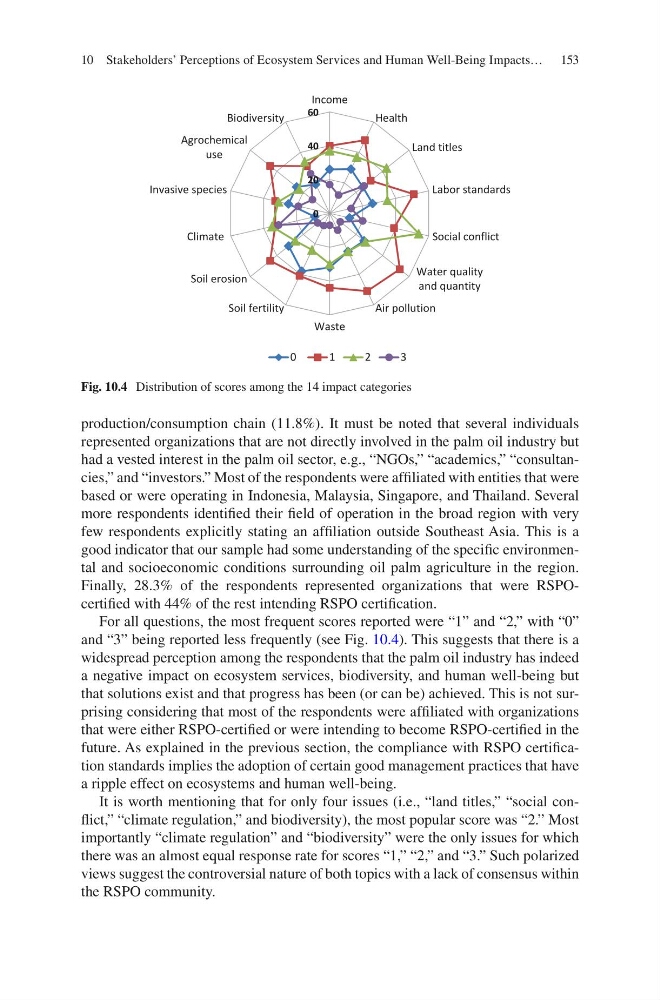
For all questions, the most frequent scores reported were “1” and “2,” with “0”
and “3” being reported less frequently (see Fig. 10.4). This suggests that there is a
widespread perception among the respondents that the palm oil industry has indeed
a negative impact on ecosystem services, biodiversity, and human well-being but
that solutions exist and that progress has been (or can be) achieved. This is not surprising considering that most of the respondents were affiliated with organizations
that were either RSPO-certified or were intending to become RSPO-certified in the
future. As explained in the previous section, the compliance with RSPO certification standards implies the adoption of certain good management practices that have
a ripple effect on ecosystems and human well-being.
It is worth mentioning that for only four issues (i.e., “land titles,” “social conflict,” “climate regulation,” and biodiversity), the most popular score was “2.” Most
importantly “climate regulation” and “biodiversity” were the only issues for which
there was an almost equal response rate for scores “1,” “2,” and “3.” Such polarized
views suggest the controversial nature of both topics with a lack of consensus within
the RSPO community.
0
20
40
60
Income
Health
Land titles
Labor standards
Social conflict
Water quality
and quantity
Air pollution
Waste
Soil fertility
Soil erosion
Climate
Invasive species
Agrochemical
use
Biodiversity
0
1
2
3
Fig. 10.4 Distribution of scores among the 14 impact categories
10 Stakeholders’ Perceptions of Ecosystem Services and Human Well-Being Impacts…
production/consumption chain (11.8%). It must be noted that several individuals
represented organizations that are not directly involved in the palm oil industry but
had a vested interest in the palm oil sector, e.g., “NGOs,” “academics,” “consultancies,” and “investors.” Most of the respondents were affiliated with entities that were
based or were operating in Indonesia, Malaysia, Singapore, and Thailand. Several
more respondents identified their field of operation in the broad region with very
few respondents explicitly stating an affiliation outside Southeast Asia. This is a
good indicator that our sample had some understanding of the specific environmental and socioeconomic conditions surrounding oil palm agriculture in the region.
Finally, 28.3% of the respondents represented organizations that were RSPOcertified with 44% of the rest intending RSPO certification.
For all questions, the most frequent scores reported were “1” and “2,” with “0”
and “3” being reported less frequently (see Fig. 10.4). This suggests that there is a
widespread perception among the respondents that the palm oil industry has indeed
a negative impact on ecosystem services, biodiversity, and human well-being but
that solutions exist and that progress has been (or can be) achieved. This is not surprising considering that most of the respondents were affiliated with organizations
that were either RSPO-certified or were intending to become RSPO-certified in the
future. As explained in the previous section, the compliance with RSPO certification standards implies the adoption of certain good management practices that have
a ripple effect on ecosystems and human well-being.
It is worth mentioning that for only four issues (i.e., “land titles,” “social conflict,” “climate regulation,” and biodiversity), the most popular score was “2.” Most
importantly “climate regulation” and “biodiversity” were the only issues for which
there was an almost equal response rate for scores “1,” “2,” and “3.” Such polarized
views suggest the controversial nature of both topics with a lack of consensus within
the RSPO community.
0
20
40
60
Income
Health
Land titles
Labor standards
Social conflict
Water quality
and quantity
Air pollution
Waste
Soil fertility
Soil erosion
Climate
Invasive species
Agrochemical
use
Biodiversity
0
1
2
3
Fig. 10.4 Distribution of scores among the 14 impact categories
10 Stakeholders’ Perceptions of Ecosystem Services and Human Well-Being Impacts…