

48
By following these guidelines, uncertainty of precipitation measurements remains
within a 25 % deviation from standard observations taken in a flat and open area.
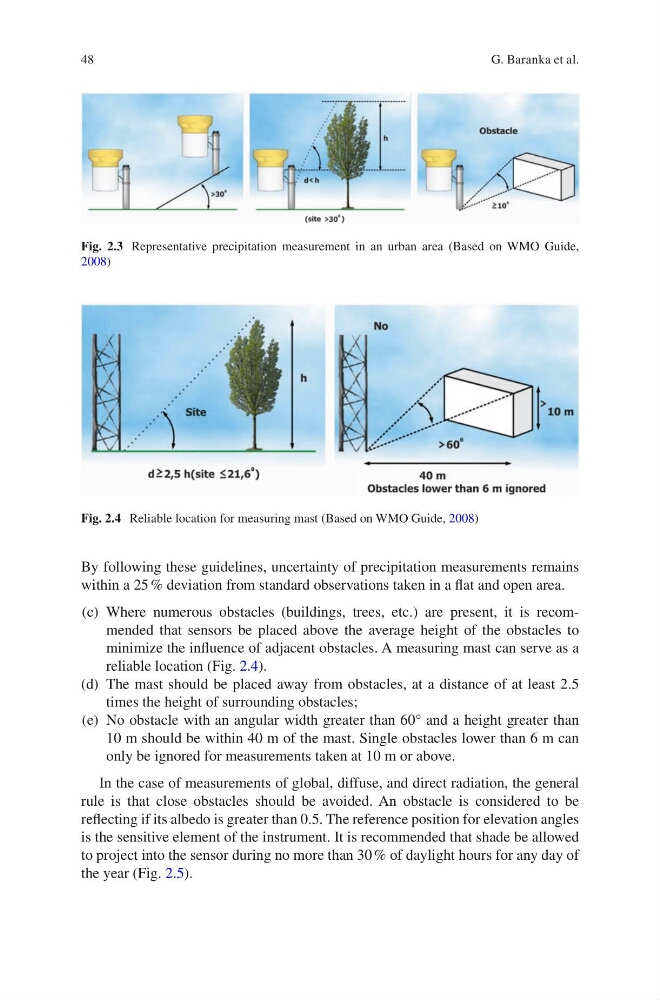
(c) Where numerous obstacles (buildings, trees, etc.) are present, it is recommended that sensors be placed above the average height of the obstacles to
minimize the influence of adjacent obstacles. A measuring mast can serve as a
reliable location (Fig. 2.4).
(d) The mast should be placed away from obstacles, at a distance of at least 2.5
times the height of surrounding obstacles;
(e) No obstacle with an angular width greater than 60° and a height greater than
10 m should be within 40 m of the mast. Single obstacles lower than 6 m can
only be ignored for measurements taken at 10 m or above.
In the case of measurements of global, diffuse, and direct radiation, the general
rule is that close obstacles should be avoided. An obstacle is considered to be
reflecting if its albedo is greater than 0.5. The reference position for elevation angles
is the sensitive element of the instrument. It is recommended that shade be allowed
to project into the sensor during no more than 30 % of daylight hours for any day of
the year (Fig. 2.5).
Fig. 2.3 Representative precipitation measurement in an urban area (Based on WMO Guide,
2008)
Fig. 2.4 Reliable location for measuring mast (Based on WMO Guide, 2008)
G. Baranka et al.
By following these guidelines, uncertainty of precipitation measurements remains
within a 25 % deviation from standard observations taken in a flat and open area.
(c) Where numerous obstacles (buildings, trees, etc.) are present, it is recommended that sensors be placed above the average height of the obstacles to
minimize the influence of adjacent obstacles. A measuring mast can serve as a
reliable location (Fig. 2.4).
(d) The mast should be placed away from obstacles, at a distance of at least 2.5
times the height of surrounding obstacles;
(e) No obstacle with an angular width greater than 60° and a height greater than
10 m should be within 40 m of the mast. Single obstacles lower than 6 m can
only be ignored for measurements taken at 10 m or above.
In the case of measurements of global, diffuse, and direct radiation, the general
rule is that close obstacles should be avoided. An obstacle is considered to be
reflecting if its albedo is greater than 0.5. The reference position for elevation angles
is the sensitive element of the instrument. It is recommended that shade be allowed
to project into the sensor during no more than 30 % of daylight hours for any day of
the year (Fig. 2.5).
Fig. 2.3 Representative precipitation measurement in an urban area (Based on WMO Guide,
2008)
Fig. 2.4 Reliable location for measuring mast (Based on WMO Guide, 2008)
G. Baranka et al.