

47
(a) Obstacles around the screen influence the irradiative balance of the screen. A
screen close to a vertical obstacle may be shaded from the solar radiation, “protected” against the night radiative cooling of the air by receiving the warmer
infrared radiation from this obstacle, or otherwise influenced by reflected
radiation.
(b) Neighboring artificial surfaces may heat the air. Reflective surfaces (e. g., buildings, concrete surfaces, car parks) and water sources (e. g., ponds, lakes, irrigated areas) should be avoided.
Each climate parameter being measured at a site carries its own considerations.
The following requirements represent a good urban observation station, acceptable
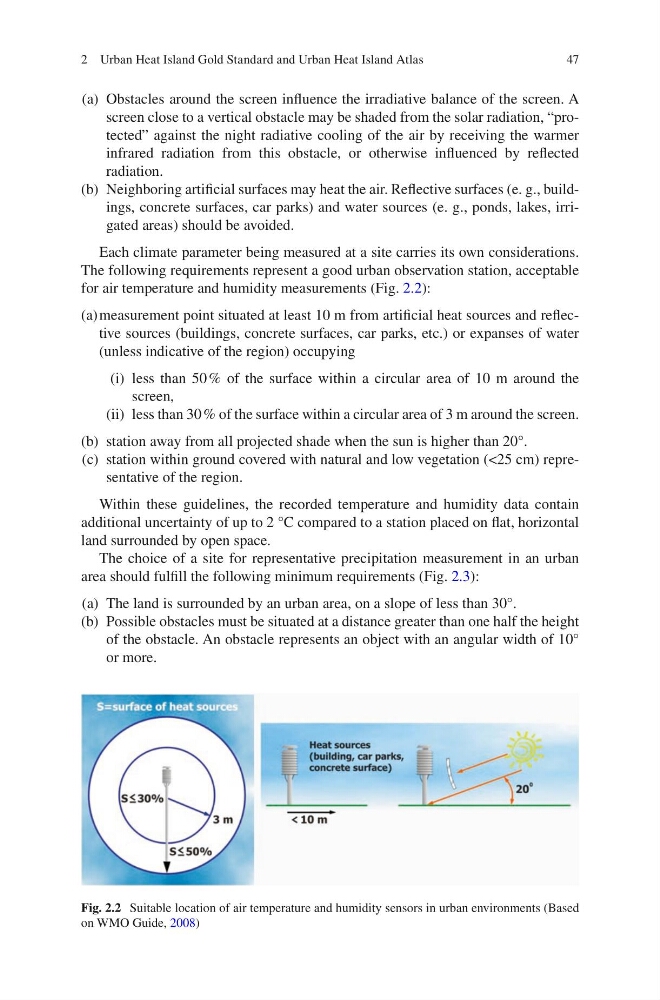
for air temperature and humidity measurements (Fig. 2.2):
(a) measurement point situated at least 10 m from artificial heat sources and reflective sources (buildings, concrete surfaces, car parks, etc.) or expanses of water
(unless indicative of the region) occupying
(i) less than 50 % of the surface within a circular area of 10 m around the
screen,
(ii) less than 30 % of the surface within a circular area of 3 m around the screen.
(b) station away from all projected shade when the sun is higher than 20°.
(c) station within ground covered with natural and low vegetation (<25 cm) representative of the region.
Within these guidelines, the recorded temperature and humidity data contain
additional uncertainty of up to 2 °C compared to a station placed on flat, horizontal
land surrounded by open space.
The choice of a site for representative precipitation measurement in an urban
area should fulfill the following minimum requirements (Fig. 2.3):
(a) The land is surrounded by an urban area, on a slope of less than 30°.
(b) Possible obstacles must be situated at a distance greater than one half the height
of the obstacle. An obstacle represents an object with an angular width of 10°
or more.
Fig. 2.2 Suitable location of air temperature and humidity sensors in urban environments (Based
on WMO Guide, 2008)
2 Urban Heat Island Gold Standard and Urban Heat Island Atlas
(a) Obstacles around the screen influence the irradiative balance of the screen. A
screen close to a vertical obstacle may be shaded from the solar radiation, “protected” against the night radiative cooling of the air by receiving the warmer
infrared radiation from this obstacle, or otherwise influenced by reflected
radiation.
(b) Neighboring artificial surfaces may heat the air. Reflective surfaces (e. g., buildings, concrete surfaces, car parks) and water sources (e. g., ponds, lakes, irrigated areas) should be avoided.
Each climate parameter being measured at a site carries its own considerations.
The following requirements represent a good urban observation station, acceptable
for air temperature and humidity measurements (Fig. 2.2):
(a) measurement point situated at least 10 m from artificial heat sources and reflective sources (buildings, concrete surfaces, car parks, etc.) or expanses of water
(unless indicative of the region) occupying
(i) less than 50 % of the surface within a circular area of 10 m around the
screen,
(ii) less than 30 % of the surface within a circular area of 3 m around the screen.
(b) station away from all projected shade when the sun is higher than 20°.
(c) station within ground covered with natural and low vegetation (<25 cm) representative of the region.
Within these guidelines, the recorded temperature and humidity data contain
additional uncertainty of up to 2 °C compared to a station placed on flat, horizontal
land surrounded by open space.
The choice of a site for representative precipitation measurement in an urban
area should fulfill the following minimum requirements (Fig. 2.3):
(a) The land is surrounded by an urban area, on a slope of less than 30°.
(b) Possible obstacles must be situated at a distance greater than one half the height
of the obstacle. An obstacle represents an object with an angular width of 10°
or more.
Fig. 2.2 Suitable location of air temperature and humidity sensors in urban environments (Based
on WMO Guide, 2008)
2 Urban Heat Island Gold Standard and Urban Heat Island Atlas