

28
RegCM’s boundary layer scheme. However, as RegCM4.2 by default does not consider urban type land-use categories, we extracted the urban land-use information
from the Corine 2006 (EEA 2006) database and we have added this information
to the RegCM4.2 land-use database. In those parts of the domain where this was
not available in Corine data, the GLC2000 (GLC 2000) database was used.
We considered two categories, urban and suburban. See Fig. 1.16 for the urban
land-use coverage for the SUBBATS 1 km × 1 km subgrid module.
The domain for the present study has been selected to cover most of Central
Europe with a spatial resolution of 10 km × 10 km. It is divided into 23 vertical
levels reaching up to 5 hPa. For convection, we have used the Grell scheme (Grell
1993). RegCM4.2 is initialized and driven by the ERA-Interim reanalysis (Simmons
et al. 2007). The time step for the integration is 30 s.
1.3.4.4 Results
Figure 1.17 presents the change of selected meteorological parameters between
experiments SLUCM (the urban canopy model turned on) and NOURBAN (urban
canopy not considered) averaged over years 2005–2009. Shaded areas represent
significant changes on the 95 % confidence level. We show only winter (left panels)
and summer (right panels) seasons, actually, the effect is well expressed in spring
and autumn as well, but summer signal is stronger.
For temperature, there is an evident increase with urban canopy introduced in
summer, for winter only slight signal can be seen for big cities like Berlin and
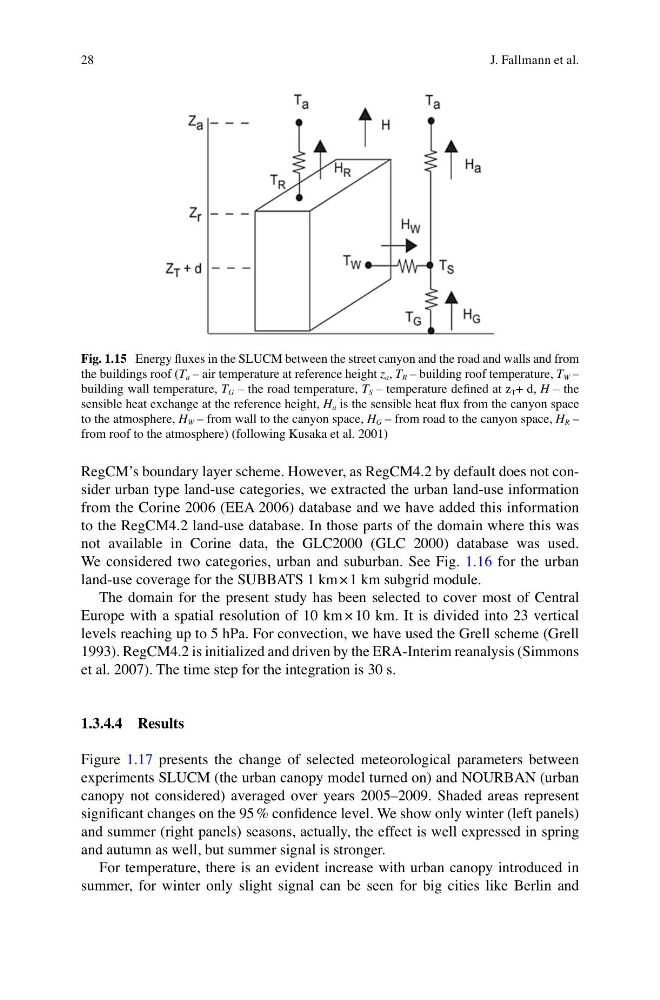
Fig. 1.15 Energy fluxes in the SLUCM between the street canyon and the road and walls and from
the buildings roof (T a – air temperature at reference height z a , T R – building roof temperature, T W –
building wall temperature, T G – the road temperature, T S – temperature defined at z T + d, H – the
sensible heat exchange at the reference height, H a is the sensible heat flux from the canyon space
to the atmosphere, H W – from wall to the canyon space, H G – from road to the canyon space, H R –
from roof to the atmosphere) (following Kusaka et al. 2001)
J. Fallmann et al.
RegCM’s boundary layer scheme. However, as RegCM4.2 by default does not consider urban type land-use categories, we extracted the urban land-use information
from the Corine 2006 (EEA 2006) database and we have added this information
to the RegCM4.2 land-use database. In those parts of the domain where this was
not available in Corine data, the GLC2000 (GLC 2000) database was used.
We considered two categories, urban and suburban. See Fig. 1.16 for the urban
land-use coverage for the SUBBATS 1 km × 1 km subgrid module.
The domain for the present study has been selected to cover most of Central
Europe with a spatial resolution of 10 km × 10 km. It is divided into 23 vertical
levels reaching up to 5 hPa. For convection, we have used the Grell scheme (Grell
1993). RegCM4.2 is initialized and driven by the ERA-Interim reanalysis (Simmons
et al. 2007). The time step for the integration is 30 s.
1.3.4.4 Results
Figure 1.17 presents the change of selected meteorological parameters between
experiments SLUCM (the urban canopy model turned on) and NOURBAN (urban
canopy not considered) averaged over years 2005–2009. Shaded areas represent
significant changes on the 95 % confidence level. We show only winter (left panels)
and summer (right panels) seasons, actually, the effect is well expressed in spring
and autumn as well, but summer signal is stronger.
For temperature, there is an evident increase with urban canopy introduced in
summer, for winter only slight signal can be seen for big cities like Berlin and
Fig. 1.15 Energy fluxes in the SLUCM between the street canyon and the road and walls and from
the buildings roof (T a – air temperature at reference height z a , T R – building roof temperature, T W –
building wall temperature, T G – the road temperature, T S – temperature defined at z T + d, H – the
sensible heat exchange at the reference height, H a is the sensible heat flux from the canyon space
to the atmosphere, H W – from wall to the canyon space, H G – from road to the canyon space, H R –
from roof to the atmosphere) (following Kusaka et al. 2001)
J. Fallmann et al.