

27
sophisticated urban parameterizations lying under these land-surface models that
better represent for the urban land-use type most urban features like building morphology, street geometry, variability of the properties of artificial surfaces, as well
as the description of radiation trapping in the street canyon. For this purpose, Chen
et al. (2010) provide a Single Layer Urban Canopy Model (SLUCM), originally
developed by Kusaka et al. (2001) and applied in Kusaka and Kimura (2004).
This SLUCM model has been implemented into RegCM4.2 by linking it to the
BATS surface scheme, applying SUBBATS with 1 km × 1 km sub-grid resolution.
SLUCM is called within SUBBATS wherever urban land-use categories are recognized in the land-use data supplied. The scheme returns the total sensible heat flux
from the roof/wall/road to BATS, as well as the total momentum flux. The total
friction velocity is aggregated from urban and non-urban surfaces and passed to
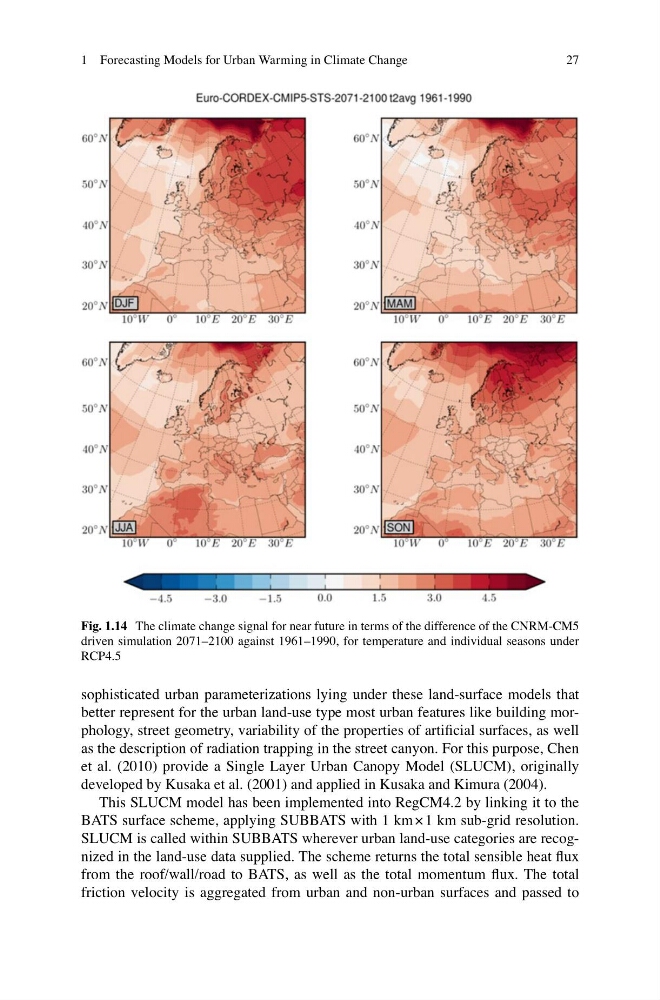
Fig. 1.14 The climate change signal for near future in terms of the difference of the CNRM-CM5
driven simulation 2071–2100 against 1961–1990, for temperature and individual seasons under
RCP4.5
1 Forecasting Models for Urban Warming in Climate Change
sophisticated urban parameterizations lying under these land-surface models that
better represent for the urban land-use type most urban features like building morphology, street geometry, variability of the properties of artificial surfaces, as well
as the description of radiation trapping in the street canyon. For this purpose, Chen
et al. (2010) provide a Single Layer Urban Canopy Model (SLUCM), originally
developed by Kusaka et al. (2001) and applied in Kusaka and Kimura (2004).
This SLUCM model has been implemented into RegCM4.2 by linking it to the
BATS surface scheme, applying SUBBATS with 1 km × 1 km sub-grid resolution.
SLUCM is called within SUBBATS wherever urban land-use categories are recognized in the land-use data supplied. The scheme returns the total sensible heat flux
from the roof/wall/road to BATS, as well as the total momentum flux. The total
friction velocity is aggregated from urban and non-urban surfaces and passed to
Fig. 1.14 The climate change signal for near future in terms of the difference of the CNRM-CM5
driven simulation 2071–2100 against 1961–1990, for temperature and individual seasons under
RCP4.5
1 Forecasting Models for Urban Warming in Climate Change