

328
The area of interest was divided into three zones, with the fi rst being inside the
city ring road, the second a 3 km band from the fi rst, and the third a 2.5 km band
from the second. The zones have been further divided according to land use; we
have grouped the classes into: built up, water, agricultural land, and forest. Build up
and water areas smaller than the resolution of the thermal band (1 ha) were excluded
from the analysis. The fi rst zone was further partitioned to city districts, and the
second and third zones to areas of settlements.
Comparison of temperatures included build up areas of smaller cities close to
Ljubljana (Kranj, Domžale, Kamnik, Grosuplje, and Vrhnika) and some of the
city’s more interesting regions (the centre, industrial areas, business-shopping centres, areas of individual housing, and parks). The impact of water and trees on the
surrounding surface temperature was assessed with profi ling – across the whole city
and through specifi c areas of interest.
We have found that Ljubljana exhibits a distinct urban heat island. Furthermore,
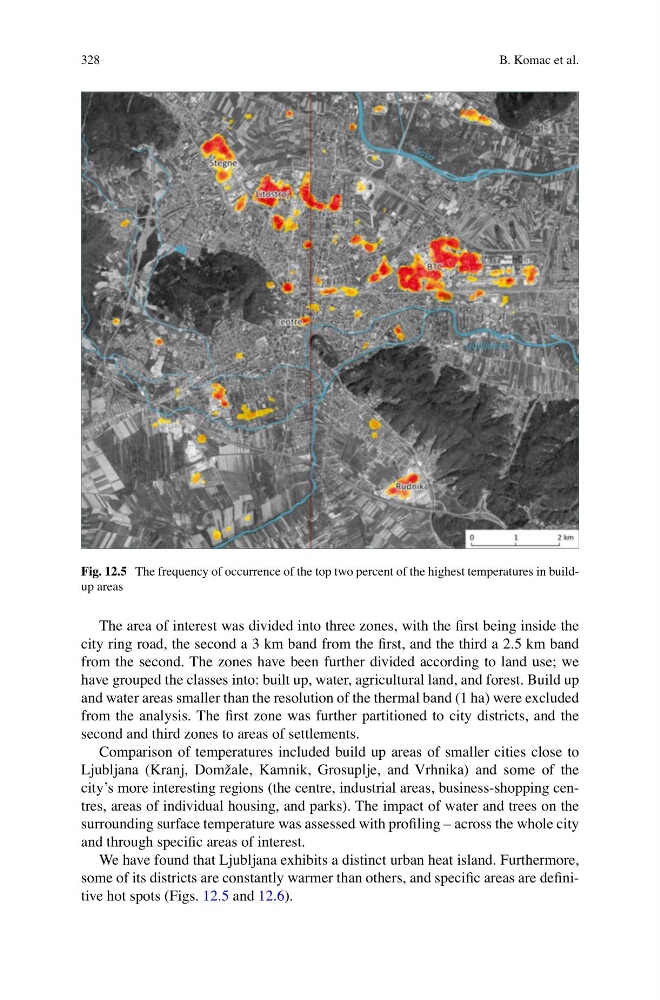
some of its districts are constantly warmer than others, and specifi c areas are defi nitive hot spots (Figs. 12.5 and 12.6 ).
Fig. 12.5 The frequency of occurrence of the top two percent of the highest temperatures in buildup areas
B. Komac et al.
The area of interest was divided into three zones, with the fi rst being inside the
city ring road, the second a 3 km band from the fi rst, and the third a 2.5 km band
from the second. The zones have been further divided according to land use; we
have grouped the classes into: built up, water, agricultural land, and forest. Build up
and water areas smaller than the resolution of the thermal band (1 ha) were excluded
from the analysis. The fi rst zone was further partitioned to city districts, and the
second and third zones to areas of settlements.
Comparison of temperatures included build up areas of smaller cities close to
Ljubljana (Kranj, Domžale, Kamnik, Grosuplje, and Vrhnika) and some of the
city’s more interesting regions (the centre, industrial areas, business-shopping centres, areas of individual housing, and parks). The impact of water and trees on the
surrounding surface temperature was assessed with profi ling – across the whole city
and through specifi c areas of interest.
We have found that Ljubljana exhibits a distinct urban heat island. Furthermore,
some of its districts are constantly warmer than others, and specifi c areas are defi nitive hot spots (Figs. 12.5 and 12.6 ).
Fig. 12.5 The frequency of occurrence of the top two percent of the highest temperatures in buildup areas
B. Komac et al.