

316
11.5 Possibility of Reducing UHI Intensity
For the calculations of the scenarios of the possible UHI reduction, two areas were
chosen – Włodarzewska and Twarda (very city centre). Koło was eliminated because
there was nothing to change and the existing thermal conditions were friendly for
humans.
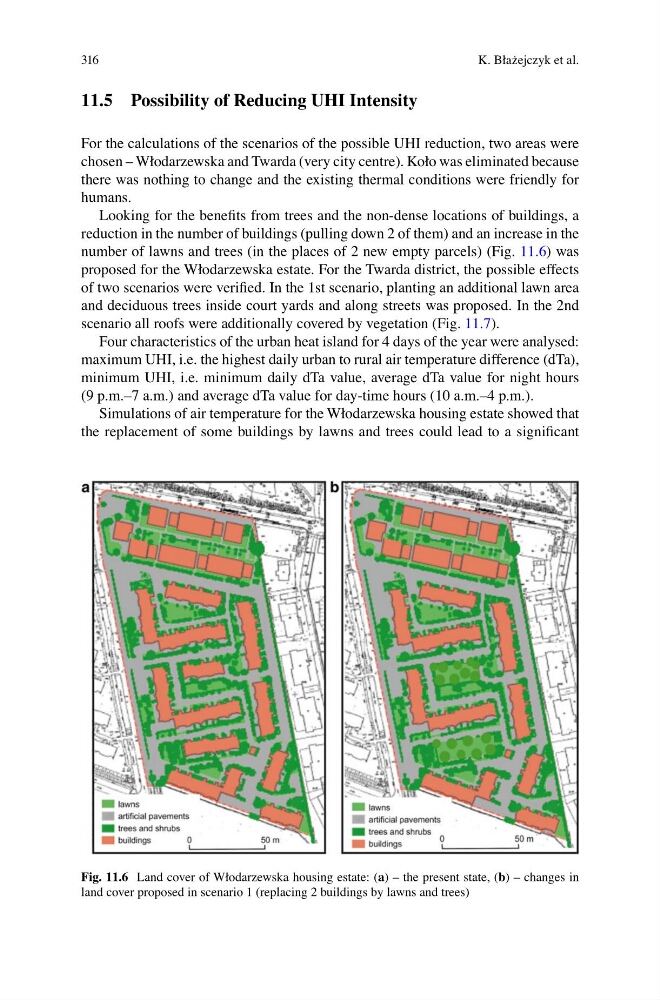
Looking for the benefi ts from trees and the non-dense locations of buildings, a
reduction in the number of buildings (pulling down 2 of them) and an increase in the
number of lawns and trees (in the places of 2 new empty parcels) (Fig. 11.6 ) was
proposed for the Włodarzewska estate. For the Twarda district, the possible effects
of two scenarios were verifi ed. In the 1st scenario, planting an additional lawn area
and deciduous trees inside court yards and along streets was proposed. In the 2nd
scenario all roofs were additionally covered by vegetation (Fig. 11.7 ).
Four characteristics of the urban heat island for 4 days of the year were analysed:
maximum UHI, i.e. the highest daily urban to rural air temperature difference (dTa),
minimum UHI, i.e. minimum daily dTa value, average dTa value for night hours
(9 p.m.–7 a.m.) and average dTa value for day-time hours (10 a.m.–4 p.m.).
Simulations of air temperature for the Włodarzewska housing estate showed that
the replacement of some buildings by lawns and trees could lead to a signifi cant
Fig. 11.6 Land cover of Włodarzewska housing estate: ( a ) – the present state, ( b ) – changes in
land cover proposed in scenario 1 (replacing 2 buildings by lawns and trees)
K. Błażejczyk et al.
11.5 Possibility of Reducing UHI Intensity
For the calculations of the scenarios of the possible UHI reduction, two areas were
chosen – Włodarzewska and Twarda (very city centre). Koło was eliminated because
there was nothing to change and the existing thermal conditions were friendly for
humans.
Looking for the benefi ts from trees and the non-dense locations of buildings, a
reduction in the number of buildings (pulling down 2 of them) and an increase in the
number of lawns and trees (in the places of 2 new empty parcels) (Fig. 11.6 ) was
proposed for the Włodarzewska estate. For the Twarda district, the possible effects
of two scenarios were verifi ed. In the 1st scenario, planting an additional lawn area
and deciduous trees inside court yards and along streets was proposed. In the 2nd
scenario all roofs were additionally covered by vegetation (Fig. 11.7 ).
Four characteristics of the urban heat island for 4 days of the year were analysed:
maximum UHI, i.e. the highest daily urban to rural air temperature difference (dTa),
minimum UHI, i.e. minimum daily dTa value, average dTa value for night hours
(9 p.m.–7 a.m.) and average dTa value for day-time hours (10 a.m.–4 p.m.).
Simulations of air temperature for the Włodarzewska housing estate showed that
the replacement of some buildings by lawns and trees could lead to a signifi cant
Fig. 11.6 Land cover of Włodarzewska housing estate: ( a ) – the present state, ( b ) – changes in
land cover proposed in scenario 1 (replacing 2 buildings by lawns and trees)
K. Błażejczyk et al.