

317
reduction of UHI (Fig. 11.8 ). Maximum and minimum UHI values in spring,
summer and autumn could be lowered by about 0.5 °C, and in winter up to 1 °C. The
proposed land use changes would also cause a reduction of average UHI values,
greater at night than during day-time hours.
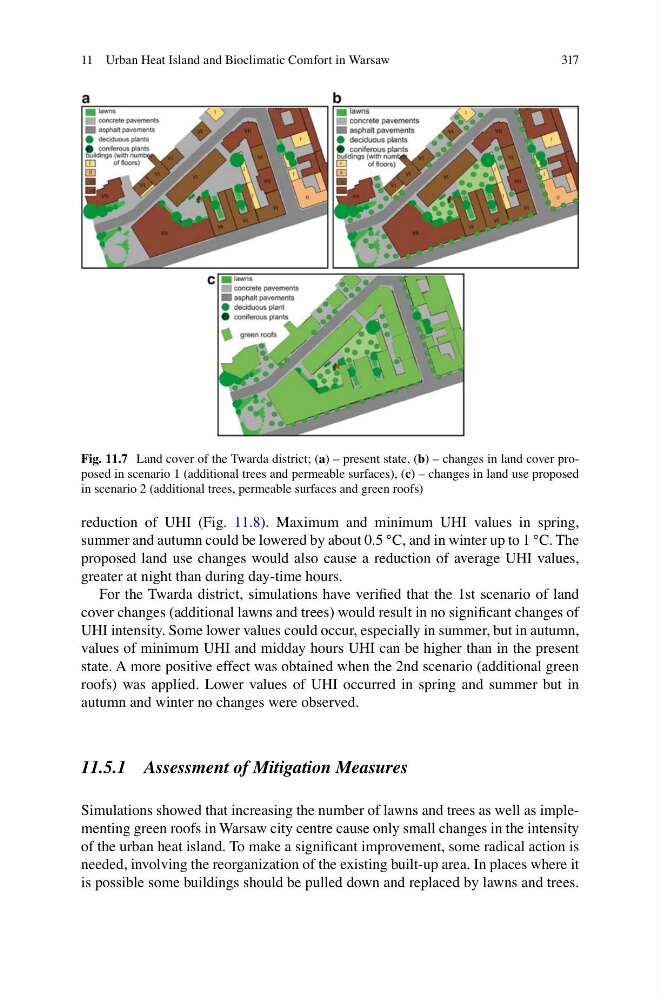
For the Twarda district, simulations have verifi ed that the 1st scenario of land
cover changes (additional lawns and trees) would result in no signifi cant changes of
UHI intensity. Some lower values could occur, especially in summer, but in autumn,
values of minimum UHI and midday hours UHI can be higher than in the present
state. A more positive effect was obtained when the 2nd scenario (additional green
roofs) was applied. Lower values of UHI occurred in spring and summer but in
autumn and winter no changes were observed.
11.5.1 Assessment of Mitigation Measures
Simulations showed that increasing the number of lawns and trees as well as implementing green roofs in Warsaw city centre cause only small changes in the intensity
of the urban heat island. To make a signifi cant improvement, some radical action is
needed, involving the reorganization of the existing built-up area. In places where it
is possible some buildings should be pulled down and replaced by lawns and trees.
Fig. 11.7 Land cover of the Twarda district; ( a ) – present state, ( b ) – changes in land cover proposed in scenario 1 (additional trees and permeable surfaces), ( c ) – changes in land use proposed
in scenario 2 (additional trees, permeable surfaces and green roofs)
11 Urban Heat Island and Bioclimatic Comfort in Warsaw
reduction of UHI (Fig. 11.8 ). Maximum and minimum UHI values in spring,
summer and autumn could be lowered by about 0.5 °C, and in winter up to 1 °C. The
proposed land use changes would also cause a reduction of average UHI values,
greater at night than during day-time hours.
For the Twarda district, simulations have verifi ed that the 1st scenario of land
cover changes (additional lawns and trees) would result in no signifi cant changes of
UHI intensity. Some lower values could occur, especially in summer, but in autumn,
values of minimum UHI and midday hours UHI can be higher than in the present
state. A more positive effect was obtained when the 2nd scenario (additional green
roofs) was applied. Lower values of UHI occurred in spring and summer but in
autumn and winter no changes were observed.
11.5.1 Assessment of Mitigation Measures
Simulations showed that increasing the number of lawns and trees as well as implementing green roofs in Warsaw city centre cause only small changes in the intensity
of the urban heat island. To make a signifi cant improvement, some radical action is
needed, involving the reorganization of the existing built-up area. In places where it
is possible some buildings should be pulled down and replaced by lawns and trees.
Fig. 11.7 Land cover of the Twarda district; ( a ) – present state, ( b ) – changes in land cover proposed in scenario 1 (additional trees and permeable surfaces), ( c ) – changes in land use proposed
in scenario 2 (additional trees, permeable surfaces and green roofs)
11 Urban Heat Island and Bioclimatic Comfort in Warsaw