

291
mean radiant temperature in the whole area is 57 °C; ranging from 23.8 °C to
75.6 °C. The lowest mean radiant temperature was calculated in the shadow of trees
in green areas. The mean radiant temperature is at least 3 K higher in the shadow of
buildings and 45 K higher in sealed courtyards. The mean radiant temperature has
the greatest infl uence on PET in the daytime on a sunny summer day. PET rises up
to 58 °C above sealed surfaces with low albedo, high solar irradiation and low wind
speed. In green areas, PET ranges between 18 and 28 °C in shaded, but does not
exceed 35 °C in unshaded areas. Streets which are parallel to the wind direction
(e. g. Bebel and Bismarck Street), featured lower PET (ΔPET ≤ 10 K) than other
streets (Senefelder Street). The difference in PET between sealed and non-sealed
areas is at least 10 K (Ketterer et al. 2013 ).
10.2.2.2 Micro-scale Simulations
10.2.2.2.1 Surface Types
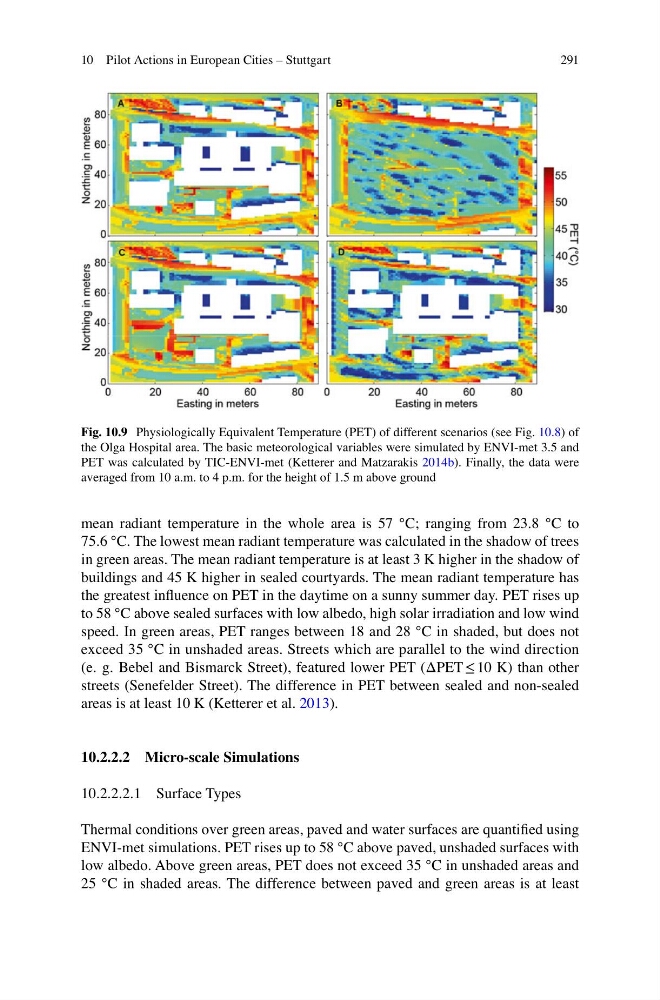
Thermal conditions over green areas, paved and water surfaces are quantifi ed using
ENVI-met simulations. PET rises up to 58 °C above paved, unshaded surfaces with
low albedo. Above green areas, PET does not exceed 35 °C in unshaded areas and
25 °C in shaded areas. The difference between paved and green areas is at least
Fig. 10.9 Physiologically Equivalent Temperature (PET) of different scenarios (see Fig. 10.8 ) of
the Olga Hospital area. The basic meteorological variables were simulated by ENVI-met 3.5 and
PET was calculated by TIC-ENVI-met (Ketterer and Matzarakis 2014b ). Finally, the data were
averaged from 10 a.m. to 4 p.m. for the height of 1.5 m above ground
10 Pilot Actions in European Cities – Stuttgart
mean radiant temperature in the whole area is 57 °C; ranging from 23.8 °C to
75.6 °C. The lowest mean radiant temperature was calculated in the shadow of trees
in green areas. The mean radiant temperature is at least 3 K higher in the shadow of
buildings and 45 K higher in sealed courtyards. The mean radiant temperature has
the greatest infl uence on PET in the daytime on a sunny summer day. PET rises up
to 58 °C above sealed surfaces with low albedo, high solar irradiation and low wind
speed. In green areas, PET ranges between 18 and 28 °C in shaded, but does not
exceed 35 °C in unshaded areas. Streets which are parallel to the wind direction
(e. g. Bebel and Bismarck Street), featured lower PET (ΔPET ≤ 10 K) than other
streets (Senefelder Street). The difference in PET between sealed and non-sealed
areas is at least 10 K (Ketterer et al. 2013 ).
10.2.2.2 Micro-scale Simulations
10.2.2.2.1 Surface Types
Thermal conditions over green areas, paved and water surfaces are quantifi ed using
ENVI-met simulations. PET rises up to 58 °C above paved, unshaded surfaces with
low albedo. Above green areas, PET does not exceed 35 °C in unshaded areas and
25 °C in shaded areas. The difference between paved and green areas is at least
Fig. 10.9 Physiologically Equivalent Temperature (PET) of different scenarios (see Fig. 10.8 ) of
the Olga Hospital area. The basic meteorological variables were simulated by ENVI-met 3.5 and
PET was calculated by TIC-ENVI-met (Ketterer and Matzarakis 2014b ). Finally, the data were
averaged from 10 a.m. to 4 p.m. for the height of 1.5 m above ground
10 Pilot Actions in European Cities – Stuttgart