

292
10 K. Considering the assessment scale of Matzarakis and Mayer ( 1996 ), the thermal stress can be reduced from strong heat stress above paved surfaces to light heat
stress above green surfaces (Fig. 10.9 ).
The installation of a small pond has no signifi cant impact on the spatial average
of the studied Olga Hospital area, but a local impact on the air temperature. Air
temperature is decreased due to the smaller Bowen ratio and enhanced latent heat
fl ux. Additionally, water has a very high specifi c heat capacity. However, small and
shallow water surfaces heat up relatively fast, so that they can have a warming effect
during evenings and nights in mid-summer as well as in early autumn.
ENVI-met simulations of the current scenario with the Olga Hospital and for a
scenario with a park were done for a calm, hot summer day and compared for 14
LST. The specially averaged PET value decreases by 2.6 K in the park scenario. The
wind speed increases due to lower roughness in the lee (east) side of the park and
decreases PET, too. The PET value was decreased by maximum 7.0 K an on average
by 1.7 K in the street east of the park. On the streets in the north and south of the park,
PET is 0.4 and 0.8 K lower than in the current state. A park with a continuous green
area is 1–20 K PET colder then green areas on the built-up area. The more trees in a
park, the cooler PET on a hot summer day and the smaller the diurnal amplitude
of the temperature. However, the air temperature differences between different
scenarios are below 2 °C (Ketterer et al. 2013 ; Ketterer and Matzarakis 2014b ).
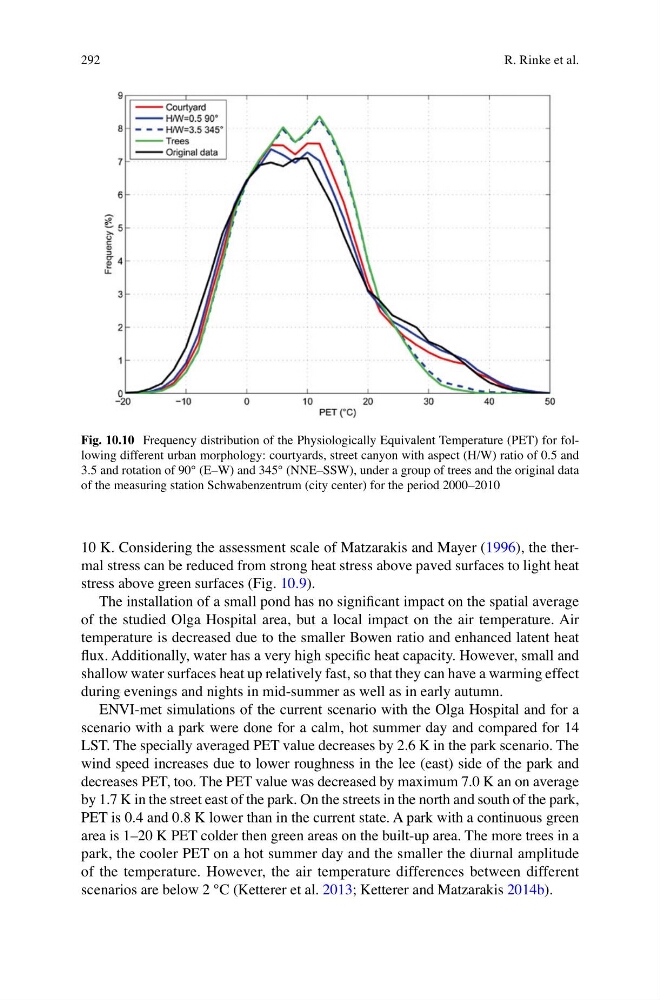
Fig. 10.10 Frequency distribution of the Physiologically Equivalent Temperature (PET) for following different urban morphology: courtyards, street canyon with aspect (H/W) ratio of 0.5 and
3.5 and rotation of 90° (E–W) and 345° (NNE–SSW), under a group of trees and the original data
of the measuring station Schwabenzentrum (city center) for the period 2000–2010
R. Rinke et al.
10 K. Considering the assessment scale of Matzarakis and Mayer ( 1996 ), the thermal stress can be reduced from strong heat stress above paved surfaces to light heat
stress above green surfaces (Fig. 10.9 ).
The installation of a small pond has no signifi cant impact on the spatial average
of the studied Olga Hospital area, but a local impact on the air temperature. Air
temperature is decreased due to the smaller Bowen ratio and enhanced latent heat
fl ux. Additionally, water has a very high specifi c heat capacity. However, small and
shallow water surfaces heat up relatively fast, so that they can have a warming effect
during evenings and nights in mid-summer as well as in early autumn.
ENVI-met simulations of the current scenario with the Olga Hospital and for a
scenario with a park were done for a calm, hot summer day and compared for 14
LST. The specially averaged PET value decreases by 2.6 K in the park scenario. The
wind speed increases due to lower roughness in the lee (east) side of the park and
decreases PET, too. The PET value was decreased by maximum 7.0 K an on average
by 1.7 K in the street east of the park. On the streets in the north and south of the park,
PET is 0.4 and 0.8 K lower than in the current state. A park with a continuous green
area is 1–20 K PET colder then green areas on the built-up area. The more trees in a
park, the cooler PET on a hot summer day and the smaller the diurnal amplitude
of the temperature. However, the air temperature differences between different
scenarios are below 2 °C (Ketterer et al. 2013 ; Ketterer and Matzarakis 2014b ).
Fig. 10.10 Frequency distribution of the Physiologically Equivalent Temperature (PET) for following different urban morphology: courtyards, street canyon with aspect (H/W) ratio of 0.5 and
3.5 and rotation of 90° (E–W) and 345° (NNE–SSW), under a group of trees and the original data
of the measuring station Schwabenzentrum (city center) for the period 2000–2010
R. Rinke et al.