

290
10.2.2 Case Study Olga Hospital (Stuttgart-West)
10.2.2.1 Quantifi cation of Mitigation and Adaptation Possibilities
For the case study the area of the Olga Hospital in Stuttgart-West is chosen. The
Olga Hospital is a hospital, that is not longer in use and should be redesigned into a
residental area in the next years. The human thermal comfort conditions of the case
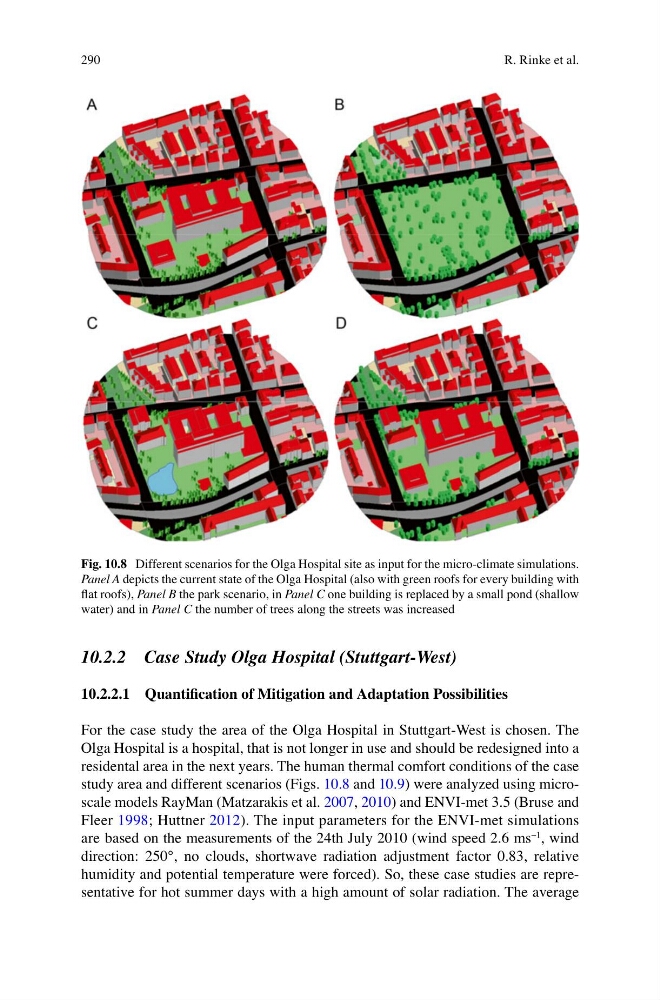
study area and different scenarios (Figs. 10.8 and 10.9 ) were analyzed using microscale models RayMan (Matzarakis et al. 2007 , 2010 ) and ENVI-met 3.5 (Bruse and
Fleer 1998 ; Huttner 2012 ). The input parameters for the ENVI-met simulations
are based on the measurements of the 24th July 2010 (wind speed 2.6 ms
−1 , wind
direction: 250°, no clouds, shortwave radiation adjustment factor 0.83, relative
humidity and potential temperature were forced). So, these case studies are representative for hot summer days with a high amount of solar radiation. The average
Fig. 10.8 Different scenarios for the Olga Hospital site as input for the micro-climate simulations.
Panel A depicts the current state of the Olga Hospital (also with green roofs for every building with
fl at roofs), Panel B the park scenario, in Panel C one building is replaced by a small pond (shallow
water) and in Panel C the number of trees along the streets was increased
R. Rinke et al.
10.2.2 Case Study Olga Hospital (Stuttgart-West)
10.2.2.1 Quantifi cation of Mitigation and Adaptation Possibilities
For the case study the area of the Olga Hospital in Stuttgart-West is chosen. The
Olga Hospital is a hospital, that is not longer in use and should be redesigned into a
residental area in the next years. The human thermal comfort conditions of the case
study area and different scenarios (Figs. 10.8 and 10.9 ) were analyzed using microscale models RayMan (Matzarakis et al. 2007 , 2010 ) and ENVI-met 3.5 (Bruse and
Fleer 1998 ; Huttner 2012 ). The input parameters for the ENVI-met simulations
are based on the measurements of the 24th July 2010 (wind speed 2.6 ms
−1 , wind
direction: 250°, no clouds, shortwave radiation adjustment factor 0.83, relative
humidity and potential temperature were forced). So, these case studies are representative for hot summer days with a high amount of solar radiation. The average
Fig. 10.8 Different scenarios for the Olga Hospital site as input for the micro-climate simulations.
Panel A depicts the current state of the Olga Hospital (also with green roofs for every building with
fl at roofs), Panel B the park scenario, in Panel C one building is replaced by a small pond (shallow
water) and in Panel C the number of trees along the streets was increased
R. Rinke et al.