

289
typical building structure in the district are blocks with additional buildings in the
inner areas of the blocks (Fig. 10.6 ). These characteristics causes poor ventilation
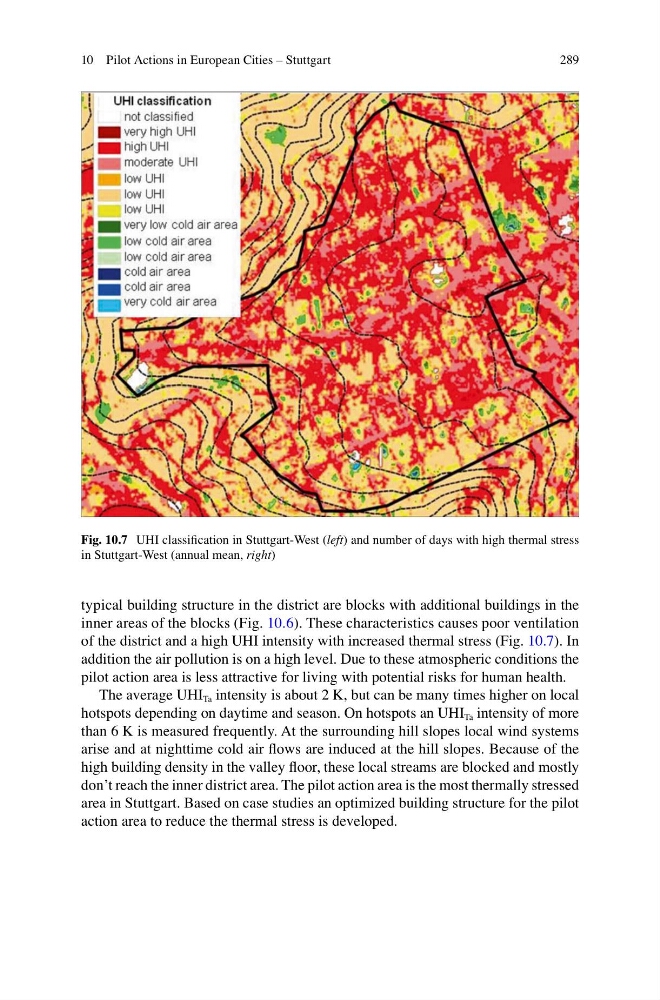
of the district and a high UHI intensity with increased thermal stress (Fig. 10.7 ). In
addition the air pollution is on a high level. Due to these atmospheric conditions the
pilot action area is less attractive for living with potential risks for human health.
The average UHI Ta intensity is about 2 K, but can be many times higher on local
hotspots depending on daytime and season. On hotspots an UHI Ta intensity of more
than 6 K is measured frequently. At the surrounding hill slopes local wind systems
arise and at nighttime cold air fl ows are induced at the hill slopes. Because of the
high building density in the valley fl oor, these local streams are blocked and mostly
don’t reach the inner district area. The pilot action area is the most thermally stressed
area in Stuttgart. Based on case studies an optimized building structure for the pilot
action area to reduce the thermal stress is developed.
Fig. 10.7 UHI classifi cation in Stuttgart-West ( left ) and number of days with high thermal stress
in Stuttgart-West (annual mean, right )
10 Pilot Actions in European Cities – Stuttgart
typical building structure in the district are blocks with additional buildings in the
inner areas of the blocks (Fig. 10.6 ). These characteristics causes poor ventilation
of the district and a high UHI intensity with increased thermal stress (Fig. 10.7 ). In
addition the air pollution is on a high level. Due to these atmospheric conditions the
pilot action area is less attractive for living with potential risks for human health.
The average UHI Ta intensity is about 2 K, but can be many times higher on local
hotspots depending on daytime and season. On hotspots an UHI Ta intensity of more
than 6 K is measured frequently. At the surrounding hill slopes local wind systems
arise and at nighttime cold air fl ows are induced at the hill slopes. Because of the
high building density in the valley fl oor, these local streams are blocked and mostly
don’t reach the inner district area. The pilot action area is the most thermally stressed
area in Stuttgart. Based on case studies an optimized building structure for the pilot
action area to reduce the thermal stress is developed.
Fig. 10.7 UHI classifi cation in Stuttgart-West ( left ) and number of days with high thermal stress
in Stuttgart-West (annual mean, right )
10 Pilot Actions in European Cities – Stuttgart