

286
and Höppe 1987 ; Höppe 1993 , 1999 ; Matzarakis et al. 1999 ) measured at the sites
Schwabenzentrum (MS), Schnarrenberg (DWD), airport station Echterdingen
(DWD) and at University Hohenheim (UnH). Average annual UHI Ta intensity (based
on air temperature) at Schwabenzentrum is 2 K and at Schnarrenberg 1.6 K. In the
Neckar valley, the mean UHI Ta is 0.9 K. At the suburb Hohenheim, the UHI Ta of
0.3 K is not pronounced as the suburb is surrounded by agricultural areas and has a
higher elevation as the rural reference station Echterdingen. The urban-rural differences in PET are higher with 4.1 K (3.1 K) between Schnarrenberg (Schwabenzentrum)
and Echterdingen.
During summer, the UHI PET (UHI Ta ) is by 15.2 % (8.1 %) higher than 6 °C in the
city center. However, a UHI between 0 and 6 °C is most frequent at the other measuring sites. The UHI effect is stronger and more frequent during summer than
during winter, increasing the already existing heat load. The minimum UHI Ta occurs
in the late morning, whereupon the rural air temperature is often higher than the
urban, especially during warm seasons. The UHI Ta peaks at 6:00 p.m. in the winter
and 9:00 p.m. during spring, summer and autumn at Schwabenzentrum. At
Neckartal, the amplitude of the diurnal cycle is weaker and UHI Ta is maximal in the
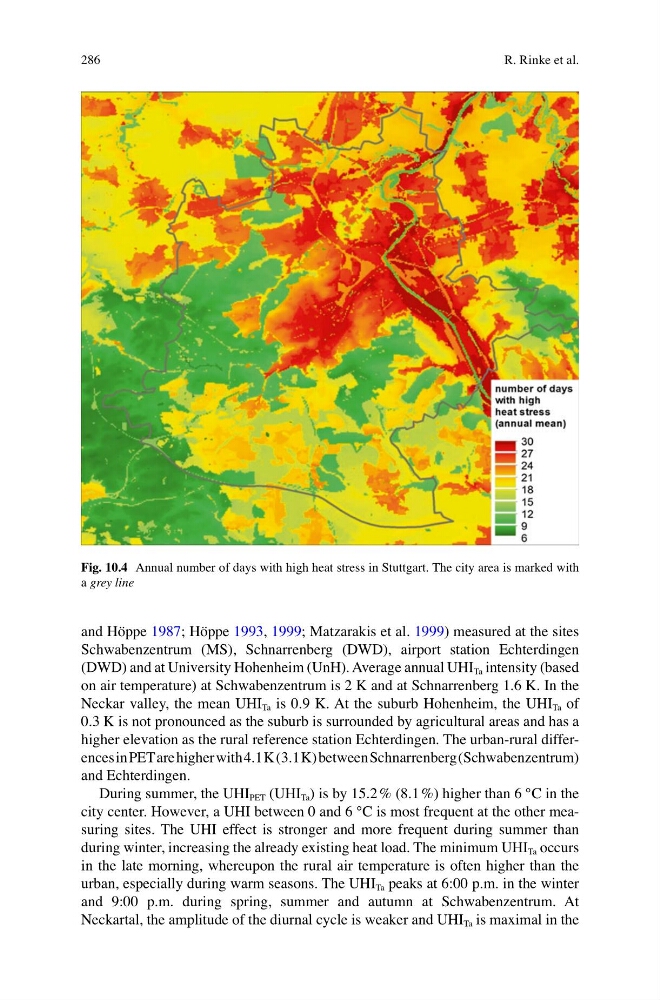
Fig. 10.4 Annual number of days with high heat stress in Stuttgart. The city area is marked with
a grey line
R. Rinke et al.
and Höppe 1987 ; Höppe 1993 , 1999 ; Matzarakis et al. 1999 ) measured at the sites
Schwabenzentrum (MS), Schnarrenberg (DWD), airport station Echterdingen
(DWD) and at University Hohenheim (UnH). Average annual UHI Ta intensity (based
on air temperature) at Schwabenzentrum is 2 K and at Schnarrenberg 1.6 K. In the
Neckar valley, the mean UHI Ta is 0.9 K. At the suburb Hohenheim, the UHI Ta of
0.3 K is not pronounced as the suburb is surrounded by agricultural areas and has a
higher elevation as the rural reference station Echterdingen. The urban-rural differences in PET are higher with 4.1 K (3.1 K) between Schnarrenberg (Schwabenzentrum)
and Echterdingen.
During summer, the UHI PET (UHI Ta ) is by 15.2 % (8.1 %) higher than 6 °C in the
city center. However, a UHI between 0 and 6 °C is most frequent at the other measuring sites. The UHI effect is stronger and more frequent during summer than
during winter, increasing the already existing heat load. The minimum UHI Ta occurs
in the late morning, whereupon the rural air temperature is often higher than the
urban, especially during warm seasons. The UHI Ta peaks at 6:00 p.m. in the winter
and 9:00 p.m. during spring, summer and autumn at Schwabenzentrum. At
Neckartal, the amplitude of the diurnal cycle is weaker and UHI Ta is maximal in the
Fig. 10.4 Annual number of days with high heat stress in Stuttgart. The city area is marked with
a grey line
R. Rinke et al.