

285
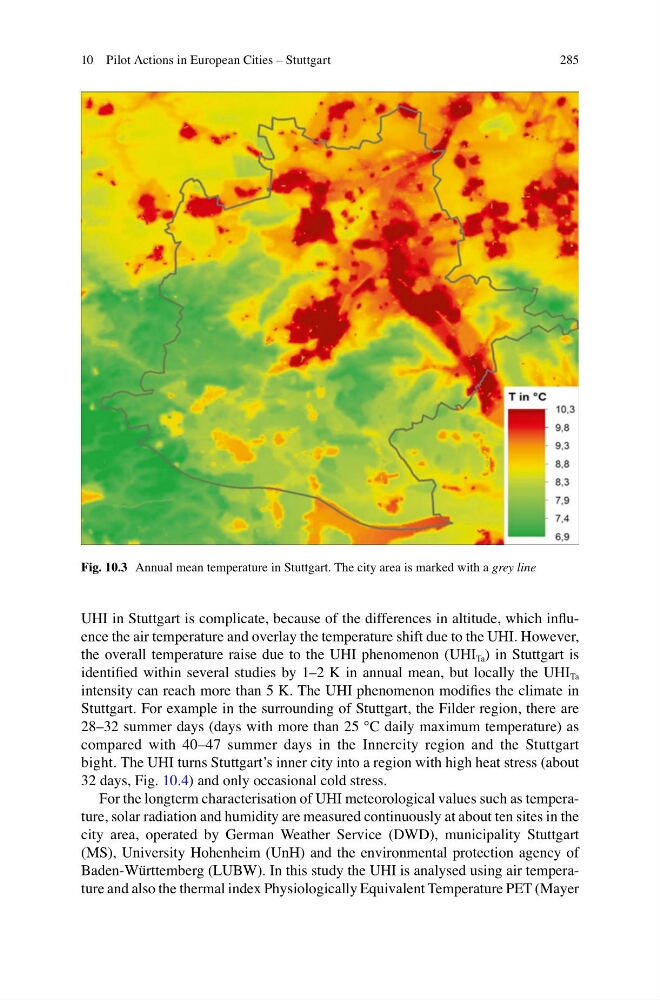
UHI in Stuttgart is complicate, because of the differences in altitude, which infl uence the air temperature and overlay the temperature shift due to the UHI. However,
the overall temperature raise due to the UHI phenomenon (UHI Ta ) in Stuttgart is
identifi ed within several studies by 1–2 K in annual mean, but locally the UHI Ta
intensity can reach more than 5 K. The UHI phenomenon modifi es the climate in
Stuttgart. For example in the surrounding of Stuttgart, the Filder region, there are
28–32 summer days (days with more than 25 °C daily maximum temperature) as
compared with 40–47 summer days in the Innercity region and the Stuttgart
bight. The UHI turns Stuttgart’s inner city into a region with high heat stress (about
32 days, Fig. 10.4 ) and only occasional cold stress.
For the longterm characterisation of UHI meteorological values such as temperature, solar radiation and humidity are measured continuously at about ten sites in the
city area, operated by German Weather Service (DWD), municipality Stuttgart
(MS), University Hohenheim (UnH) and the environmental protection agency of
Baden-Württemberg (LUBW). In this study the UHI is analysed using air temperature and also the thermal index Physiologically Equivalent Temperature PET (Mayer
Fig. 10.3 Annual mean temperature in Stuttgart. The city area is marked with a grey line
10 Pilot Actions in European Cities – Stuttgart
UHI in Stuttgart is complicate, because of the differences in altitude, which infl uence the air temperature and overlay the temperature shift due to the UHI. However,
the overall temperature raise due to the UHI phenomenon (UHI Ta ) in Stuttgart is
identifi ed within several studies by 1–2 K in annual mean, but locally the UHI Ta
intensity can reach more than 5 K. The UHI phenomenon modifi es the climate in
Stuttgart. For example in the surrounding of Stuttgart, the Filder region, there are
28–32 summer days (days with more than 25 °C daily maximum temperature) as
compared with 40–47 summer days in the Innercity region and the Stuttgart
bight. The UHI turns Stuttgart’s inner city into a region with high heat stress (about
32 days, Fig. 10.4 ) and only occasional cold stress.
For the longterm characterisation of UHI meteorological values such as temperature, solar radiation and humidity are measured continuously at about ten sites in the
city area, operated by German Weather Service (DWD), municipality Stuttgart
(MS), University Hohenheim (UnH) and the environmental protection agency of
Baden-Württemberg (LUBW). In this study the UHI is analysed using air temperature and also the thermal index Physiologically Equivalent Temperature PET (Mayer
Fig. 10.3 Annual mean temperature in Stuttgart. The city area is marked with a grey line
10 Pilot Actions in European Cities – Stuttgart