

85
deployment of complex simulation tools. A second challenge pertains to the issue of
model reliability: Even highly detailed and mathematically consistent simulation
tools may yield erroneous results given incomplete (or inaccurate) input data.
The high level of domain complexity involved in urban microclimate modelling
aggravates this model reliability problem. To exemplify this circumstance, consider
the simple case of predicting the air temperature in a specific location in the city of
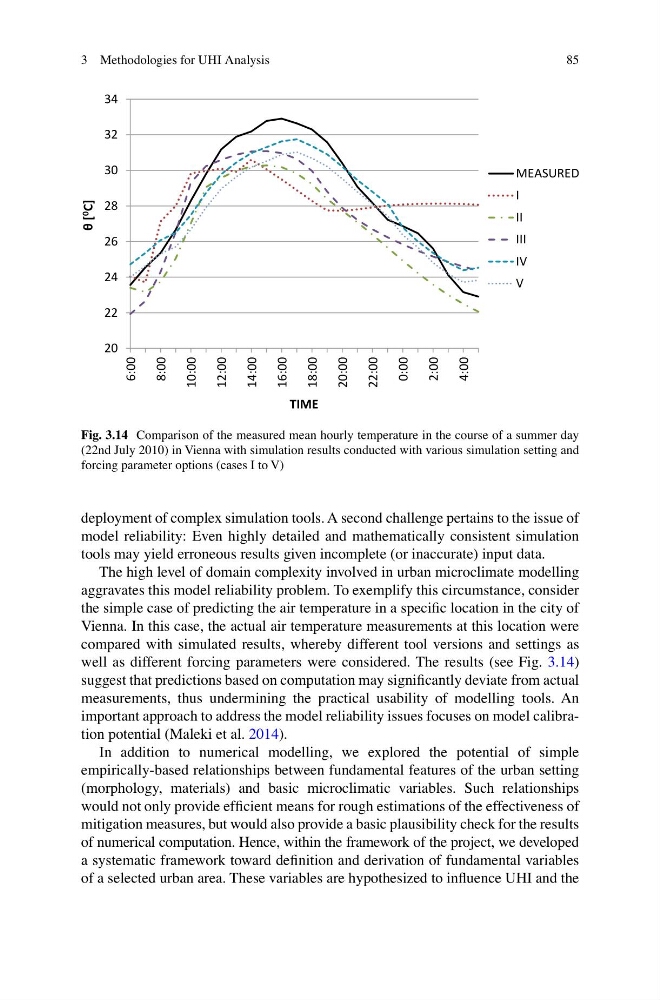
Vienna. In this case, the actual air temperature measurements at this location were
compared with simulated results, whereby different tool versions and settings as
well as different forcing parameters were considered. The results (see Fig. 3.14)
suggest that predictions based on computation may significantly deviate from actual
measurements, thus undermining the practical usability of modelling tools. An
important approach to address the model reliability issues focuses on model calibration potential (Maleki et al. 2014).
In addition to numerical modelling, we explored the potential of simple
empirically- based relationships between fundamental features of the urban setting
(morphology, materials) and basic microclimatic variables. Such relationships
would not only provide efficient means for rough estimations of the effectiveness of
mitigation measures, but would also provide a basic plausibility check for the results
of numerical computation. Hence, within the framework of the project, we developed
a systematic framework toward definition and derivation of fundamental variables
of a selected urban area. These variables are hypothesized to influence UHI and the
20
22
24
26
28
30
32
34
6:00
8:00
10:00
12:00
14:00
16:00
18:00
20:00
22:00
0:00
2:00
4:00
θ [ 0
C]
TIME
MEASURED
I
II
III
IV
V
Fig. 3.14 Comparison of the measured mean hourly temperature in the course of a summer day
(22nd July 2010) in Vienna with simulation results conducted with various simulation setting and
forcing parameter options (cases I to V)
3 Methodologies for UHI Analysis
deployment of complex simulation tools. A second challenge pertains to the issue of
model reliability: Even highly detailed and mathematically consistent simulation
tools may yield erroneous results given incomplete (or inaccurate) input data.
The high level of domain complexity involved in urban microclimate modelling
aggravates this model reliability problem. To exemplify this circumstance, consider
the simple case of predicting the air temperature in a specific location in the city of
Vienna. In this case, the actual air temperature measurements at this location were
compared with simulated results, whereby different tool versions and settings as
well as different forcing parameters were considered. The results (see Fig. 3.14)
suggest that predictions based on computation may significantly deviate from actual
measurements, thus undermining the practical usability of modelling tools. An
important approach to address the model reliability issues focuses on model calibration potential (Maleki et al. 2014).
In addition to numerical modelling, we explored the potential of simple
empirically- based relationships between fundamental features of the urban setting
(morphology, materials) and basic microclimatic variables. Such relationships
would not only provide efficient means for rough estimations of the effectiveness of
mitigation measures, but would also provide a basic plausibility check for the results
of numerical computation. Hence, within the framework of the project, we developed
a systematic framework toward definition and derivation of fundamental variables
of a selected urban area. These variables are hypothesized to influence UHI and the
20
22
24
26
28
30
32
34
6:00
8:00
10:00
12:00
14:00
16:00
18:00
20:00
22:00
0:00
2:00
4:00
θ [ 0
C]
TIME
MEASURED
I
II
III
IV
V
Fig. 3.14 Comparison of the measured mean hourly temperature in the course of a summer day
(22nd July 2010) in Vienna with simulation results conducted with various simulation setting and
forcing parameter options (cases I to V)
3 Methodologies for UHI Analysis