

128
6 Answers to Supplementary Problems
E I Y
X 3
⎡
⎢
⎢
⎣
7 −4 1 0
−4 6 −4 1
1 −4 5 −2
−14 24 −18 5
⎤
⎥
⎥
⎦
⎡
⎢
⎢
⎣
u 2
u 3
u 4
u 5
⎤
⎥
⎥
⎦ =
⎡
⎢
⎢
⎣
0
0
−F 0
0
⎤
⎥
⎥
⎦ .
(6.78)
relative error =
1
8
+
81
384
−
81
384
× 100 = 159.259% .
(6.79)
(b)
E I Y
d
3 u
dX 3
4
= −Q Z
X =
3L
4
= F 0 .
(6.80)
E I Y
X 3
⎡
⎢
⎢
⎣
7 −4 1 0
−4 6 −4 1
1 −4 5 −2
27 −18 5 0
⎤
⎥
⎥
⎦
⎡
⎢
⎢
⎣
u 2
u 3
u 4
u 5
⎤
⎥
⎥
⎦ =
⎡
⎢
⎢
⎣
0
0
−F 0
2F 0
⎤
⎥
⎥
⎦ .
(6.81)
relative error =
7
32
−
81
384
81
384
× 100 = 3.704% .
(6.82)
3.11 Finite difference approximation of a cantilevered beam based on five
domain nodes—conversion of tip load into distributed load
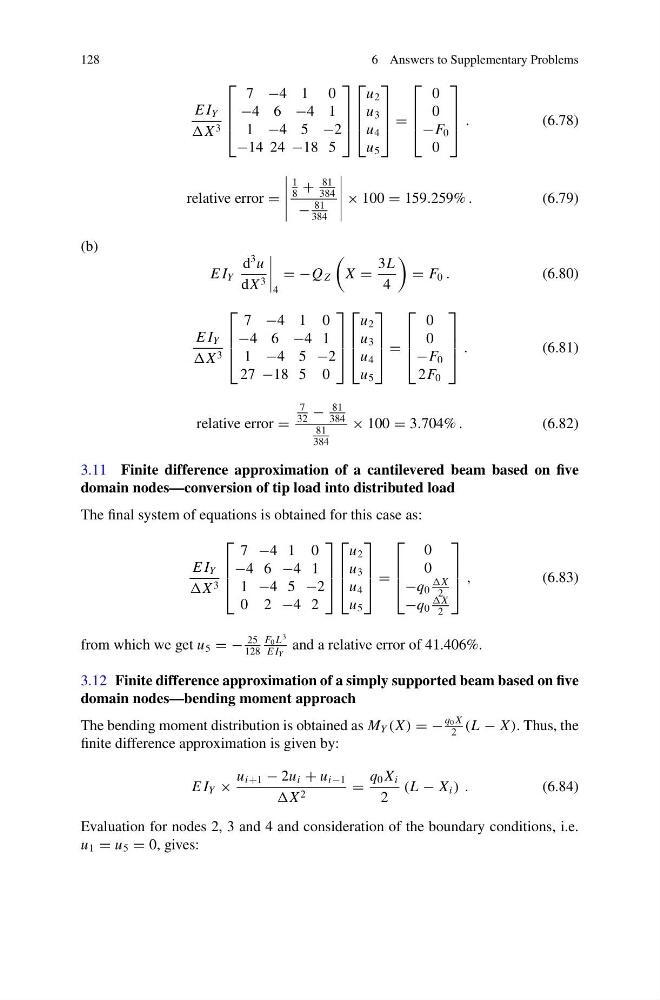
The final system of equations is obtained for this case as:
E I Y
X 3
⎡
⎢
⎢
⎣
7 −4 1 0
−4 6 −4 1
1 −4 5 −2
0 2 −4 2
⎤
⎥
⎥
⎦
⎡
⎢
⎢
⎣
u 2
u 3
u 4
u 5
⎤
⎥
⎥
⎦ =
⎡
⎢
⎢
⎣
0
0
−q 0
X
2
−q 0
X
2
⎤
⎥
⎥
⎦ ,
(6.83)
from which we get u 5 = −
25
128
F 0 L
3
E I Y
and a relative error of 41.406%.
3.12 Finite difference approximation of a simply supported beam based on five
domain nodes—bending moment approach
The bending moment distribution is obtained as M Y (X ) = −
q 0 X
2
(L − X ). Thus, the
finite difference approximation is given by:
E I Y ×
u i+1 − 2u i + u i−1
X 2
=
q 0 X i
2
(L − X i ) .
(6.84)
Evaluation for nodes 2, 3 and 4 and consideration of the boundary conditions, i.e.
u 1 = u 5 = 0, gives:
6 Answers to Supplementary Problems
E I Y
X 3
⎡
⎢
⎢
⎣
7 −4 1 0
−4 6 −4 1
1 −4 5 −2
−14 24 −18 5
⎤
⎥
⎥
⎦
⎡
⎢
⎢
⎣
u 2
u 3
u 4
u 5
⎤
⎥
⎥
⎦ =
⎡
⎢
⎢
⎣
0
0
−F 0
0
⎤
⎥
⎥
⎦ .
(6.78)
relative error =
1
8
+
81
384
−
81
384
× 100 = 159.259% .
(6.79)
(b)
E I Y
d
3 u
dX 3
4
= −Q Z
X =
3L
4
= F 0 .
(6.80)
E I Y
X 3
⎡
⎢
⎢
⎣
7 −4 1 0
−4 6 −4 1
1 −4 5 −2
27 −18 5 0
⎤
⎥
⎥
⎦
⎡
⎢
⎢
⎣
u 2
u 3
u 4
u 5
⎤
⎥
⎥
⎦ =
⎡
⎢
⎢
⎣
0
0
−F 0
2F 0
⎤
⎥
⎥
⎦ .
(6.81)
relative error =
7
32
−
81
384
81
384
× 100 = 3.704% .
(6.82)
3.11 Finite difference approximation of a cantilevered beam based on five
domain nodes—conversion of tip load into distributed load
The final system of equations is obtained for this case as:
E I Y
X 3
⎡
⎢
⎢
⎣
7 −4 1 0
−4 6 −4 1
1 −4 5 −2
0 2 −4 2
⎤
⎥
⎥
⎦
⎡
⎢
⎢
⎣
u 2
u 3
u 4
u 5
⎤
⎥
⎥
⎦ =
⎡
⎢
⎢
⎣
0
0
−q 0
X
2
−q 0
X
2
⎤
⎥
⎥
⎦ ,
(6.83)
from which we get u 5 = −
25
128
F 0 L
3
E I Y
and a relative error of 41.406%.
3.12 Finite difference approximation of a simply supported beam based on five
domain nodes—bending moment approach
The bending moment distribution is obtained as M Y (X ) = −
q 0 X
2
(L − X ). Thus, the
finite difference approximation is given by:
E I Y ×
u i+1 − 2u i + u i−1
X 2
=
q 0 X i
2
(L − X i ) .
(6.84)
Evaluation for nodes 2, 3 and 4 and consideration of the boundary conditions, i.e.
u 1 = u 5 = 0, gives: