

6.3 Answers for Problems from Chap. 3
127
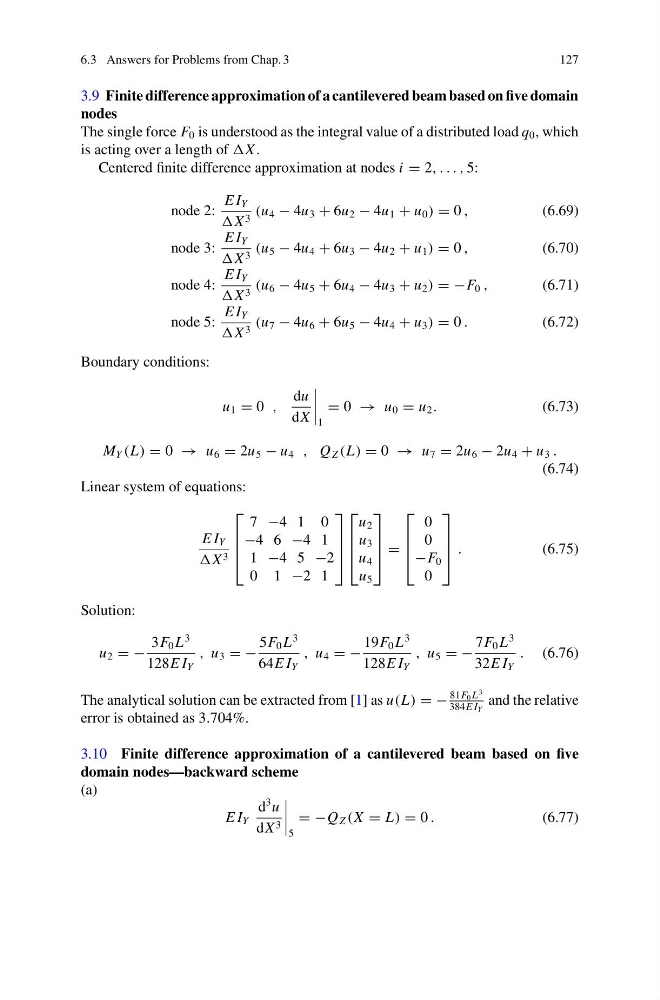
3.9 Finite difference approximation of a cantilevered beam based on five domain
nodes
The single force F 0 is understood as the integral value of a distributed load q 0 , which
is acting over a length of X .
Centered finite difference approximation at nodes i = 2, . . . , 5:
node 2:
E I Y
X 3 (u 4 − 4u 3 + 6u 2 − 4u 1 + u 0 ) = 0 ,
(6.69)
node 3:
E I Y
X 3 (u 5 − 4u 4 + 6u 3 − 4u 2 + u 1 ) = 0 ,
(6.70)
node 4:
E I Y
X 3 (u 6 − 4u 5 + 6u 4 − 4u 3 + u 2 ) = −F 0 ,
(6.71)
node 5:
E I Y
X 3 (u 7 − 4u 6 + 6u 5 − 4u 4 + u 3 ) = 0 .
(6.72)
Boundary conditions:
u 1 = 0 ,
du
dX
1
= 0 → u 0 = u 2 .
(6.73)
M Y (L) = 0 → u 6 = 2u 5 − u 4 , Q Z (L) = 0 → u 7 = 2u 6 − 2u 4 + u 3 .
(6.74)
Linear system of equations:
E I Y
X 3
⎡
⎢
⎢
⎣
7 −4 1 0
−4 6 −4 1
1 −4 5 −2
0 1 −2 1
⎤
⎥
⎥
⎦
⎡
⎢
⎢
⎣
u 2
u 3
u 4
u 5
⎤
⎥
⎥
⎦ =
⎡
⎢
⎢
⎣
0
0
−F 0
0
⎤
⎥
⎥
⎦ .
(6.75)
Solution:
u 2 = −
3F 0 L
3
128E I Y
, u 3 = −
5F 0 L
3
64E I Y
, u 4 = −
19F 0 L
3
128E I Y
, u 5 = −
7F 0 L
3
32E I Y
. (6.76)
The analytical solution can be extracted from [1] as u(L) = −
81F 0 L
3
384E I Y
and the relative
error is obtained as 3.704%.
3.10 Finite difference approximation of a cantilevered beam based on five
domain nodes—backward scheme
(a)
E I Y
d
3 u
dX 3
5
= −Q Z (X = L) = 0 .
(6.77)
127
3.9 Finite difference approximation of a cantilevered beam based on five domain
nodes
The single force F 0 is understood as the integral value of a distributed load q 0 , which
is acting over a length of X .
Centered finite difference approximation at nodes i = 2, . . . , 5:
node 2:
E I Y
X 3 (u 4 − 4u 3 + 6u 2 − 4u 1 + u 0 ) = 0 ,
(6.69)
node 3:
E I Y
X 3 (u 5 − 4u 4 + 6u 3 − 4u 2 + u 1 ) = 0 ,
(6.70)
node 4:
E I Y
X 3 (u 6 − 4u 5 + 6u 4 − 4u 3 + u 2 ) = −F 0 ,
(6.71)
node 5:
E I Y
X 3 (u 7 − 4u 6 + 6u 5 − 4u 4 + u 3 ) = 0 .
(6.72)
Boundary conditions:
u 1 = 0 ,
du
dX
1
= 0 → u 0 = u 2 .
(6.73)
M Y (L) = 0 → u 6 = 2u 5 − u 4 , Q Z (L) = 0 → u 7 = 2u 6 − 2u 4 + u 3 .
(6.74)
Linear system of equations:
E I Y
X 3
⎡
⎢
⎢
⎣
7 −4 1 0
−4 6 −4 1
1 −4 5 −2
0 1 −2 1
⎤
⎥
⎥
⎦
⎡
⎢
⎢
⎣
u 2
u 3
u 4
u 5
⎤
⎥
⎥
⎦ =
⎡
⎢
⎢
⎣
0
0
−F 0
0
⎤
⎥
⎥
⎦ .
(6.75)
Solution:
u 2 = −
3F 0 L
3
128E I Y
, u 3 = −
5F 0 L
3
64E I Y
, u 4 = −
19F 0 L
3
128E I Y
, u 5 = −
7F 0 L
3
32E I Y
. (6.76)
The analytical solution can be extracted from [1] as u(L) = −
81F 0 L
3
384E I Y
and the relative
error is obtained as 3.704%.
3.10 Finite difference approximation of a cantilevered beam based on five
domain nodes—backward scheme
(a)
E I Y
d
3 u
dX 3
5
= −Q Z (X = L) = 0 .
(6.77)