

6.3 Answers for Problems from Chap. 3
129
⎡
⎢
⎢
⎣
−2 1 0
1 −2 1
0 1 −2
⎤
⎥
⎥
⎦
⎡
⎢
⎢
⎣
u 2
u 3
u 4
⎤
⎥
⎥
⎦ =
⎡
⎢
⎢
⎣
q 0 X
3
2E I Y
(L − X )
q 0 X
3
E I Y
(L − 2X )
3q 0 X
3
2E I Y
(L − 3X )
⎤
⎥
⎥
⎦ .
(6.85)
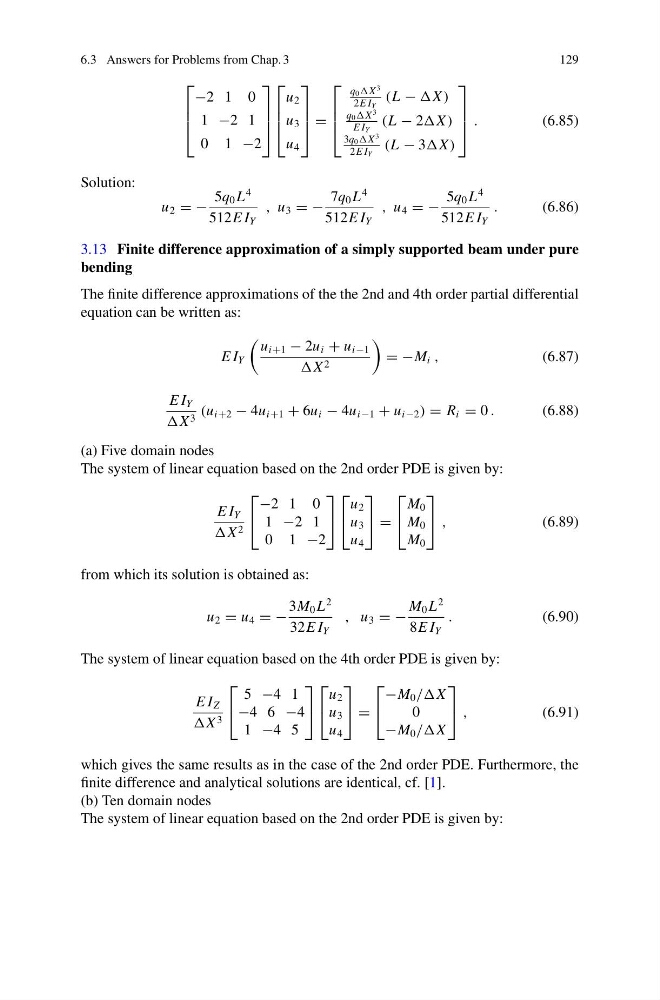
Solution:
u 2 = −
5q 0 L
4
512E I Y
, u 3 = −
7q 0 L
4
512E I Y
, u 4 = −
5q 0 L
4
512E I Y
.
(6.86)
3.13 Finite difference approximation of a simply supported beam under pure
bending
The finite difference approximations of the the 2nd and 4th order partial differential
equation can be written as:
E I Y
u i+1 − 2u i + u i−1
X 2
= −M i ,
(6.87)
E I Y
X 3 (u i+2 − 4u i+1 + 6u i − 4u i−1 + u i−2 ) = R i = 0 .
(6.88)
(a) Five domain nodes
The system of linear equation based on the 2nd order PDE is given by:
E I Y
X 2
⎡
⎣
−2 1 0
1 −2 1
0 1 −2
⎤
⎦
⎡
⎣
u 2
u 3
u 4
⎤
⎦ =
⎡
⎣
M 0
M 0
M 0
⎤
⎦ ,
(6.89)
from which its solution is obtained as:
u 2 = u 4 = −
3M 0 L
2
32E I Y
, u 3 = −
M 0 L
2
8E I Y
.
(6.90)
The system of linear equation based on the 4th order PDE is given by:
E I Z
X 3
⎡
⎣
5 −4 1
−4 6 −4
1 −4 5
⎤
⎦
⎡
⎣
u 2
u 3
u 4
⎤
⎦ =
⎡
⎣
−M 0 //X
0
−M 0 //X
⎤
⎦ ,
(6.91)
which gives the same results as in the case of the 2nd order PDE. Furthermore, the
finite difference and analytical solutions are identical, cf. [1].
(b) Ten domain nodes
The system of linear equation based on the 2nd order PDE is given by:
129
⎡
⎢
⎢
⎣
−2 1 0
1 −2 1
0 1 −2
⎤
⎥
⎥
⎦
⎡
⎢
⎢
⎣
u 2
u 3
u 4
⎤
⎥
⎥
⎦ =
⎡
⎢
⎢
⎣
q 0 X
3
2E I Y
(L − X )
q 0 X
3
E I Y
(L − 2X )
3q 0 X
3
2E I Y
(L − 3X )
⎤
⎥
⎥
⎦ .
(6.85)
Solution:
u 2 = −
5q 0 L
4
512E I Y
, u 3 = −
7q 0 L
4
512E I Y
, u 4 = −
5q 0 L
4
512E I Y
.
(6.86)
3.13 Finite difference approximation of a simply supported beam under pure
bending
The finite difference approximations of the the 2nd and 4th order partial differential
equation can be written as:
E I Y
u i+1 − 2u i + u i−1
X 2
= −M i ,
(6.87)
E I Y
X 3 (u i+2 − 4u i+1 + 6u i − 4u i−1 + u i−2 ) = R i = 0 .
(6.88)
(a) Five domain nodes
The system of linear equation based on the 2nd order PDE is given by:
E I Y
X 2
⎡
⎣
−2 1 0
1 −2 1
0 1 −2
⎤
⎦
⎡
⎣
u 2
u 3
u 4
⎤
⎦ =
⎡
⎣
M 0
M 0
M 0
⎤
⎦ ,
(6.89)
from which its solution is obtained as:
u 2 = u 4 = −
3M 0 L
2
32E I Y
, u 3 = −
M 0 L
2
8E I Y
.
(6.90)
The system of linear equation based on the 4th order PDE is given by:
E I Z
X 3
⎡
⎣
5 −4 1
−4 6 −4
1 −4 5
⎤
⎦
⎡
⎣
u 2
u 3
u 4
⎤
⎦ =
⎡
⎣
−M 0 //X
0
−M 0 //X
⎤
⎦ ,
(6.91)
which gives the same results as in the case of the 2nd order PDE. Furthermore, the
finite difference and analytical solutions are identical, cf. [1].
(b) Ten domain nodes
The system of linear equation based on the 2nd order PDE is given by: