

In Fig. 4.26a, which is the magnified SEM image of dashed square Fig. 4.25d,
vesicular structures remain inside the sponge-like volcanic glass. However, two
types of vesicle walls can be distinguished: thick and thin. Two thin walls (indicated
by red boxes labeled c and d in Fig. 4.26a) were found to be Al-rich according to
their EDX spectra (Fig. 4.26c, d). These EDX spectra are close to that for allophanic
material. In contrast, a thick wall (indicated by the blue box labelled b in Fig. 4.26a),
has an EDX spectrum similar to that of non-colored volcanic glass like Fig. 4.1a–c.
Examining the Al and Si element maps of Fig. 4.26a shown in Fig. 4.26e, f,
respectively, thin walls in the Fig. 4.26a are Al-rich and Si-poor, whereas thick
walls are Al-poor and Si-rich. These observations suggest that the thin walls of
vesicles are allophanic altermorphs described by Stoops (2007) and Gerard et al.
(2007). Comparing the element maps of Al and Si, Fig. 4.26e, f, respectively, it can
be seen that allophanic altermorphs also surround the thick volcanic glass. Hence,
the allophanic altermorph formed by releasing Si, Ca, Na, and other soluble elements
from the surface of volcanic glass, and remains at the original site.
Figure 4.25e shows a phenocryst that displays cleavage. Examining the cleavage
reveals (Fig. 4.27a) thin stripes along the edge of the remaining phenocryst. Examining EDX spectra of the thin stripe (dashed square (b) in Fig. 4.27a) and phenocryst
(dashed square (c) in Fig. 4.27a) reveals that they are allophanic material and
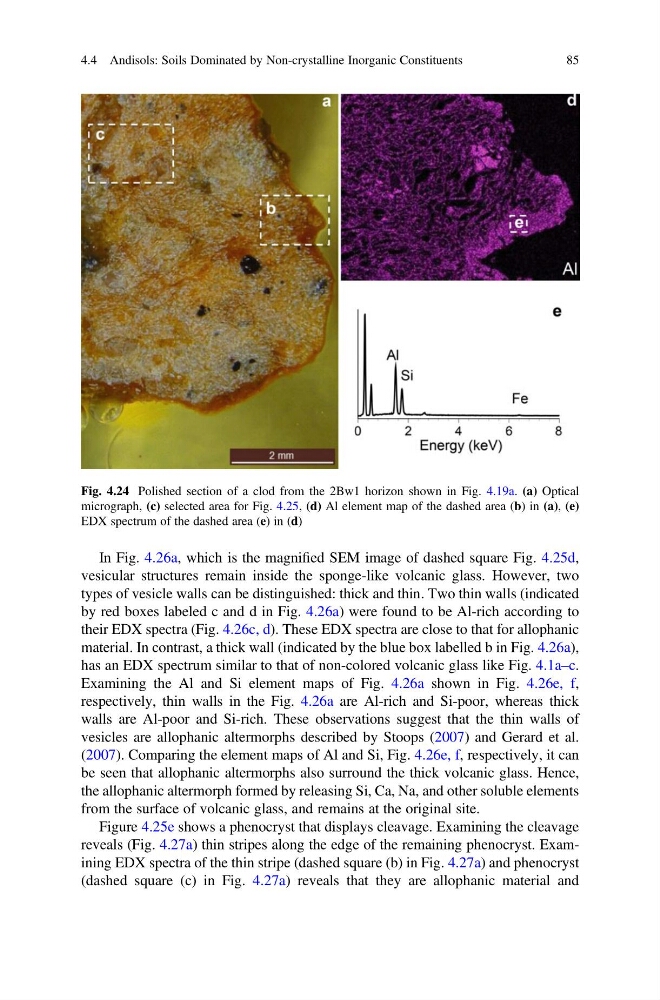
Fig. 4.24 Polished section of a clod from the 2Bw1 horizon shown in Fig. 4.19a. (a) Optical
micrograph, (c) selected area for Fig. 4.25, (d) Al element map of the dashed area (b) in (a), (e)
EDX spectrum of the dashed area (e) in (d)
4.4 Andisols: Soils Dominated by Non-crystalline Inorganic Constituents
85
vesicular structures remain inside the sponge-like volcanic glass. However, two
types of vesicle walls can be distinguished: thick and thin. Two thin walls (indicated
by red boxes labeled c and d in Fig. 4.26a) were found to be Al-rich according to
their EDX spectra (Fig. 4.26c, d). These EDX spectra are close to that for allophanic
material. In contrast, a thick wall (indicated by the blue box labelled b in Fig. 4.26a),
has an EDX spectrum similar to that of non-colored volcanic glass like Fig. 4.1a–c.
Examining the Al and Si element maps of Fig. 4.26a shown in Fig. 4.26e, f,
respectively, thin walls in the Fig. 4.26a are Al-rich and Si-poor, whereas thick
walls are Al-poor and Si-rich. These observations suggest that the thin walls of
vesicles are allophanic altermorphs described by Stoops (2007) and Gerard et al.
(2007). Comparing the element maps of Al and Si, Fig. 4.26e, f, respectively, it can
be seen that allophanic altermorphs also surround the thick volcanic glass. Hence,
the allophanic altermorph formed by releasing Si, Ca, Na, and other soluble elements
from the surface of volcanic glass, and remains at the original site.
Figure 4.25e shows a phenocryst that displays cleavage. Examining the cleavage
reveals (Fig. 4.27a) thin stripes along the edge of the remaining phenocryst. Examining EDX spectra of the thin stripe (dashed square (b) in Fig. 4.27a) and phenocryst
(dashed square (c) in Fig. 4.27a) reveals that they are allophanic material and
Fig. 4.24 Polished section of a clod from the 2Bw1 horizon shown in Fig. 4.19a. (a) Optical
micrograph, (c) selected area for Fig. 4.25, (d) Al element map of the dashed area (b) in (a), (e)
EDX spectrum of the dashed area (e) in (d)
4.4 Andisols: Soils Dominated by Non-crystalline Inorganic Constituents
85