

pumice. The light gray parts of Fig. 4.19d are voids. In the 3Bw5 horizon (4.19e),
small light brown and orange parts are found within the weathered pumice. These
parts are similar in appearance to the orange-reddish altermorph reported for the
Bw3 horizon of the Andosol of Tenerife by Stoops (2007). The light gray parts are
also voids in Fig. 4.19e. The micromass of these three thin sections, Fig. 4.19c–e,
showed undifferentiated b-fabric between crossed polarizers, indicating that isotropic or non-crystalline materials are dominant in the fine materials of these horizons.
SEM-EDX analyses of polished sections further reveal the properties of the A3,
2Bw1, and 3Bw5 horizons. Figure 4.20a shows an optical microscope photograph of
the polished section prepared from a clod of the A3 horizon (Fig. 4.19a). The dashed
square (Fig. 4.20b) in the upper left corner of Fig. 4.20a was magnified in Fig. 4.20c.
Weathered minerals and other particles appear in the dark-colored fine materials with
the humus. Figure 4.20d, e, the same area as in Fig. 4.20c, show element maps for Al
(magenta) and Si (cyan), respectively. Comparing the color intensity, Al concentration is higher than Si for all of the fine materials except for the coarse particles. This
result is highly contrasting with Fig. 4.15f, g where the Si concentration is higher
than the Al concentration. The element maps of Fig. 4.20d and e are the result of
Andisol formation, consisting of changes in the Si-rich parent material of volcanic
glass to form Al-rich allophane, imogolite and Al-humus (Table 4.2). The concentrations of oxalate-extractable Al (Al o ), Al p , and Si o in horizon are 7.6, 2.2, and
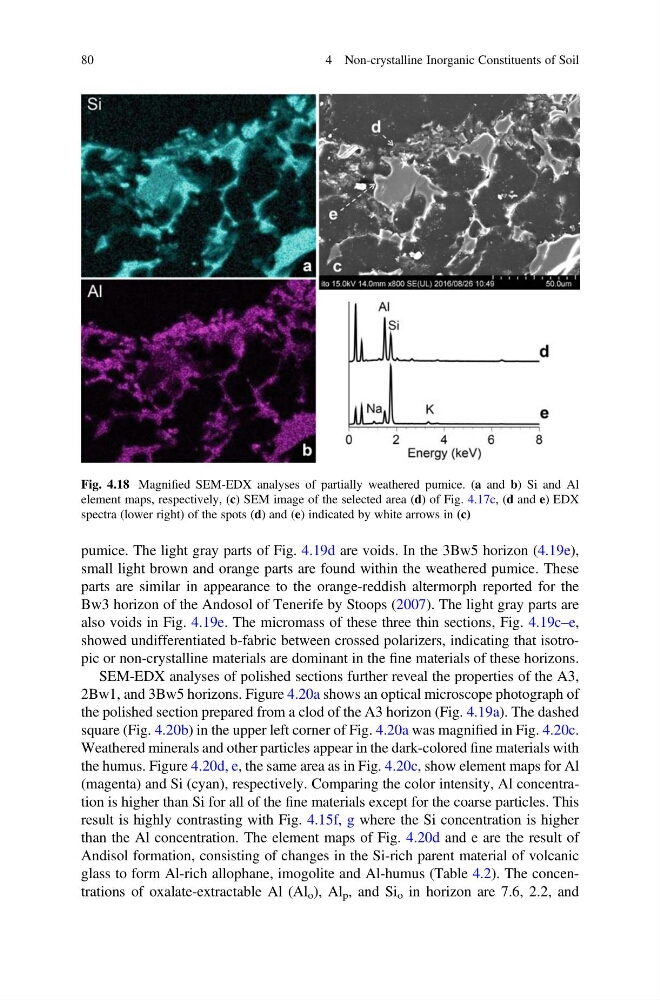
Fig. 4.18 Magnified SEM-EDX analyses of partially weathered pumice. (a and b) Si and Al
element maps, respectively, (c) SEM image of the selected area (d) of Fig. 4.17c, (d and e) EDX
spectra (lower right) of the spots (d) and (e) indicated by white arrows in (c)
80
4 Non-crystalline Inorganic Constituents of Soil
small light brown and orange parts are found within the weathered pumice. These
parts are similar in appearance to the orange-reddish altermorph reported for the
Bw3 horizon of the Andosol of Tenerife by Stoops (2007). The light gray parts are
also voids in Fig. 4.19e. The micromass of these three thin sections, Fig. 4.19c–e,
showed undifferentiated b-fabric between crossed polarizers, indicating that isotropic or non-crystalline materials are dominant in the fine materials of these horizons.
SEM-EDX analyses of polished sections further reveal the properties of the A3,
2Bw1, and 3Bw5 horizons. Figure 4.20a shows an optical microscope photograph of
the polished section prepared from a clod of the A3 horizon (Fig. 4.19a). The dashed
square (Fig. 4.20b) in the upper left corner of Fig. 4.20a was magnified in Fig. 4.20c.
Weathered minerals and other particles appear in the dark-colored fine materials with
the humus. Figure 4.20d, e, the same area as in Fig. 4.20c, show element maps for Al
(magenta) and Si (cyan), respectively. Comparing the color intensity, Al concentration is higher than Si for all of the fine materials except for the coarse particles. This
result is highly contrasting with Fig. 4.15f, g where the Si concentration is higher
than the Al concentration. The element maps of Fig. 4.20d and e are the result of
Andisol formation, consisting of changes in the Si-rich parent material of volcanic
glass to form Al-rich allophane, imogolite and Al-humus (Table 4.2). The concentrations of oxalate-extractable Al (Al o ), Al p , and Si o in horizon are 7.6, 2.2, and
Fig. 4.18 Magnified SEM-EDX analyses of partially weathered pumice. (a and b) Si and Al
element maps, respectively, (c) SEM image of the selected area (d) of Fig. 4.17c, (d and e) EDX
spectra (lower right) of the spots (d) and (e) indicated by white arrows in (c)
80
4 Non-crystalline Inorganic Constituents of Soil