

2.5%, respectively, indicating that the A3 horizon is highly weathered and
allophanic, and that it contains Al-humus complexes. Nevertheless, there are still
coarse silica particles that are probably cristobalite, quartz, or phytoliths. In
Fig. 4.20c, a few reticulated patterns were observed, and one of them (highlighted
by dashed square (f)) was magnified in Fig. 4.21a.
Figure 4.21a shows a reticulated pattern of Fig. 4.20f with magnification, and the
EDX spectrum of the dashed area is highly dominated by Al (Fig. 4.21b), whereas
the EDX spectrum of the fine materials near the reticulated pattern suggests
allophanic material (Fig. 4.21c). The Al element map of the reticulated area
(Fig. 4.21d) shows that the Al concentration is nearly homogeneous with little Si
present (Fig. 4.21e). These results suggest that the reticulated material is a sclerotia
grain.
Sclerotia grains separated from the A3 horizon soil were examined. Water was
added to the air-dried soil and ultrasonic treatment was carried out for 10 min. After
allowing the suspension to stand for several minutes, dark spherical particles floating
on the surface of water were ladled out on a filter paper and air-dried. Figure 4.22a
shows the spherical particles separated from the A3 horizon soil, and Fig. 4.22b is
the magnified SEM image of the particle. Further magnification of the dashed square
in Fig. 4.22b gives Fig. 4.22c, where small holes appear. The hole is one of the
characteristics of the sclerotia grain (Watanabe et al. 2001, 2002, 2004, 2007). The
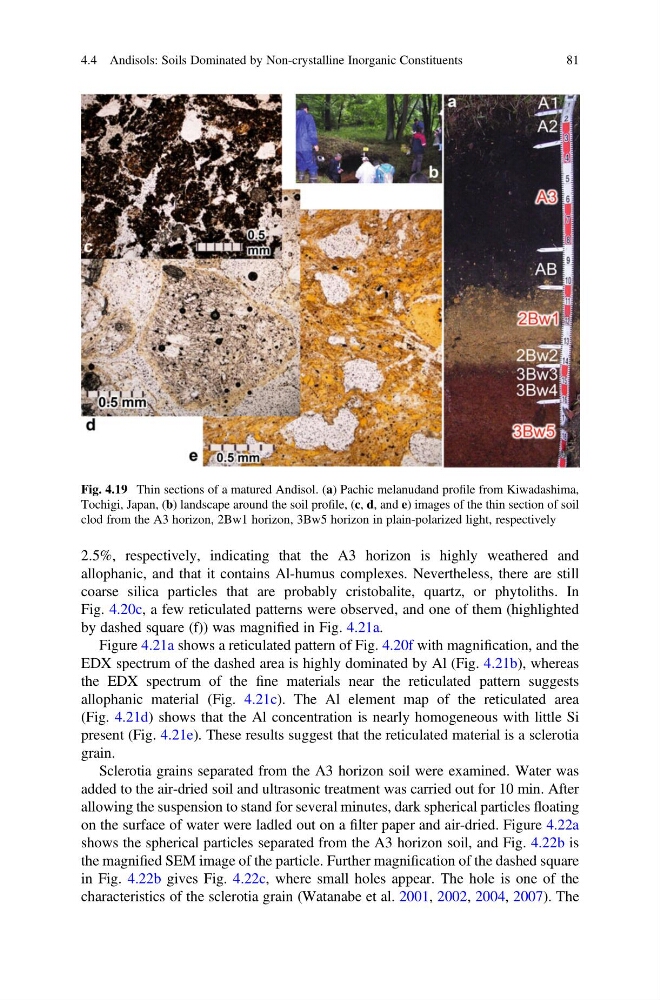
Fig. 4.19 Thin sections of a matured Andisol. (a) Pachic melanudand profile from Kiwadashima,
Tochigi, Japan, (b) landscape around the soil profile, (c, d, and e) images of the thin section of soil
clod from the A3 horizon, 2Bw1 horizon, 3Bw5 horizon in plain-polarized light, respectively
4.4 Andisols: Soils Dominated by Non-crystalline Inorganic Constituents
81
allophanic, and that it contains Al-humus complexes. Nevertheless, there are still
coarse silica particles that are probably cristobalite, quartz, or phytoliths. In
Fig. 4.20c, a few reticulated patterns were observed, and one of them (highlighted
by dashed square (f)) was magnified in Fig. 4.21a.
Figure 4.21a shows a reticulated pattern of Fig. 4.20f with magnification, and the
EDX spectrum of the dashed area is highly dominated by Al (Fig. 4.21b), whereas
the EDX spectrum of the fine materials near the reticulated pattern suggests
allophanic material (Fig. 4.21c). The Al element map of the reticulated area
(Fig. 4.21d) shows that the Al concentration is nearly homogeneous with little Si
present (Fig. 4.21e). These results suggest that the reticulated material is a sclerotia
grain.
Sclerotia grains separated from the A3 horizon soil were examined. Water was
added to the air-dried soil and ultrasonic treatment was carried out for 10 min. After
allowing the suspension to stand for several minutes, dark spherical particles floating
on the surface of water were ladled out on a filter paper and air-dried. Figure 4.22a
shows the spherical particles separated from the A3 horizon soil, and Fig. 4.22b is
the magnified SEM image of the particle. Further magnification of the dashed square
in Fig. 4.22b gives Fig. 4.22c, where small holes appear. The hole is one of the
characteristics of the sclerotia grain (Watanabe et al. 2001, 2002, 2004, 2007). The
Fig. 4.19 Thin sections of a matured Andisol. (a) Pachic melanudand profile from Kiwadashima,
Tochigi, Japan, (b) landscape around the soil profile, (c, d, and e) images of the thin section of soil
clod from the A3 horizon, 2Bw1 horizon, 3Bw5 horizon in plain-polarized light, respectively
4.4 Andisols: Soils Dominated by Non-crystalline Inorganic Constituents
81