

4.4.3 A Horizon Soil with Andic Soil Properties
The next example is a matured Andisol including a humus-rich A horizon and highly
weathered Bw horizons. Figure 4.19a shows a Pachic Melanudand profile. The
profile has thick black A horizons, yellow 2Bw horizons (Nantai-Shichihonzakura
(Nt-S) tephra), and reddish brown 3Bw horizons (Nantai-Imaichi (Nt-I) tephra,
Ishizaki et al. 2017). Both Nt-I and Nt-S were ejected from Mt. Nantai, Japan. As
no other layer is found between the two, the interval between Nt-I and Nt-S
deposition is estimated to be short. The age of Na-I is estimated to be ca. 17 ka
(Ishizaki et al. 2017 and references therein). By definition, the bulk density of
matured Andisols is 0.90 Mg m
À3 or less. Bulk density values of matured Andisols
are as low as 0.5 or 0.6 Mg m
À3 .
The micromorphological and chemical properties of the A3, 2Bw1, and 3Bw5
horizons were examined using thin sections and polished sections. The vegetation of
the sampled site is Quercus Serrata and undergrowth (Otowa and Shoji 1987)
(Fig. 4.19b). Thin sections of the A3 horizon (Fig. 4.19c) showed porous and
granular microstructure (Stoops 2007) similar to those reported by Kawai (1969).
In the 2Bw1 horizon (Fig. 4.19d), a coating of fine, light brown material is probably
a more weathered part of pumice particles. Vesicular structure remains inside the
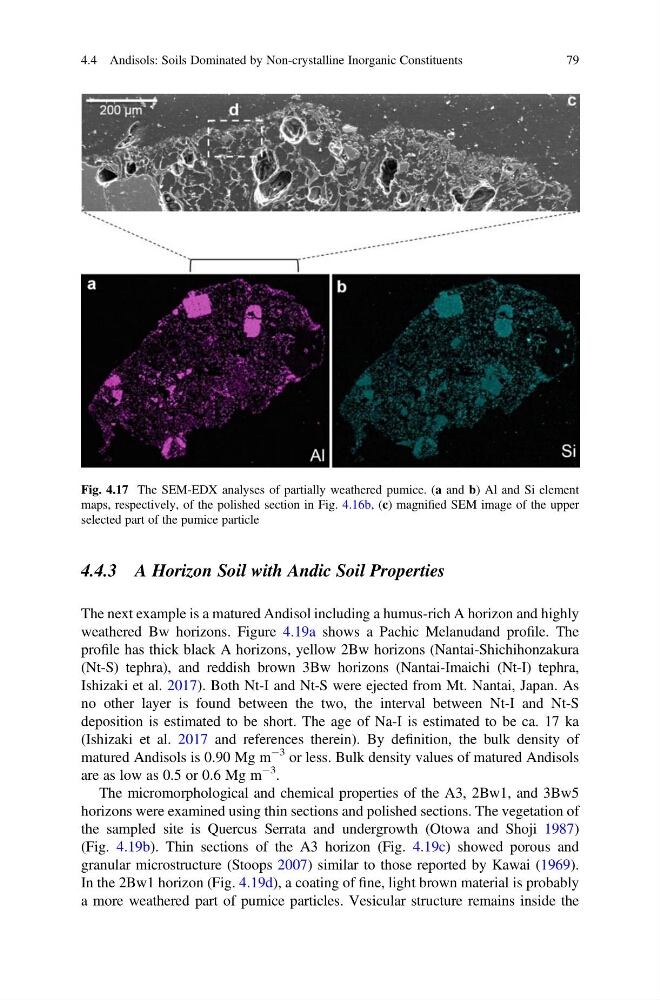
Fig. 4.17 The SEM-EDX analyses of partially weathered pumice. (a and b) Al and Si element
maps, respectively, of the polished section in Fig. 4.16b, (c) magnified SEM image of the upper
selected part of the pumice particle
4.4 Andisols: Soils Dominated by Non-crystalline Inorganic Constituents
79
The next example is a matured Andisol including a humus-rich A horizon and highly
weathered Bw horizons. Figure 4.19a shows a Pachic Melanudand profile. The
profile has thick black A horizons, yellow 2Bw horizons (Nantai-Shichihonzakura
(Nt-S) tephra), and reddish brown 3Bw horizons (Nantai-Imaichi (Nt-I) tephra,
Ishizaki et al. 2017). Both Nt-I and Nt-S were ejected from Mt. Nantai, Japan. As
no other layer is found between the two, the interval between Nt-I and Nt-S
deposition is estimated to be short. The age of Na-I is estimated to be ca. 17 ka
(Ishizaki et al. 2017 and references therein). By definition, the bulk density of
matured Andisols is 0.90 Mg m
À3 or less. Bulk density values of matured Andisols
are as low as 0.5 or 0.6 Mg m
À3 .
The micromorphological and chemical properties of the A3, 2Bw1, and 3Bw5
horizons were examined using thin sections and polished sections. The vegetation of
the sampled site is Quercus Serrata and undergrowth (Otowa and Shoji 1987)
(Fig. 4.19b). Thin sections of the A3 horizon (Fig. 4.19c) showed porous and
granular microstructure (Stoops 2007) similar to those reported by Kawai (1969).
In the 2Bw1 horizon (Fig. 4.19d), a coating of fine, light brown material is probably
a more weathered part of pumice particles. Vesicular structure remains inside the
Fig. 4.17 The SEM-EDX analyses of partially weathered pumice. (a and b) Al and Si element
maps, respectively, of the polished section in Fig. 4.16b, (c) magnified SEM image of the upper
selected part of the pumice particle
4.4 Andisols: Soils Dominated by Non-crystalline Inorganic Constituents
79