

particle 7 is isotropic, its Al content is too high to allow for identification as a
volcanic glass.
Diatoms, which are also biogenic opals, are also found in the clay or silt fractions
of A horizon soils. Diatoms can be identified by their characteristic frustule. As
laminar opaline silica is almost always smaller than 5 μm, it does not affect the glass
counting of the 2–0.02 mm fraction.
Thus, by using both polarizing microscope and SEM-EDX, the ability to identify
non-crystalline soil constituents such as volcanic glass and phytoliths is greatly
enhanced. Remaining issues include a few phytoliths and diatoms that are weakly
anisotropic, and crystalline particles completely covered by volcanic glass. Although
some iron minerals are not transparent under optical microscope, they can be
identified using an Fe element map.
4.3.4 Al-Humus Complex
Al-humus complex (Al-humus) is one of the active Al materials in Andisols and
Spodosols. Al-humus was recently reviewed by Takahashi and Dahlgren (2016).
This section is focused on Al-humus in Andisols, because in these soils Al-humus is
much less mobile, whereas that in Spodosols appears more mobile and is related to
eluviation–illuviation processes (Ito et al. 1991). The justification for covering
Al-humus despite its partially organic structure is that (i) it is highly reactive with
phosphate, (ii) Al-humus formation appears to be competitive with allophane and
imogolite in Andisols depending on the pH and organic matter content, and (iii) it is
the major active Al form in the A horizons of non-allophanic Andisols.
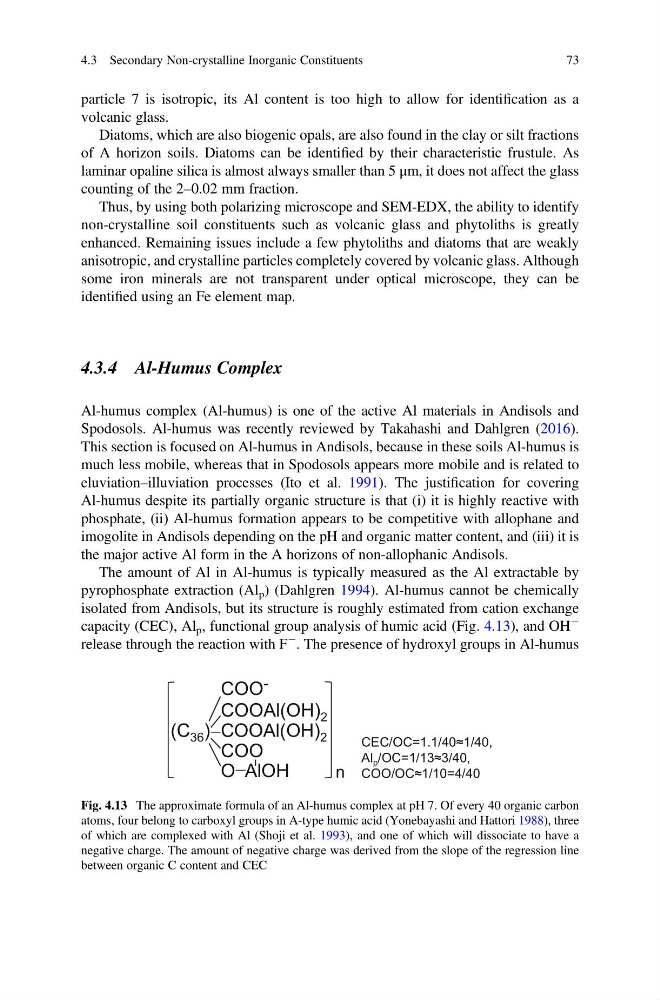
The amount of Al in Al-humus is typically measured as the Al extractable by
pyrophosphate extraction (Al p ) (Dahlgren 1994). Al-humus cannot be chemically
isolated from Andisols, but its structure is roughly estimated from cation exchange
capacity (CEC), Al p , functional group analysis of humic acid (Fig. 4.13), and OH
À
release through the reaction with F
À
. The presence of hydroxyl groups in Al-humus
COO -
COOAl(OH) 2
(C 36 ) COOAl(OH) 2
COO
O AlOH
CEC/OC=1.1/40≈1/40,
Al p /OC=1/13≈3/40,
COO/OC≈1/10=4/40
n
Fig. 4.13 The approximate formula of an Al-humus complex at pH 7. Of every 40 organic carbon
atoms, four belong to carboxyl groups in A-type humic acid (Yonebayashi and Hattori 1988), three
of which are complexed with Al (Shoji et al. 1993), and one of which will dissociate to have a
negative charge. The amount of negative charge was derived from the slope of the regression line
between organic C content and CEC
4.3 Secondary Non-crystalline Inorganic Constituents
73
volcanic glass.
Diatoms, which are also biogenic opals, are also found in the clay or silt fractions
of A horizon soils. Diatoms can be identified by their characteristic frustule. As
laminar opaline silica is almost always smaller than 5 μm, it does not affect the glass
counting of the 2–0.02 mm fraction.
Thus, by using both polarizing microscope and SEM-EDX, the ability to identify
non-crystalline soil constituents such as volcanic glass and phytoliths is greatly
enhanced. Remaining issues include a few phytoliths and diatoms that are weakly
anisotropic, and crystalline particles completely covered by volcanic glass. Although
some iron minerals are not transparent under optical microscope, they can be
identified using an Fe element map.
4.3.4 Al-Humus Complex
Al-humus complex (Al-humus) is one of the active Al materials in Andisols and
Spodosols. Al-humus was recently reviewed by Takahashi and Dahlgren (2016).
This section is focused on Al-humus in Andisols, because in these soils Al-humus is
much less mobile, whereas that in Spodosols appears more mobile and is related to
eluviation–illuviation processes (Ito et al. 1991). The justification for covering
Al-humus despite its partially organic structure is that (i) it is highly reactive with
phosphate, (ii) Al-humus formation appears to be competitive with allophane and
imogolite in Andisols depending on the pH and organic matter content, and (iii) it is
the major active Al form in the A horizons of non-allophanic Andisols.
The amount of Al in Al-humus is typically measured as the Al extractable by
pyrophosphate extraction (Al p ) (Dahlgren 1994). Al-humus cannot be chemically
isolated from Andisols, but its structure is roughly estimated from cation exchange
capacity (CEC), Al p , functional group analysis of humic acid (Fig. 4.13), and OH
À
release through the reaction with F
À
. The presence of hydroxyl groups in Al-humus
COO -
COOAl(OH) 2
(C 36 ) COOAl(OH) 2
COO
O AlOH
CEC/OC=1.1/40≈1/40,
Al p /OC=1/13≈3/40,
COO/OC≈1/10=4/40
n
Fig. 4.13 The approximate formula of an Al-humus complex at pH 7. Of every 40 organic carbon
atoms, four belong to carboxyl groups in A-type humic acid (Yonebayashi and Hattori 1988), three
of which are complexed with Al (Shoji et al. 1993), and one of which will dissociate to have a
negative charge. The amount of negative charge was derived from the slope of the regression line
between organic C content and CEC
4.3 Secondary Non-crystalline Inorganic Constituents
73