

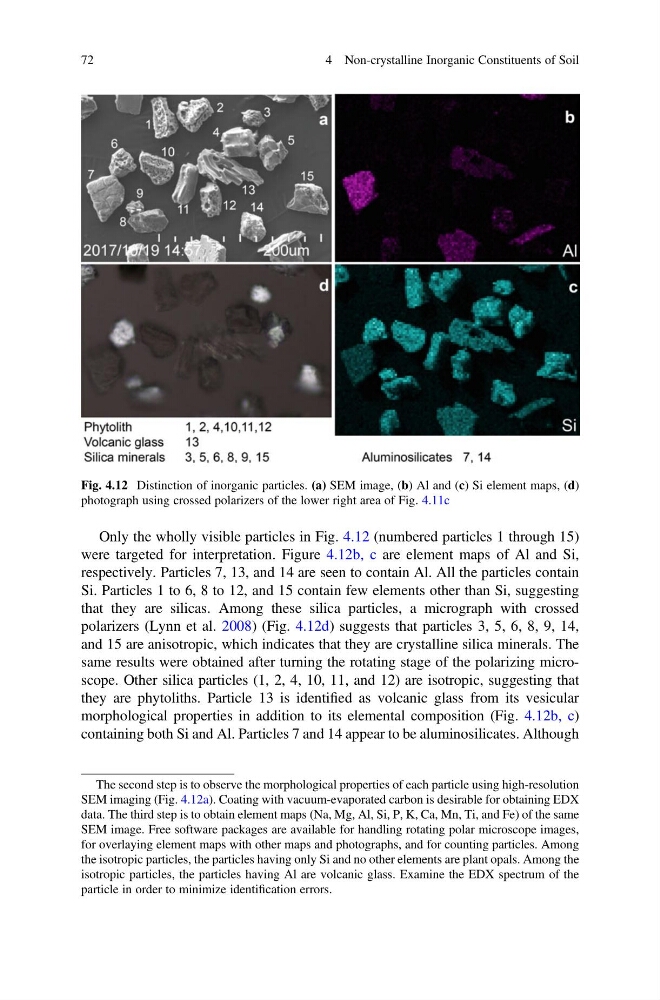
Only the wholly visible particles in Fig. 4.12 (numbered particles 1 through 15)
were targeted for interpretation. Figure 4.12b, c are element maps of Al and Si,
respectively. Particles 7, 13, and 14 are seen to contain Al. All the particles contain
Si. Particles 1 to 6, 8 to 12, and 15 contain few elements other than Si, suggesting
that they are silicas. Among these silica particles, a micrograph with crossed
polarizers (Lynn et al. 2008) (Fig. 4.12d) suggests that particles 3, 5, 6, 8, 9, 14,
and 15 are anisotropic, which indicates that they are crystalline silica minerals. The
same results were obtained after turning the rotating stage of the polarizing microscope. Other silica particles (1, 2, 4, 10, 11, and 12) are isotropic, suggesting that
they are phytoliths. Particle 13 is identified as volcanic glass from its vesicular
morphological properties in addition to its elemental composition (Fig. 4.12b, c)
containing both Si and Al. Particles 7 and 14 appear to be aluminosilicates. Although
Fig. 4.12 Distinction of inorganic particles. (a) SEM image, (b) Al and (c) Si element maps, (d)
photograph using crossed polarizers of the lower right area of Fig. 4.11c
The second step is to observe the morphological properties of each particle using high-resolution
SEM imaging (Fig. 4.12a). Coating with vacuum-evaporated carbon is desirable for obtaining EDX
data. The third step is to obtain element maps (Na, Mg, Al, Si, P, K, Ca, Mn, Ti, and Fe) of the same
SEM image. Free software packages are available for handling rotating polar microscope images,
for overlaying element maps with other maps and photographs, and for counting particles. Among
the isotropic particles, the particles having only Si and no other elements are plant opals. Among the
isotropic particles, the particles having Al are volcanic glass. Examine the EDX spectrum of the
particle in order to minimize identification errors.
72
4 Non-crystalline Inorganic Constituents of Soil
were targeted for interpretation. Figure 4.12b, c are element maps of Al and Si,
respectively. Particles 7, 13, and 14 are seen to contain Al. All the particles contain
Si. Particles 1 to 6, 8 to 12, and 15 contain few elements other than Si, suggesting
that they are silicas. Among these silica particles, a micrograph with crossed
polarizers (Lynn et al. 2008) (Fig. 4.12d) suggests that particles 3, 5, 6, 8, 9, 14,
and 15 are anisotropic, which indicates that they are crystalline silica minerals. The
same results were obtained after turning the rotating stage of the polarizing microscope. Other silica particles (1, 2, 4, 10, 11, and 12) are isotropic, suggesting that
they are phytoliths. Particle 13 is identified as volcanic glass from its vesicular
morphological properties in addition to its elemental composition (Fig. 4.12b, c)
containing both Si and Al. Particles 7 and 14 appear to be aluminosilicates. Although
Fig. 4.12 Distinction of inorganic particles. (a) SEM image, (b) Al and (c) Si element maps, (d)
photograph using crossed polarizers of the lower right area of Fig. 4.11c
The second step is to observe the morphological properties of each particle using high-resolution
SEM imaging (Fig. 4.12a). Coating with vacuum-evaporated carbon is desirable for obtaining EDX
data. The third step is to obtain element maps (Na, Mg, Al, Si, P, K, Ca, Mn, Ti, and Fe) of the same
SEM image. Free software packages are available for handling rotating polar microscope images,
for overlaying element maps with other maps and photographs, and for counting particles. Among
the isotropic particles, the particles having only Si and no other elements are plant opals. Among the
isotropic particles, the particles having Al are volcanic glass. Examine the EDX spectrum of the
particle in order to minimize identification errors.
72
4 Non-crystalline Inorganic Constituents of Soil