

4.3.3 Phytoliths
Phytoliths, or plant opals, are a type of biogenic opals (Wilding et al. 1977; Drees
et al. 1989). Phytoliths are typically found in the particle size fraction of 5–50 μm
and are larger than laminar opaline silica (Fig. 4.10b). Phytoliths are abundant in A
or buried A horizons. Phytoliths are non-crystalline silica, formed in plant cells. As
the morphological form of a phytolith is specific to plant species to some extent, the
form of phytoliths in a buried A horizon can be used to estimate the paleovegetation
of the buried A horizon (Kondo et al. 1988). Phytoliths possibly benefit plants by
contributing to Si nutrient cycling.
Figure 4.11a shows an example of the Udand profile, which has abundant
phytoliths in the A1 horizon. Figure 4.11c is an optical micrograph of the
0.05–0.02 mm fraction, and particles indicated by white arrows can be judged as
phyoliths according to their morphological characteristics.
Biogenic opals, laminar opaline silica, and volcanic glasses are non-crystalline.
Morphological characteristics are used to identify non-crystalline inorganic constituents. Although XRD is a powerful tool for the identification of crystalline constituents, it is not effective for non-crystalline inorganic constituents. Elemental
composition is an useful tool for identification of non-crystalline inorganic
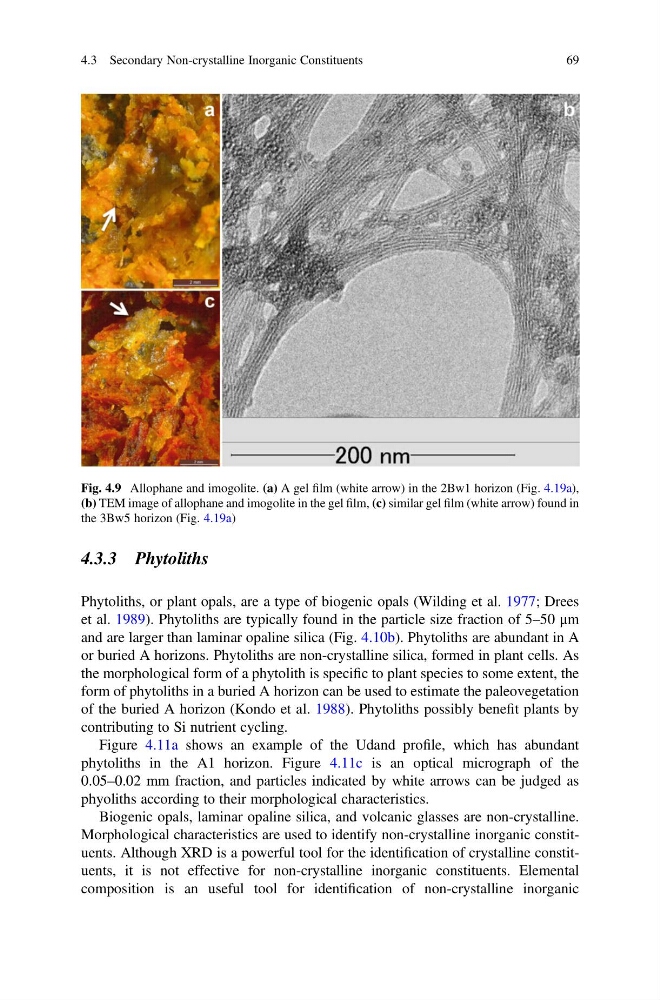
Fig. 4.9 Allophane and imogolite. (a) A gel film (white arrow) in the 2Bw1 horizon (Fig. 4.19a),
(b) TEM image of allophane and imogolite in the gel film, (c) similar gel film (white arrow) found in
the 3Bw5 horizon (Fig. 4.19a)
4.3 Secondary Non-crystalline Inorganic Constituents
69
Phytoliths, or plant opals, are a type of biogenic opals (Wilding et al. 1977; Drees
et al. 1989). Phytoliths are typically found in the particle size fraction of 5–50 μm
and are larger than laminar opaline silica (Fig. 4.10b). Phytoliths are abundant in A
or buried A horizons. Phytoliths are non-crystalline silica, formed in plant cells. As
the morphological form of a phytolith is specific to plant species to some extent, the
form of phytoliths in a buried A horizon can be used to estimate the paleovegetation
of the buried A horizon (Kondo et al. 1988). Phytoliths possibly benefit plants by
contributing to Si nutrient cycling.
Figure 4.11a shows an example of the Udand profile, which has abundant
phytoliths in the A1 horizon. Figure 4.11c is an optical micrograph of the
0.05–0.02 mm fraction, and particles indicated by white arrows can be judged as
phyoliths according to their morphological characteristics.
Biogenic opals, laminar opaline silica, and volcanic glasses are non-crystalline.
Morphological characteristics are used to identify non-crystalline inorganic constituents. Although XRD is a powerful tool for the identification of crystalline constituents, it is not effective for non-crystalline inorganic constituents. Elemental
composition is an useful tool for identification of non-crystalline inorganic
Fig. 4.9 Allophane and imogolite. (a) A gel film (white arrow) in the 2Bw1 horizon (Fig. 4.19a),
(b) TEM image of allophane and imogolite in the gel film, (c) similar gel film (white arrow) found in
the 3Bw5 horizon (Fig. 4.19a)
4.3 Secondary Non-crystalline Inorganic Constituents
69