

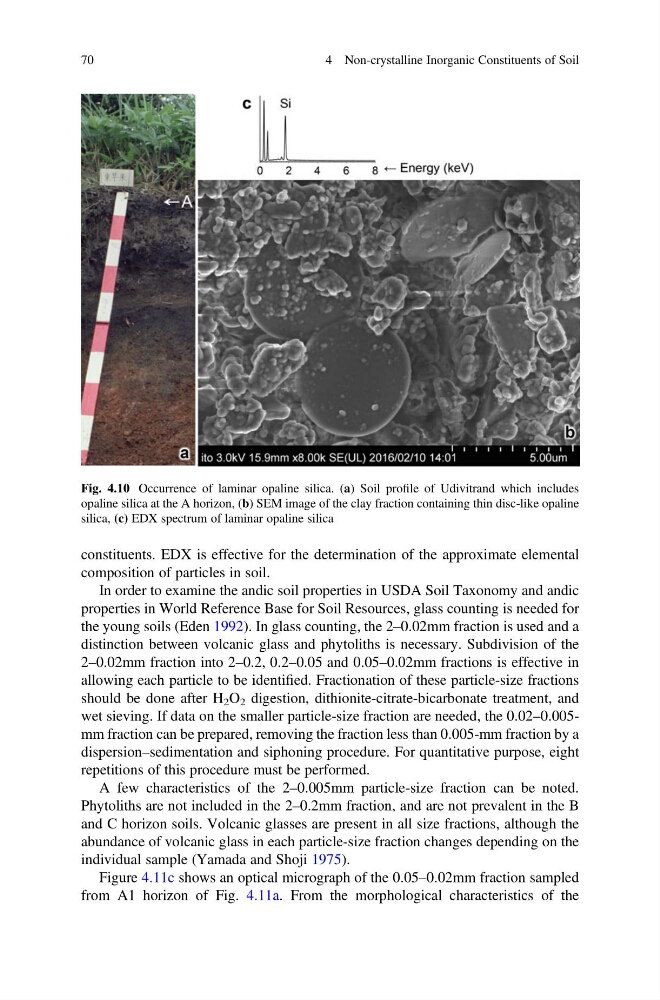
constituents. EDX is effective for the determination of the approximate elemental
composition of particles in soil.
In order to examine the andic soil properties in USDA Soil Taxonomy and andic
properties in World Reference Base for Soil Resources, glass counting is needed for
the young soils (Eden 1992). In glass counting, the 2–0.02mm fraction is used and a
distinction between volcanic glass and phytoliths is necessary. Subdivision of the
2–0.02mm fraction into 2–0.2, 0.2–0.05 and 0.05–0.02mm fractions is effective in
allowing each particle to be identified. Fractionation of these particle-size fractions
should be done after H 2 O 2 digestion, dithionite-citrate-bicarbonate treatment, and
wet sieving. If data on the smaller particle-size fraction are needed, the 0.02–0.005mm fraction can be prepared, removing the fraction less than 0.005-mm fraction by a
dispersion–sedimentation and siphoning procedure. For quantitative purpose, eight
repetitions of this procedure must be performed.
A few characteristics of the 2–0.005mm particle-size fraction can be noted.
Phytoliths are not included in the 2–0.2mm fraction, and are not prevalent in the B
and C horizon soils. Volcanic glasses are present in all size fractions, although the
abundance of volcanic glass in each particle-size fraction changes depending on the
individual sample (Yamada and Shoji 1975).
Figure 4.11c shows an optical micrograph of the 0.05–0.02mm fraction sampled
from A1 horizon of Fig. 4.11a. From the morphological characteristics of the
Fig. 4.10 Occurrence of laminar opaline silica. (a) Soil profile of Udivitrand which includes
opaline silica at the A horizon, (b) SEM image of the clay fraction containing thin disc-like opaline
silica, (c) EDX spectrum of laminar opaline silica
70
4 Non-crystalline Inorganic Constituents of Soil
composition of particles in soil.
In order to examine the andic soil properties in USDA Soil Taxonomy and andic
properties in World Reference Base for Soil Resources, glass counting is needed for
the young soils (Eden 1992). In glass counting, the 2–0.02mm fraction is used and a
distinction between volcanic glass and phytoliths is necessary. Subdivision of the
2–0.02mm fraction into 2–0.2, 0.2–0.05 and 0.05–0.02mm fractions is effective in
allowing each particle to be identified. Fractionation of these particle-size fractions
should be done after H 2 O 2 digestion, dithionite-citrate-bicarbonate treatment, and
wet sieving. If data on the smaller particle-size fraction are needed, the 0.02–0.005mm fraction can be prepared, removing the fraction less than 0.005-mm fraction by a
dispersion–sedimentation and siphoning procedure. For quantitative purpose, eight
repetitions of this procedure must be performed.
A few characteristics of the 2–0.005mm particle-size fraction can be noted.
Phytoliths are not included in the 2–0.2mm fraction, and are not prevalent in the B
and C horizon soils. Volcanic glasses are present in all size fractions, although the
abundance of volcanic glass in each particle-size fraction changes depending on the
individual sample (Yamada and Shoji 1975).
Figure 4.11c shows an optical micrograph of the 0.05–0.02mm fraction sampled
from A1 horizon of Fig. 4.11a. From the morphological characteristics of the
Fig. 4.10 Occurrence of laminar opaline silica. (a) Soil profile of Udivitrand which includes
opaline silica at the A horizon, (b) SEM image of the clay fraction containing thin disc-like opaline
silica, (c) EDX spectrum of laminar opaline silica
70
4 Non-crystalline Inorganic Constituents of Soil