

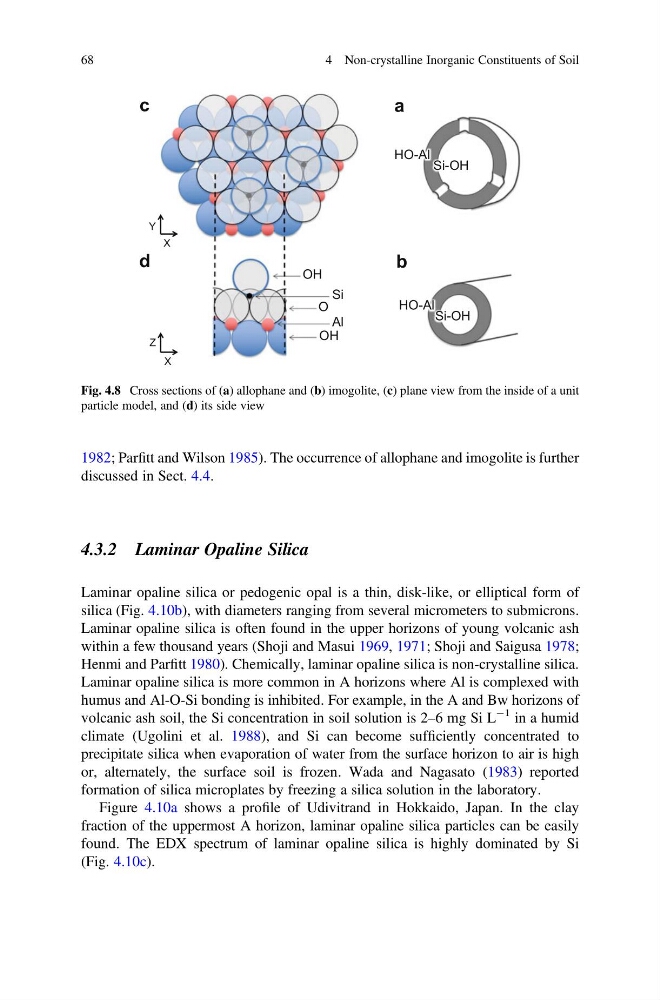
1982; Parfitt and Wilson 1985). The occurrence of allophane and imogolite is further
discussed in Sect. 4.4.
4.3.2 Laminar Opaline Silica
Laminar opaline silica or pedogenic opal is a thin, disk-like, or elliptical form of
silica (Fig. 4.10b), with diameters ranging from several micrometers to submicrons.
Laminar opaline silica is often found in the upper horizons of young volcanic ash
within a few thousand years (Shoji and Masui 1969, 1971; Shoji and Saigusa 1978;
Henmi and Parfitt 1980). Chemically, laminar opaline silica is non-crystalline silica.
Laminar opaline silica is more common in A horizons where Al is complexed with
humus and Al-O-Si bonding is inhibited. For example, in the A and Bw horizons of
volcanic ash soil, the Si concentration in soil solution is 2–6 mg Si L
À1 in a humid
climate (Ugolini et al. 1988), and Si can become sufficiently concentrated to
precipitate silica when evaporation of water from the surface horizon to air is high
or, alternately, the surface soil is frozen. Wada and Nagasato (1983) reported
formation of silica microplates by freezing a silica solution in the laboratory.
Figure 4.10a shows a profile of Udivitrand in Hokkaido, Japan. In the clay
fraction of the uppermost A horizon, laminar opaline silica particles can be easily
found. The EDX spectrum of laminar opaline silica is highly dominated by Si
(Fig. 4.10c).
Y
X
X
Z
OH
Si
O
Al
OH
Si-OH
HO-Al
Si-OH
HO-Al
a
b
d
c
Fig. 4.8 Cross sections of (a) allophane and (b) imogolite, (c) plane view from the inside of a unit
particle model, and (d) its side view
68
4 Non-crystalline Inorganic Constituents of Soil
discussed in Sect. 4.4.
4.3.2 Laminar Opaline Silica
Laminar opaline silica or pedogenic opal is a thin, disk-like, or elliptical form of
silica (Fig. 4.10b), with diameters ranging from several micrometers to submicrons.
Laminar opaline silica is often found in the upper horizons of young volcanic ash
within a few thousand years (Shoji and Masui 1969, 1971; Shoji and Saigusa 1978;
Henmi and Parfitt 1980). Chemically, laminar opaline silica is non-crystalline silica.
Laminar opaline silica is more common in A horizons where Al is complexed with
humus and Al-O-Si bonding is inhibited. For example, in the A and Bw horizons of
volcanic ash soil, the Si concentration in soil solution is 2–6 mg Si L
À1 in a humid
climate (Ugolini et al. 1988), and Si can become sufficiently concentrated to
precipitate silica when evaporation of water from the surface horizon to air is high
or, alternately, the surface soil is frozen. Wada and Nagasato (1983) reported
formation of silica microplates by freezing a silica solution in the laboratory.
Figure 4.10a shows a profile of Udivitrand in Hokkaido, Japan. In the clay
fraction of the uppermost A horizon, laminar opaline silica particles can be easily
found. The EDX spectrum of laminar opaline silica is highly dominated by Si
(Fig. 4.10c).
Y
X
X
Z
OH
Si
O
Al
OH
Si-OH
HO-Al
Si-OH
HO-Al
a
b
d
c
Fig. 4.8 Cross sections of (a) allophane and (b) imogolite, (c) plane view from the inside of a unit
particle model, and (d) its side view
68
4 Non-crystalline Inorganic Constituents of Soil